Toggle light / dark theme

Immunizing quantum computers against errors

Building a quantum computer requires reckoning with errors—in more than one sense. Quantum bits, or “qubits,” which can take on the logical values zero and one simultaneously, and thus carry out calculations faster, are extremely susceptible to perturbations. A possible remedy for this is quantum error correction, which means that each qubit is represented redundantly in several copies, such that errors can be detected and eventually corrected without disturbing the fragile quantum state of the qubit itself. Technically, this is very demanding. However, several years ago, an alternative proposal suggested storing information not in several redundant qubits, but rather in the many oscillatory states of a single quantum harmonic oscillator. The research group of Jonathan Home, professor at the Institute for Quantum Electronics at ETH Zurich, has now realised such a qubit encoded in an oscillator. Their results have been published in the scientific journal Nature.

Periodic oscillatory states

In Home’s laboratory, Ph.D. student Christa Flühmann and her colleagues work with electrically charged calcium atoms that are trapped by electric fields. Using appropriately chosen laser beams, these ions are cooled down to very low temperatures at which their oscillations in the electric fields, inside which the ions slosh back and forth like marbles in a bowl, are described by quantum mechanics as so-called . “At that point, things get exciting,” says Flühmann, who is first author of the Nature paper. “We can now manipulate the oscillatory states of the ions in such a way that their position and momentum uncertainties are distributed among many periodically arranged states.”

Neutrinos seen in the clustering of galaxies

In early times, the universe was an energetic mix of strongly interacting particles. The first particles to break free from this dense soup were neutrinos, the lightest and most weakly interacting particles of the Standard Model of particle physics. These neutrinos are still around us today, but are very hard to detect directly because they are so weakly interacting. An international team of cosmologists, including Daniel Baumann and Benjamin Wallisch from the University of Amsterdam, have now succeeded in measuring the influence of this ‘cosmic neutrino background’ on the way galaxies have become clustered during the evolution of the universe. The research was published in Nature Physics this week.

Laser ‘drill’ sets a new world record in laser-driven electron acceleration

Combining a first laser pulse to heat up and “drill” through a plasma, and another to accelerate electrons to incredibly high energies in just tens of centimeters, scientists have nearly doubled the previous record for laser-driven particle acceleration.

The -plasma experiments, conducted at the Department of Energy’s Lawrence Berkeley National Laboratory (Berkeley Lab), are pushing toward more compact and affordable types of to power exotic, high-energy machines—like X-ray free-electron lasers and particle colliders—that could enable researchers to see more clearly at the scale of molecules, atoms, and even subatomic particles.

The new record of propelling electrons to 7.8 billion electron volts (7.8 GeV) at the Berkeley Lab Laser Accelerator (BELLA) Center surpasses a 4.25 GeV result at BELLA announced in 2014. The latest research is detailed in the Feb. 25 edition of the journal Physical Review Letters. The record result was achieved during the summer of 2018.

A quantum magnet with a topological twist

Taking their name from an intricate Japanese basket pattern, kagome magnets are thought to have electronic properties that could be valuable for future quantum devices and applications. Theories predict that some electrons in these materials have exotic, so-called topological behaviors and others behave somewhat like graphene, another material prized for its potential for new types of electronics.

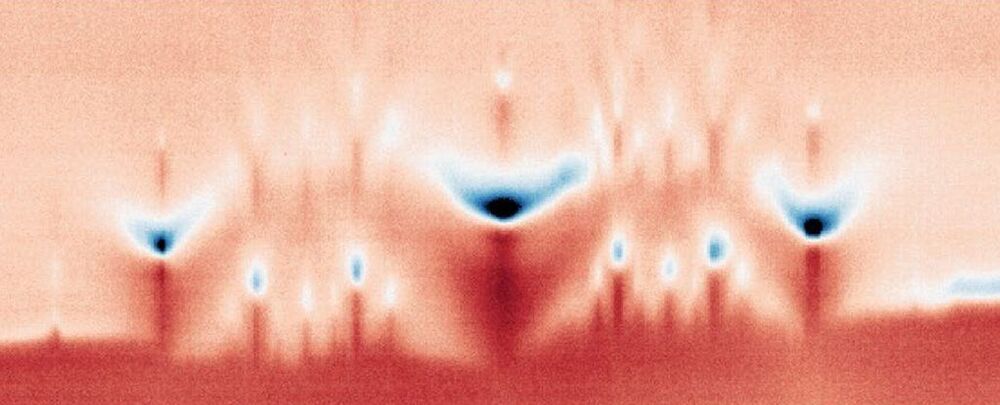
Now, an international team led by researchers at Princeton University has observed that some of the in these magnets behave collectively, like an almost infinitely massive electron that is strangely magnetic, rather than like individual particles. The study was published in the journal Nature Physics this week.

The team also showed that placing the kagome magnet in a causes the direction of magnetism to reverse. This “negative magnetism” is akin to having a compass that points south instead of north, or a refrigerator magnet that suddenly refuses to stick.

Physicists get thousands of semiconductor nuclei to do ‘quantum dances’ in unison

A team of Cambridge researchers have found a way to control the sea of nuclei in semiconductor quantum dots so they can operate as a quantum memory device.

Quantum dots are crystals made up of thousands of atoms, and each of these atoms interacts magnetically with the trapped electron. If left alone to its own devices, this interaction of the electron with the nuclear spins, limits the usefulness of the electron as a bit—a qubit.

Led by Professor Mete Atatüre, a Fellow at St John’s College, University of Cambridge, the research group, located at the Cavendish Laboratory, exploit the laws of quantum physics and optics to investigate computing, sensing or communication applications.

Physicists Have Finally Solved a Fundamental Mystery Concerning The Insides of Atoms

Something about atoms has never added up. Fundamental particles called quarks get kind of sluggish once they’re caught up in crowds of protons and neutrons – and quite frankly, they shouldn’t.

For decades, physicists have hunted for clues on the quark’s tendency to slow down in larger atoms, but have come up empty-handed. But now, a closer look at old data has finally revealed a clue to explain this strange phenomenon.

A massive team of physicists known as the CLAS Collaboration (after the CEBAF Large Acceptance Spectrometer) recently ran through data gathered from previous experiments at the Jefferson Lab’s Continuous Electron Beam Accelerator Facility.

Breakthrough in the search for graphene-based electronics

For 15 years, scientists have tried to exploit the “miracle material” graphene to produce nanoscale electronics. On paper, graphene should be great for just that: it is ultra-thin—only one atom thick and therefore two-dimensional, it is excellent for conducting electrical current, and holds great promise for future forms of electronics that are faster and more energy efficient. In addition, graphene consists of carbon atoms – of which we have an unlimited supply.

In theory, graphene can be altered to perform many different tasks within e.g. electronics, photonics or sensors simply by cutting tiny patterns in it, as this fundamentally alters its . One “simple” task, which has turned out to be surprisingly difficult, is to induce a band gap—which is crucial for making transistors and optoelectronic devices. However, since graphene is only an atom thick all of the atoms are important and even tiny irregularities in the pattern can destroy its properties.

“Graphene is a fantastic material, which I think will play a crucial role in making new nanoscale electronics. The problem is that it is extremely difficult to engineer the electrical properties,” says Peter Bøggild, professor atDTU Physics.

/* */