Toggle light / dark theme

Researchers develop quantum-mechanical variant of the twin paradox

One of the fundamental challenges of physics is the reconciliation of Einstein’s theory of relativity and quantum mechanics. The necessity to critically question these two pillars of modern physics arises, for example, from extremely high-energy events in the cosmos, which so far can only ever be explained by one theory at a time, but not both theories in harmony. Researchers around the world are therefore searching for deviations from the laws of quantum mechanics and relativity that could open up insights into a new field of physics.

For a recent publication, scientists from Leibniz University Hannover and Ulm University have taken on the twin paradox known from Einstein’s special theory of relativity. This thought experiment revolves around a pair of twins: While one brother travels into space, the other remains on Earth. Consequently, for a certain period of time, the twins are moving in different orbits in space. The result when the pair meets again is quite astounding: The twin who has been travelling through space has aged much less than his brother who stayed at home. This phenomenon is explained by Einstein’s description of time dilation: Depending on the speed and where in the gravitational field two clocks move relative to each other, they tick at different speeds.

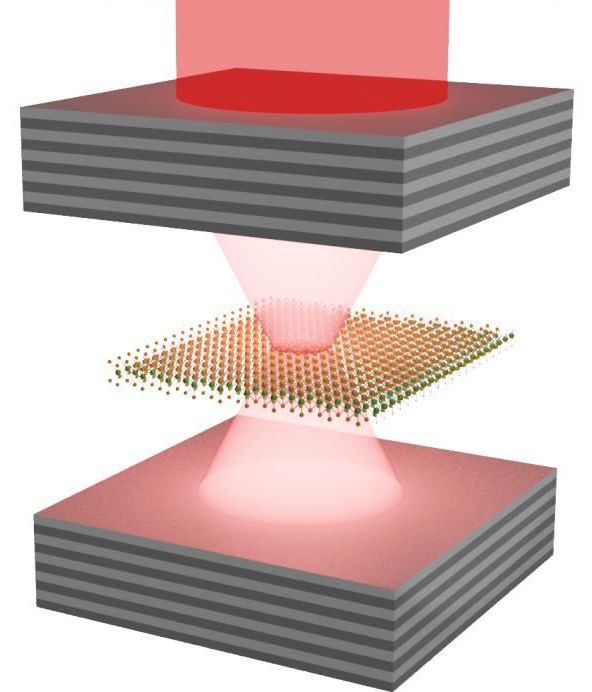
For the publication in Science Advances, the authors assumed a quantum-mechanical variant of the twin paradox with only one twin. Thanks to the superposition principle of , this twin can move along two paths at the same time. In the researchers’ , the twin is represented by an . “Such clocks use the quantum properties of atoms to measure time with high precision. The atomic clock itself is therefore a quantum-mechanical object and can move through space-time on two paths simultaneously due to the superposition principle. Together with colleagues from Hannover, we have investigated how this situation can be realised in an experiment,” explains Dr. Enno Giese, research assistant at the Institute of Quantum Physics in Ulm. To this end, the researchers have developed an experimental setup for this scenario on the basis of a quantum-physical model.

On Supersymmetry | John Ellis, Catherine Heymans, Ben Allanach, Subir Sakar, Cumrun Vafa

The standard model of physics remains incomplete. Could supersymmetry fill the gaps? From whether supersymmetric particles could fix the mass of the Higgs Boson to what this would mean for string theory, the world’s leading thinkers explain all.

John Ellis is a British theoretical physicist who is currently Clerk Maxwell Professor of Theoretical Physics at King’s College London. He was Division Leader for the CERN theory division, a founding member of the LEPC and of the LHCC at CERN and currently chair of the committee to investigate physics opportunities for future proton accelerators.

Catherine Heymans is a Professor of Astrophysics and European Research Council Fellow at the University of Edinburgh. She is also the Director of the German Centre for Cosmological Lensing at the Ruhr-University Bochum, Germany.

Ben Allanach is a member of the Department of Applied Mathematics and Theoretical Physics High Energy Physics research group and The Cambridge SUSY Working Group based at the Cavendish Laboratory.

Subir Sarkar is a physicist at the University of Oxford, where he is head of the Particle Theory Group at the Rudolf Peierls Centre for Theoretical Physics. His research interests are at the interface between fundamental physics and astrophysics & cosmology — specifically theoretical aspects of dark matter, inflation and large-scale structure formation.

Astronomers Have Traced a Single Neutrino to a Collision 3.8 Billion Light-Years Away

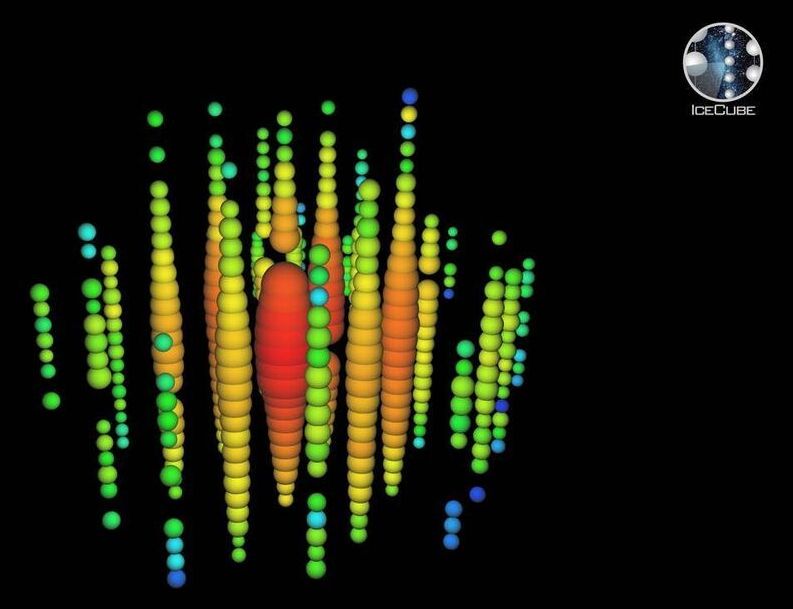
When a single neutrino was detected by a neutrino detector in Antarctica in September 2017, it was the start of something amazing. It was to become the first-ever high-energy neutrino that astronomers could trace back to an origin — a blazar galaxy called TXS 0506+056, 3.8 billion light-years away.

But, in the manner of many great discoveries, that revelation opened up a whole new can of questions, including this: why, of all the galaxies with similar properties, has a neutrino only ever been traced to this one?

Now, astronomers have found a possible answer, pinpointing the source event that produced this neutrino. The relativistic jet blasting out of a supermassive black hole could have acted as a cosmic particle collider, producing a flurry of neutrinos that, due to the shape and wobble of the jet, ended up streaming through Earth.

Producing dissipative coupling in hybrid quantum systems

As quantum objects are susceptible to their surrounding environment, quantum coherence and quantum states can easily be destroyed due to the impact of external signals, which can include thermal noise and backscattered signals in the measurement circuit. Researchers have thus been trying to develop techniques to enable nonreciprocal signal propagation, which could help to block the undesired effects of backward noise.

In a recent study, members of the dynamic spintronics group at the University of Manitoba in Canada have proposed a new method to produce dissipative coupling in hybrid quantum systems. Their technique, presented in a paper published in Physical Review Letters, enables nonreciprocal signal propagation with a substantial isolation ratio and flexible controllability.

“Our recent work on nonreciprocity in cavity magnonics is grounded in a research area combining cavity spintronics and hybrid quantum systems, which holds promise for constructing new quantum information processing platforms,” Yi-Pu Wang, a postdoctoral researcher at the University of Manitoba who was involved in the study, told Phys.org.

This is how a ‘fuzzy’ universe may have looked

Dark matter was likely the starting ingredient for brewing up the very first galaxies in the universe. Shortly after the Big Bang, particles of dark matter would have clumped together in gravitational “halos,” pulling surrounding gas into their cores, which over time cooled and condensed into the first galaxies.

Although dark matter is considered the backbone to the structure of the universe, scientists know very little about its nature, as the particles have so far evaded detection.

Now scientists at MIT, Princeton University, and Cambridge University have found that the early universe, and the very first galaxies, would have looked very different depending on the nature of dark matter. For the first time, the team has simulated what early galaxy formation would have looked like if dark matter were “fuzzy,” rather than cold or warm.

We Just Got The First Glimpse of The Mysterious Cosmic Web That Binds The Universe

After counting all the normal, luminous matter in the obvious places of the universe – galaxies, clusters of galaxies and the intergalactic medium – about half of it is still missing. So not only is 85 percent of the matter in the universe made up of an unknown, invisible substance dubbed “dark matter”, we can’t even find all the small amount of normal matter that should be there.

This is known as the “missing baryons” problem. Baryons are particles that emit or absorb light, like protons, neutrons or electrons, which make up the matter we see around us. The baryons unaccounted for are thought to be hidden in filamentary structures permeating the entire universe, also known as “the cosmic web”.

But this structure is elusive and so far we have only seen glimpses of it. Now a new study, published in Science, offers a better view that will enable us to help map what it looks like.

Quantum vacuum: Less than zero energy

Energy is a quantity that must always be positive—at least that’s what our intuition tells us. If every single particle is removed from a certain volume until there is nothing left that could possibly carry energy, then a limit has been reached. Or has it? Is it still possible to extract energy even from empty space?

Quantum physics has shown time and again that it contradicts our intuition, which is also true in this case. Under certain conditions, negative energies are allowed, at least in a certain range of space and time. An international research team at the TU Vienna, the Université libre de Bruxelles (Belgium) and the IIT Kanpur (India) have now investigated the extent to which negative is possible. It turns out that no matter which quantum theories are considered, no matter what symmetries are assumed to hold in the universe, there are always certain limits to “borrowing” energy. Locally, the energy can be less than zero, but like money borrowed from a bank, this energy must be “paid back” in the end.

Atom-by-atom experiments at the edge of the periodic table

Investigating the heaviest elements known is rewriting our knowledge of chemistry and may even mean the end of the periodic table itself, writes Kit Chapman.

In 2018, Peter Schwerdtfeger published a paper that turned chemistry on its head. According to calculations he and his colleagues performed, oganesson – element 118, the heaviest known – was not a noble gas as you would expect from its position in the periodic table, but a highly reactive solid. Even stranger, it didn’t seem to have electron shells.1

‘Well, that statement is oversimplified,’ says Schwerdtfeger, a theoretical chemist at Massey University in New Zealand. ‘You can still build up the electron densities from orbitals describing individual shells. What happens is that for oganesson the shell structure is barely visible, approaching an electron gas.’

/* */