Applied Omniscience in Transformative and Integrative Risk Management! By Mr. Andres Agostini This is an excerpt from the presentation, “…Applied Omniscience in Transformative and Integrative Risk Management!…” that discusses some management theories and practices. To read the entire piece, just click the link at the end of article:
This is an excerpt from, “Futuretronium Book” by Mr. Andres Agostini, that discusses some management theories and practices with the future-ready perspective. To read the entire piece, just click the link at the end of article:
“…#1 Futuretronium ® and the administration and application of the scientific method without innuendos and in crescendo as fluid points of inflections ascertain that the morrow is a thing of the past…”
”…#2 Futuretronium ®, subsequently, there is now and here available the unabridged, authoritative eclictation and elucidation of actionable knowledge from and for the incessantly arrhythmic, abrupt, antagonistic, mordant, caustic, and anarchistic future, as well as the contentious interrelationship between such future and the present…”
“…#3 Futuretronium ®, a radical yet rigorous strong-sense and critico-creative «Futures Thinking», systems approach to quintessential understanding of the complexities, subtleties, and intricacies, as well as the opportunities to be exploited out of the driving forces instilling and inflicting perpetual change into twenty-first century…”
Read the full book at http://lnkd.in/ZxV3Sz to further explore these topics and experience future-ready management practices and theories.
Altering the surface of orthopaedic implants has already helped patients – and nanotech can fight infections too
One of medicine’s primary objectives is to trick the body into doing something it doesn’t want to do. We try to convince our immune systems to attack cancer cells (our immune systems don’t normally attack our own bodies), we try to convince neurons to regrow (another unnatural phenomenon), and we try to convince the body to accept foreign bits, such as someone else’s kidney or a fake bone. In order to accomplish this, we try to make parts of our bodies we don’t want, such as cancers, look foreign. We try to make foreign bits that we do want, such as orthopaedic implants, look natural. Nanotechnology, as you might have guessed, can help us do just that.
Before scientists create something that has mainstream uses, it often starts as science fiction.
A new technology deep within IBM’s (NYSE: IBM[FREE Stock Trend Analysis]) Singapore research facility isn’t quite ready for the mainstream but when it is, the implications for those who suffer from fungal infections and later, other infections, could have a new ally in their fight but this ally is completely different than current treatments.
If you’re a fan of Star Trek, you’ve seen nanotechnology. These are microscopic machines that get inside machines or in this case, the body, to identify and fix problems.
Scientists have developed a nanomedicine 1,000 times small than a grain of sand that fights fungal infections. Here’s how it works: By creating an electrical charge on each of these tiny particles, they can be programmed to attack only fungal cells while leaving healthy cells alone.
The particles attach themselves to the fungi and rip their cellular membranes apart killing the cell.
This is different than conventional treatments in that it’s a physical attack where the cell is torn apart instead of a drug-like attack where the cell is put to sleep. By killing the cell, there is no opportunity for it to develop a resistance to the nanoparticle. This eliminates the growing problem plaguing doctors: Infections that are increasingly becoming resistant to current therapies.
“It rips the membrane out in a physical attack,” said IBM scientist, James Hedric. “It’s kind of like popping a balloon. We don’t put them to sleep like most drugs do. We kill them. That is why it is so effective. And they can’t adapt to a physical attack. They can adapt to drugs.”
The Lifeboat community doesn’t need me to tell them that a growing number of scientists are dedicating their time and energy into research that could radically alter the human aging trajectory. As a result we could be on the verge of the end of aging. But from an anthropological and evolutionary perspective, humans have always had the desire to end aging. Most human culture groups on the planet did this by inventing some belief structure incorporating eternal consciousness. In my mind this is a logical consequence of A) realizing you are going to die and B) not knowing how to prevent that tragedy. So from that perspective, I wanted to create a video that contextualized the modern scientific belief in radical life extension with the religious/mythological beliefs of our ancestors.
Beyond the managerial challenges (downside risks) presented by the exponential technologies as it is understood in the Technological Singularity and its inherent futuristic forces impacting the present and the future now, there are also some grave global risks that many forms of management have to tackle with immediately.
These grave global risks have nothing to do with advanced science or technology. Many of these hazards stem from nature and some are, as well, man made.
For instance, these grave global risks ─ embodying the Disruptional Singularity ─ are geological, climatological, political, geopolitical, demographic, social, economic, financial, legal and environmental, among others. The Disruptional Singularity’s major risks are gravely threatening us right now, not later.
In this essay I argue that technologies and techniques used and developed in the fields of Synthetic Ion Channels and Ion Channel Reconstitution, which have emerged from the fields of supramolecular chemistry and bio-organic chemistry throughout the past 4 decades, can be applied towards the purpose of gradual cellular (and particularly neuronal) replacement to create a new interdisciplinary field that applies such techniques and technologies towards the goal of the indefinite functional restoration of cellular mechanisms and systems, as opposed to their current proposed use of aiding in the elucidation of cellular mechanisms and their underlying principles, and as biosensors.
In earlier essays (see here and here) I identified approaches to the synthesis of non-biological functional equivalents of neuronal components (i.e. ion-channels ion-pumps and membrane sections) and their sectional integration with the existing biological neuron — a sort of “physical” emulation if you will. It has only recently come to my attention that there is an existing field emerging from supramolecular and bio-organic chemistry centered around the design, synthesis, and incorporation/integration of both synthetic/artificial ion channels and artificial bilipid membranes (i.e. lipid bilayer). The potential uses for such channels commonly listed in the literature have nothing to do with life-extension however, and the field is to my knowledge yet to envision the use of replacing our existing neuronal components as they degrade (or before they are able to), rather seeing such uses as aiding in the elucidation of cellular operations and mechanisms and as biosensors. I argue here that the very technologies and techniques that constitute the field (Synthetic Ion-Channels & Ion-Channel/Membrane Reconstitution) can be used towards the purpose of the indefinite-longevity and life-extension through the iterative replacement of cellular constituents (particularly the components comprising our neurons – ion-channels, ion-pumps, sections of bi-lipid membrane, etc.) so as to negate the molecular degradation they would have otherwise eventually undergone.
While I envisioned an electro-mechanical-systems approach in my earlier essays, the field of Synthetic Ion-Channels from the start in the early 70’s applied a molecular approach to the problem of designing molecular systems that produce certain functions according to their chemical composition or structure. Note that this approach corresponds to (or can be categorized under) the passive-physicalist sub-approach of the physicalist-functionalist approach (the broad approach overlying all varieties of physically-embodied, “prosthetic” neuronal functional replication) identified in an earlier essay.
The field of synthetic ion channels is also referred to as ion-channel reconstitution, which designates “the solubilization of the membrane, the isolation of the channel protein from the other membrane constituents and the reintroduction of that protein into some form of artificial membrane system that facilitates the measurement of channel function,” and more broadly denotes “the [general] study of ion channel function and can be used to describe the incorporation of intact membrane vesicles, including the protein of interest, into artificial membrane systems that allow the properties of the channel to be investigated” [1]. The field has been active since the 1970s, with experimental successes in the incorporation of functioning synthetic ion channels into biological bilipid membranes and artificial membranes dissimilar in molecular composition and structure to biological analogues underlying supramolecular interactions, ion selectivity and permeability throughout the 1980’s, 1990’s and 2000’s. The relevant literature suggests that their proposed use has thus far been limited to the elucidation of ion-channel function and operation, the investigation of their functional and biophysical properties, and in lesser degree for the purpose of “in-vitro sensing devices to detect the presence of physiologically-active substances including antiseptics, antibiotics, neurotransmitters, and others” through the “… transduction of bioelectrical and biochemical events into measurable electrical signals” [2].
Thus my proposal of gradually integrating artificial ion-channels and/or artificial membrane sections for the purpse of indefinite longevity (that is, their use in replacing existing biological neurons towards the aim of gradual substrate replacement, or indeed even in the alternative use of constructing artificial neurons to, rather than replace existing biological neurons, become integrated with existing biological neural networks towards the aim of intelligence amplification and augmentation while assuming functional and experiential continuity with our existing biological nervous system) appears to be novel, while the notion of artificial ion-channels and neuronal membrane systems ion general had already been conceived (and successfully created/experimentally-verified, though presumably not integrated in-vivo).
The field of Functionally-Restorative Medicine (and the orphan sub-field of whole-brain-gradual-substrate-replacement, or “physically-embodied” brain-emulation if you like) can take advantage of the decades of experimental progress in this field, incorporating both the technological and methodological infrastructures used in and underlying the field of Ion-Channel Reconstitution and Synthetic/Artificial Ion Channels & Membrane-Systems (and the technologies and methodologies underlying their corresponding experimental-verification and incorporation techniques) for the purpose of indefinite functional restoration via the gradual and iterative replacement of neuronal components (including sections of bilipid membrane, ion channels and ion pumps) by MEMS (micro-electrocal-mechanical-systems) or more likely NEMS (nano-electro-mechanical systems).
The technological and methodological infrastructure underlying this field can be utilized for both the creation of artificial neurons and for the artificial synthesis of normative biological neurons. Much work in the field required artificially synthesizing cellular components (e.g. bilipid membranes) with structural and functional properties as similar to normative biological cells as possible, so that the alternative designs (i.e. dissimilar to the normal structural and functional modalities of biological cells or cellular components) and how they affect and elucidate cellular properties, could be effectively tested. The iterative replacement of either single neurons, or the sectional replacement of neurons with synthesized cellular components (including sections of the bi-lipid membrane, voltage-dependent ion-channels, ligand-dependent ion channels, ion pumps, etc.) is made possible by the large body of work already done in the field. Consequently the technological, methodological and experimental infrastructures developed for the fields of Synthetic
Ion-Channels and Ion-Channel/Artificial-Membrane-Reconstitution can be utilized for the purpose of a.) iterative replacement and cellular upkeep via biological analogues (or not differing significantly in structure or functional & operational modality to their normal biological counterparts) and/or b.) iterative replacement with non-biological analogues of alternate structural and/or functional modalities.
Rather than sensing when a given component degrades and then replacing it with an artificially-synthesized biological or non-biological analogue, it appears to be much more efficient to determine the projected time it takes for a given component to degrade or otherwise lose functionality, and simply automate the iterative replacement in this fashion, without providing in-vivo systems for detecting molecular or structural degradation. This would allow us to achieve both experimental and pragmatic success in such cellular-prosthesis sooner, because it doesn’t rely on the complex technological and methodological infrastructure underlying in-vivo sensing, especially on the scale of single neuron components like ion-channels, and without causing operational or functional distortion to the components being sensed.
A survey of progress in the field [3] lists several broad design motifs. I will first list the deign motifs falling within the scope of the survey, and the examples it provides. Selections from both papers are meant to show the depth and breadth of the field, rather than to elucidate the specific chemical or kinetic operations under the purview of each design-variety.
For a much more comprehensive, interactive bibliography of papers falling within the field of Synthetic Ion-Channels or constituting the historical foundations of the field, see Jon Chui’s online biography here, which charts the developments in this field up until 2011.
First Survey
Unimolecular ion channels:
Examples include a.) synthetic ion channels with oligocrown ionophores, [5] b.) using a-helical peptide scaffolds and rigid push–pull p-octiphenyl scaffolds for the recognition of polarized membranes, [6] and c.) modified varieties of the b-helical scaffold of gramicidin A [7]
Barrel-stave supramolecules:
Examples of this general class falling include avoltage-gated synthetic ion channels formed by macrocyclic bolaamphiphiles and rigidrod p-octiphenyl polyols [8].
Macrocyclic, branched and linear non-peptide bolaamphiphiles as staves:
Examples of this sub-class include synthetic ion channels formed by a.) macrocyclic, branched and linear bolaamphiphiles and dimeric steroids, [9] and by b.) non-peptide macrocycles, acyclic analogs and peptide macrocycles [respectively] containing abiotic amino acids [10].
Dimeric steroid staves:
Examples of this sub-class include channels using polydroxylated norcholentriol dimer [11].
pOligophenyls as staves in rigid rod b barrels:
Examples of this sub-class include “cylindrical self-assembly of rigid-rod b-barrel pores preorganized by the nonplanarity of p-octiphenyl staves in octapeptide-p-octiphenyl monomers” [12].
Synthetic Polymers:
Examples of this sub-class include synthetic ion channels and pores comprised of a.) polyalanine, b.) polyisocyanates, c.) polyacrylates, [13] formed by i.) ionophoric, ii.) ‘smart’ and iii.) cationic polymers [14]; d.) surface-attached poly(vinyl-n-alkylpyridinium) [15]; e.) cationic oligo-polymers [16] and f.) poly(m-phenylene ethylenes) [17].
Helical b-peptides (used as staves in barrel-stave method):
Examples of this class include: a.) cationic b-peptides with antibiotic activity, presumably acting as amphiphilic helices that form micellar pores in anionic bilayer membranes [18].
Monomeric steroids:
Examples of this sub-class falling include synthetic carriers, channels and pores formed by monomeric steroids [19], synthetic cationic steroid antibiotics [that] may act by forming micellar pores in anionic membranes [20], neutral steroids as anion carriers [21] and supramolecular ion channels [22].
Complex minimalist systems:
Examples of this sub-class falling within the scope of this survey include ‘minimalist’ amphiphiles as synthetic ion channels and pores [23], membrane-active ‘smart’ double-chain amphiphiles, expected to form ‘micellar pores’ or self-assemble into ion channels in response to acid or light [24], and double-chain amphiphiles that may form ‘micellar pores’ at the boundary between photopolymerized and host bilayer domains and representative peptide conjugates that may self assemble into supramolecular pores or exhibit antibiotic activity [25].
Non-peptide macrocycles as hoops:
Examples of this sub-class falling within the scope of this survey include synthetic ion channels formed by non-peptide macrocycles acyclic analogs [26] and peptide macrocycles containing abiotic amino acids [27].
Peptide macrocycles as hoops and staves:
Examples of this sub-class include a.) synthetic ion channels formed by self-assembly of macrocyclic peptides into genuine barrel-hoop motifs that mimic the b-helix of gramicidin A with cyclic b-sheets. The macrocycles are designed to bind on top of channels and cationic antibiotics (and several analogs) are proposed to form micellar pores in anionic membranes [28]; b.) synthetic carriers, antibiotics (and analogs) and pores (and analogs) formed by macrocyclic peptides with non-natural subunits. [Certain] macrocycles may act as b-sheets, possibly as staves of b-barrel-like pores [29]; c.) bioengineered pores as sensors. Covalent capturing and fragmentations [have been] observed on the single-molecule level within engineered a-hemolysin pore containing an internal reactive thiol [30].
Summary
Thus even without knowledge of supramolecular or organic chemistry, one can see that a variety of alternate approaches to the creation of synthetic ion channels, and several sub-approaches within each larger ‘design motif’ or broad-approach, not only exist but have been experimentally verified, varietized and refined.
Second Survey
The following selections [31] illustrate the chemical, structural and functional varieties of synthetic ions categorized according to whether they are cation-conducting or anion-conducting, respectively. These examples are used to further emphasize the extent of the field, and the number of alternative approaches to synthetic ion-channel design, implementation, integration and experimental-verification already existent. Permission to use all the following selections and figures were obtained from the author of the source.
There are 6 classical design-motifs for synthetic ion-channels, categorized by structure, that are identified within the paper:
“The first non-peptidic artificial ion channel was reported by Kobuke et al. in 1992” [33].
“The channel contained “an amphiphilic ion pair consisting of oligoether-carboxylates and mono- (or di-) octadecylammoniumcations. The carboxylates formed the channel core and the cations formed the hydrophobic outer wall, which was embedded in the bilipid membrane with a channel length of about 24 to 30 Å. The resultant ion channel, formed from molecular self-assembly, is cation selective and voltage-dependent” [34].
“Later, Kokube et al. synthesized another channel comprising of resorcinol based cyclic tetramer as the building block. The resorcin-[4]-arenemonomer consisted of four long alkyl chains which aggregated to forma dimeric supramolecular structure resembling that of Gramicidin A” [35]. “Gokel et al. had studied [a set of] simple yet fully functional ion channels known as “hydraphiles” [39].
“An example (channel 3) is shown in Figure 1.6, consisting of diaza-18-crown-6 crown ether groups and alkyl chain as side arms and spacers. Channel 3 is capable of transporting protons across the bilayer membrane” [40].
“A covalently bonded macrotetracycle4 (Figure 1.8) had shown to be about three times more active than Gokel’s ‘hydraphile’ channel, and its amide-containing analogue also showed enhanced activity” [44].
“Inorganic derivative using crown ethers have also been synthesized. Hall et. al synthesized an ion channel consisting of a ferrocene and 4 diaza-18-crown-6 linked by 2 dodecyl chains (Figure 1.9). The ion channel was redox-active as oxidation of the ferrocene caused the compound to switch to an inactive form” [45]
B STAVES:
“These are more difficult to synthesize [in comparison to unimolecular varieties] because the channel formation usually involves self-assembly via non-covalent interactions” [47].“A cyclic peptide composed of even number of alternating D- and L-amino acids (Figure 1.10) was suggested to form barrel-hoop structure through backbone-backbone hydrogen bonds by De Santis” [49].
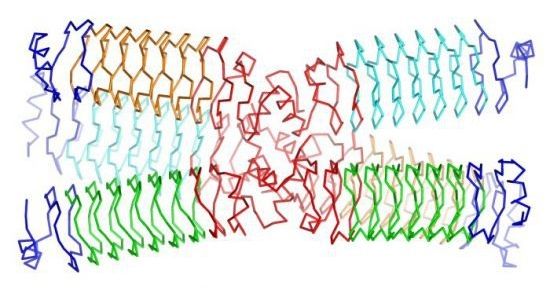
“A tubular nanotube synthesized by Ghadiri et al. consisting of cyclic D and L peptide subunits form a flat, ring-shaped conformation that stack through an extensive anti-parallel β-sheet-like hydrogen bonding interaction (Figure 1.11)” [51].
“Experimental results have shown that the channel can transport sodium and potassium ions. The channel can also be constructed by the use of direct covalent bonding between the sheets so as to increase the thermodynamic and kinetic stability” [52].
“By attaching peptides to the octiphenyl scaffold, a β-barrel can be formed via self-assembly through the formation of β-sheet structures between the peptide chains (Figure 1.13)” [53].
“The same scaffold was used by Matile etal. to mimic the structure of macrolide antibiotic amphotericin B. The channel synthesized was shown to transport cations across the membrane” [54].
“Attaching the electron-poor naphthalenediimide (NDIs) to the same octiphenyl scaffold led to the hoop-stave mismatch during self-assembly that results in a twisted and closed channel conformation (Figure 1.14). Adding the compleentary dialkoxynaphthalene (DAN) donor led to the cooperative interactions between NDI and DAN that favors the formation of barrel-stave ion channel.” [57].
MICELLAR
“These aggregate channels are formed by amphotericin involving both sterols and antibiotics arranged in two half-channel sections within the membrane” [58].
“An active form of the compound is the bolaamphiphiles (two-headed amphiphiles). (Figure 1.15) shows an example that forms an active channel structure through dimerization or trimerization within the bilayer membrane. Electrochemical studies had shown that the monomer is inactive and the active form involves dimer or larger aggregates” [60].
ANION CONDUCTING CHANNELS:
“A highly active, anion selective, monomeric cyclodextrin-based ion channel was designed by Madhavan et al (Figure 1.16). Oligoether chains were attached to the primary face of the β-cyclodextrin head group via amide bonds. The hydrophobic oligoether chains were chosen because they are long enough to span the entire lipid bilayer. The channel was able to select “anions over cations” and “discriminate among halide anions in the order I-> Br-> Cl- (following Hofmeister series)” [61].
“The anion selectivity occurred via the ring of ammonium cations being positioned just beside the cyclodextrin head group, which helped to facilitate anion selectivity. Iodide ions were transported the fastest because the activation barrier to enter the hydrophobic channel core is lower for I- compared to either Br- or Cl-“ [62]. “A more specific artificial anion selective ion channel was the chloride selective ion channel synthesized by Gokel. The building block involved a heptapeptide with Proline incorporated (Figure 1.17)” [63].
Cellular Prosthesis: Inklings of a New Interdisciplinary Approach
The paper cites “nanoreactors for catalysis and chemical or biological sensors” and “interdisciplinary uses as nano –filtration membrane, drug or gene delivery vehicles/transporters as well as channel-based antibiotics that may kill bacterial cells preferentially over mammalian cells” as some of the main applications of synthetic ion-channels [65], other than their normative use in elucidating cellular function and operation.
However, I argue that a whole interdisciplinary field and heretofore-unrecognized new approach or sub-field of Functionally-Restorative Medicine is possible through taking the technologies and techniques involved in in constructing, integrating, and experimentally-verifying either a.) non-biological analogues of ion-channels & ion-pumps (thus trans-membrane membrane proteins in general, also sometimes referred to as transport proteins or integral membrane proteins) and membranes (which include normative bilipid membranes, non-lipid membranes and chemically-augmented bilipid membranes), and b.) the artificial synthesis of biological analogues of ion-channels, ion-pumps and membranes, which are structurally and chemically equivalent to naturally-occurring biological components but which are synthesized artificially – and applying such technologies and techniques toward the purpose the gradual replacement of our existing biological neurons constituting our nervous systems – or at least those neuron-populations that comprise the neo- and prefrontal-cortex, and through iterative procedures of gradual replacement thereby achieving indefinite-longevity. There is still work to be done in determining the comparative advantages and disadvantages of various structural and functional (i.e. design) motifs, and in the logistics of implanting the iterative replacement or reconstitution of ion-channels, ion-pumps and sections of neuronal membrane in-vivo.
The conceptual schemes outlined in Concepts for Functional Replication of Biological Neurons [66], Gradual Neuron Replacement for the Preservation of Subjective-Continuity [67] and Wireless Synapses, Artificial Plasticity, and Neuromodulation [68] would constitute variations on the basic approach underlying this proposed, embryonic interdisciplinary field. Certain approaches within the fields of nanomedicine itself, particularly those approaches that constitute the functional emulation of existing cell-types, such as but not limited to Robert Freitas’s conceptual designs for the functional emulation of the red blood cell (a.k.a. erythrocytes, haematids) [69], i.e. the Resperocyte, itself should be seen as falling under the purview of this new approach, although not all approaches to Nanomedicine (diagnostics, drug-delivery and neuroelectronic interfacing) constitute the physical (i.e. electromechanical, kinetic and/or molecular physically-embodied) and functional emulation of biological cells.
The field of functionally-restorative medicine in general (and of nanomedicine in particular) and the field of supramolecular and organic chemistry converge here, where these technological, methodological, and experimental infrastructures developed in field of Synthetic Ion-Channels and Ion Channel Reconstitution can be employed to develop a new interdisciplinary approach that applies the logic of prosthesis to the cellular and cellular-component (i.e. sub-cellular) scale; same tools, new use. These techniques could be used to iteratively replace the components of our neurons as they degrade, or to replace them with more robust systems that are less susceptible to molecular degradation. Instead of repairing the cellular DNA, RNA and protein transcription and synthesis machinery, we bypass it completely by configuring and integrating the neuronal components (ion-channels, ion-pumps and sections of bilipid membrane) directly.
Thus I suggest that theoreticians of nanomedicine look to the large quantity of literature already developed in the emerging fields of synthetic ion-channels and membrane-reconstitution, towards the objective of adapting and applying existing technologies and methodologies to the new purpose of iterative maintenance, upkeep and/or replacement of cellular (and particularly neuronal) constituents with either non-biological analogues or artificially-synthesized-but-chemically/structurally-equivalent biological analogues.
This new sub-field of Synthetic Biology needs a name to differentiate it from the other approaches to Functionally-Restorative Medicine. I suggest the designation ‘cellular prosthesis’.
References:
[1] Williams (1994)., An introduction to the methods available for ion channel reconstitution. in D.C Ogden Microelectrode techniques, The Plymouth workshop edition, CambridgeCompany of Biologists.
[2] Tomich, J., Montal, M. (1996). U.S Patent No. 5,16,890. Washington, DC: U.S. Patent and Trademark Office.
[69] Freitas Jr., R., (1998). “Exploratory Design in Medical Nanotechnology: A Mechanical Artificial Red Cell”. Artificial Cells, Blood Substitutes, and Immobil. Biotech. (26): 411–430. Access: http://www.ncbi.nlm.nih.gov/pubmed/9663339
I was about to discuss the third of three concepts, but thought a look back would be appropriate at this time. In my earlier post I had shown that the photon/particle wave function could not be part of the photon/particle as this would violate the empirical Lorentz-Fitzgerald transformations and therefore, Einstein’s Special Theory of Relativity. The wave function is only the photon/particle’s disturbance of the spacetime it is in, and therefore explains why photons/particles have wave properties. They don’t. They disturb spacetime like a pebble dropped into a pond. The pond’s ripples are not the pebble.
In the recent findings, Dr. Alberto Peruzzo, University of Bristol (UK) the lead author of the paper and quoting “The measurement apparatus detected strong nonlocality, which certified that the photon behaved simultaneously as a wave and a particle in our experiment, … This represents a strong refutation of models in which the photon is either a wave or a particle.” This is a very important finding and another step in the progress of science towards a better understanding of our Universe.
Those of you who have been following my blog posts will recognize that this is empirical validation using single structure test that shows that both wave and particle properties occur together. What is required next, to be empirically rigorous, is to either confirm or deny that this wave function is a spacetime disturbance. For that we require a dual structure test.
If this wave function is a spacetime disturbance, then Einstein’s Special Theory of Relativity is upheld, and we would require a major rethink of quantum physics or the physics of elementary particles. If this wave function is a not spacetime disturbance but part of the particle structure, then there is an empirical exception to the Lorentz-Fitzgerald transformation and we would require a rethink of Einstein’s Special Theory of Relativity.
Here is a proposal for a dual structure test (to test two alternative hypotheses) which probably only an organization like CERN could execute. Is it possible to disturb spacetime in a manner as to exhibit the properties of a known particle but has no mass? That is the underlying elementary particle is not present. I suppose other research institutions could attempt this, too. If successful … it will be a bigger discovery that Dr. Alberto Peruzzo and his team.
My money is on Lorentz-Fitzgerald and Einstein being correct, and I infer that the physics community of quantum and string theorist would not be happy at the possibility of this dual structure test.
So I ask, in the spirit of the Kline Directive, can we as a community of physicists and engineers come together, to explore what others have not, to seek what others will not, to change what others dare not, to make interstellar travel a reality within our lifetimes?
Benjamin T Solomon is the author & principal investigator of the 12-year study into the theoretical & technological feasibility of gravitation modification, titled An Introduction to Gravity Modification, to achieve interstellar travel in our lifetimes. For more information visit iSETI LLC, Interstellar Space Exploration Technology Initiative.
To achieve interstellar travel, the Kline Directive instructs us to be bold, to explore what others have not, to seek what others will not, to change what others dare not. To extend the boundaries of our knowledge, to advocate new methods, techniques and research, to sponsor change not status quo, on 5 fronts, Legal Standing, Safety Awareness, Economic Viability, Theoretical-Empirical Relationships, and Technological Feasibility.
In this post I discuss the second of three concepts, that if implemented should speed up the rate of innovation and discovery so that we can achieve interstellar travel within a time frame of decades, not centuries. Okay, I must remind you that this will probably upset some physicists.
One of the findings of my 12-year study was that gravitational acceleration was independent of the internal structure of a particle, therefore, the elegantly simple formula, g=τc2, for gravitational acceleration. This raised the question, what is the internal structure of a particle? For ‘normal’ matter, the Standard Model suggests that protons and neutrons consist of quarks, or other mass based particles. Electrons and photons are thought to be elementary.
I had a thought, a test for mass as the gravitational source. If ionized matter showed the same gravitational acceleration effects as non-ionized matter, then one could conclude that mass is the source of gravitational acceleration, not quark interaction; because the different ionizations would have different electron mass but the same quark interaction. This would be a difficult test to do correctly because the electric field effects are much greater than gravitational effects.
One could ask, what is the internal structure of a photon? The correct answer is that no one knows. Here is why. In electromagnetism, radio antenna’s specifically, the energy inside the hollow antenna is zero. However, in quantum theory, specifically the nanowire for light photons, the energy inside the nanowire increases towards the center of the nanowire. I’m not going to provide any references as I not criticizing any specific researcher. So which is it?
One could ask the question, at what wavelength does this energy distribution change, from zero (for radio waves) to an increase (for light photons)? Again, this is another example of the mathematics of physics providing correct answers while being inconsistent. So we don’t know.
To investigate further, I borrowed a proposal from two German physicists, I. V. Drozdov and A. A. Stahlhofen, (How long is a photon?) who had suggested that a photon was about half a wavelength long. I thought, why stop there? What if it was an infinitely thin slice? Wait. What was that? An infinitely thin slice! That would be consistent with Einstein’s Special Theory of Relativity! That means if the photon is indeed an infinitely thin pulse, why do we observe the wave function that is inconsistent with Special Theory of Relativity? That anything traveling at the velocity of light must have a thickness of zero, as dictated by the Lorentz-Fitzgerald transformations.
The only consistent answer I could come up with was that the wave function was the photon’s effect or the photon’s disturbance on spacetime, and not the photon itself.
Here is an analogy. Take a garden rake, turn it upside down and place it under a carpet. Move it. What do you see? The carpet exhibits an envelope like wave function that appears to be moving in the direction the garden rake is moving. But the envelope is not moving. It is a bulge that shows up wherever the garden rake is. The rake is moving but not the envelope.
Similarly, the wave function is not moving and therefore spreads across the spacetime where the photon is. Now both are consistent with Einstein’s Special Theory of Relativity. Then why is the Standard Model successful? It is so because just as the bulge is unique to the shape of the garden rake, so are the photon’s and other particles’ wave function disturbances of spacetime are unique to the properties of the photon & respective particles.
In my book, this proposed consistency with Special Theory of Relativity points to the existence of subspace, and a means to achieve interstellar travel.
There are a lot of inconsistencies in our physical theories, and we need to start addressing these inconsistencies if we are to achieve interstellar travel sooner rather than later.
Benjamin T Solomon is the author & principal investigator of the 12-year study into the theoretical & technological feasibility of gravitation modification, titled An Introduction to Gravity Modification, to achieve interstellar travel in our lifetimes. For more information visit iSETI LLC, Interstellar Space Exploration Technology Initiative.
It starts with scary words about how every crisis comes faster and faster. However this is untrue. Many countries have been running deficits for decades. The financial crisis is no surprise. The reason the US has such high energy costs goes back to government decisions made in the 1970s. And many things that used to be crises no longer happen, like the Black Plague. We have big problems, but we’ve also got many resources we’ve built up over the centuries to help. Much of the challenges we face are political and social, not technical.
We will never fall into a new Dark Ages. The biggest problem is that we aren’t advancing as fast as we could and many are still starving, sick, etc. However, it has always been this way. The 20th century was very brutal! But we are advancing and it is mostly known threats like WMDs which could cause a disaster. In the main, the world is getting safer every day as we better understand it.
We aren’t going to build a new human. It is more like a Renaissance. Those who lost limbs will get increasingly better robotic ones, but they will still be humans. The best reason to build a robotic arm is to attach it to a human.
The video had a collectivist and authoritarian perspective when it said:
“The world’s community and leaders should encourage mankind instead of wasting resources on solving momentary problems.”
This sentence needs to be deconstructed:
1. Government acts via force. Government’s job is to maintain civil order, so having it also out there “encouraging” everyone to never waste resources is creepy. Do you want your policeman to also be your nanny? Here is a quote from C.S. Lewis:
“Of all tyrannies, a tyranny sincerely exercised for the good of its victims may be the most oppressive. It would be better to live under robber barons than under omnipotent moral busybodies. The robber baron’s cruelty may sometimes sleep, his cupidity may at some point be satiated; but those who torment us for our own good will torment us without end for they do so with the approval of their own conscience.”
2. It is wrong to think government is the solution to our problems. Most of the problems that exist today like the Greek Debt Crisis, and the US housing crisis were caused by governments trying to do too much.
3. There is no such thing as the world’s leaders. There is the UN, which doesn’t act in a humanitarian crisis until after everyone is dead. In any case, we don’t need the governments to act. We built Wikipedia.
4. “Managing resources” is codeword for socialism. If their goal is to help with the development of new technologies, then the task of managing existing resources is totally unrelated. If your job is to build robots, then your job is not also to worry about whether the water and air are dirty. Any scientist who talks about managing resources is actually a politician. Here is a quote from Frederic Hayek:
“The curious task of economics is to demonstrate to men how little they really know about what they imagine they can design. Before the obvious economic failure of Eastern European socialism, it was widely thought that a centrally planned economy would deliver not only “social justice” but also a more efficient use of economic resources. This notion appears eminently sensible at first glance. But it proves to overlook the fact that the totality of resources that one could employ in such a plan is simply not knowable to anybody, and therefore can hardly be centrally controlled.”
5. We should let individuals decide what to spend their resources on. People don’t only invest in momentary things. People build houses. In fact, if you are looking for an excuse to drink, being poor because you live in a country with 70% taxes is a good one.
The idea of tasking government to finding the solutions and to do all futuristic research and new products to shove down our throats is wrong and dangerous. We want individuals, and collections of them (corporations) to do it because they will best put it to use in ways that actually improve our lives. Everything is voluntary which encourages good customer relationships. The money will be funded towards the products people actually care about, instead of what some mastermind bureaucrat thinks we should spend money on. There are many historical examples of how government doesn’t innovate as well as the private sector: the French telephone system, Cuba, expensive corn-based ethanol, the International Space Station, healthcare. The free market is imperfect but it leads to fastest technological and social progress for the reasons Frederic Hayek has explained. A lot of government research today is wasted because it never gets put to use commercially. There are many things that can be done to make the private sector more vibrant. There are many ways government can do a better job, and all that evidence should be a warning to not use governments to endorse programs with the goal of social justice. NASA has done great things, but it was only because it existed in a modern society that it was possible.
They come up with a nice list of things that humanity can do, but they haven’t listed that the one of the most important first steps is more Linux. We aren’t going to get cool and smart robots, etc. without a lot of good free software first.
The video says:
“What we need is not just another technological revolution, but a new civilization paradigm, we need philosophy and ideology, new ethics, new culture, new psychology.”
It minimizes the technology aspect when this is the hard work by disparate scientists that will bring us the most benefits.
It is true that we need to refine our understandings of many things, but we are not starting over, just evolving. Anyone who thinks we need to start over doesn’t realize what we’ve already built and all the smart people who’ve come before. The basis of good morals from thousands of years ago still apply. It will just be extended to deal with new situations, like cloning. The general rules of math, science, and biology will remain. In many cases, we are going back to the past. The Linux and free software movement is simply returning computer software to the hundreds of years-old tradition of science. Sometimes the idea has already been discovered, but it isn’t widely used yet. It is a social problem, not a technical one.
The repeated use of the word “new”, etc. makes this video like propaganda. Cults try to get people to reset their perspective into a new world, and convince them that only they have the answers. This video comes off as a sales pitch with them as the solution to our problems, ignoring that it will take millions. Their lists of technologies are random. Some of these problems we could have solved years ago, and some we can’t solve for decades, and they mix both examples. It seems they do no know what is coming next given how disorganized they are. They also pick multiple words that are related and so are repeating themselves. Repetition is used to create an emotional impact, another trait of propaganda.
The thing about innovation and the future is that it is surprising. Many futurists get things wrong. If these guys really had the answers, they’d have invented it and made money on it. And compared to some of the tasks, we are like cavemen.
Technology evolves in a stepwise fashion, and so looking at it as some clear end results on some day in the future is wrong.
For another example: the video makes it sound like going beyond Earth and then beyond the Solar System is a two-step process when in fact it is many steps, and the journey is the reward. If they were that smart, they’d endorse the space elevator which is the only cheap way to get out there, and we can do it in 10 years.
The video suggests that humanity doesn’t have a masterplan, when I just explained that you couldn’t make one.
It also suggests that individuals are afraid of change, when in fact, that is a trait characteristic of governments as well. The government class has known for decades that Social Security is going bankrupt, but they’d rather criticize anyone who wants to reform it rather than fix the underlying problem. This video is again trying to urge collectivism with its criticism of the “mistakes” people make. The video is very arrogant at how it looks down at “the masses.” This is another common characteristic of collectivism.
Here is the first description of their contribution:
“We integrate the latest discoveries and developments from the sciences: physics, energetics, aeronautics, bio-engineering, nanotechnology, neurology, cybernetics, cognitive science.”
That sentence is laughable because it is an impossible task. To understand all of the latest advances would involve talking with millions of scientists. If they are doing all this integration work, what have they produced? They want everyone to join up today, work to be specified later.
The challenge for nuclear power is not the science, it is the lawyers who outlawed new ones in 1970s, and basically have halted all advancements in building safer and better ones. Some of these challenges are mostly political, not scientific. We need to get engineers in corporations like GE, supervised by governments, building safer and cleaner nuclear power.
If you wanted to create all of what they offer, you’d have to hire a million different people. If you were building the pyramids, you could get by with most of your workers having one skill, the ability to move heavy things around. However, the topics they list are so big and complicated, I don’t think you could build an organization that could understand it all, let alone build it.
They mention freedom and speak in egalitarian terms, but this is contradicted by their earlier words. In their world, we will all be happy worker bees, working “optimally” for their collective. Beware of masterminds offering to efficiently manage your resources.
I support discussion and debate. I am all for think-tanks and other institutions that hire scientists. However, those that lobby government to act on their behalf are scary. I don’t want every scientist lobbying the government to institute their pet plan, no matter how good it sounds. They will get so overwhelmed that they won’t be able to do their actual job. The rules of the US Federal government are very limited and generally revolve around an army and a currency. Social welfare is supposed to be handled by the states.
Some of their ideas cannot be turned into laws by the US Congress because they don’t have this authority — the States do. Obamacare is likely to be ruled unconstitutional, and their ideas are potentially much more intrusive towards individual liberty. It would require a Constitutional Amendment, which would never pass and we don’t need.
They offer a social network where scientists can plug in and figure out what they need to do. This could also be considered an actual concrete example of something they are working on. However, there are already social networks where people are advancing the future. SourceForge.net is the biggest community of programmers. There is also Github.com with 1,000,000 projects. Sage has a community advancing the state of mathematics.
If they want to create their own new community solving some aspect, that is great, especially if they have money. But the idea that they are going to make it all happen is impossible. And it will never replace all the other great communities that already exist. Even science happens on Facebook, when people chat about their work.
If they want to add value, they need to specialize. Perhaps they come up with millions of dollars and they can do research in specific areas. However, their fundamental research would very likely get used in ways they never imagined by other people. The more fundamental, the more no one team can possibly take advantage of all aspects of the discovery.
They say there is some research lab they’ve got working on cybernetics. However they don’t demonstrate any results. I don’t imagine they can be that much ahead of the rest of the world who provides them the technology they use to do their work. Imagine a competitor to Henry Ford. Could he really build a car much better given the available technology at the time? My response to anyone who has claims of some advancements is: turn it into a demo or useful product and sell it. All this video offer as evidence here is CGI, which any artist can make.
I support the idea of flying cars. First we need driverless cars and cheaper energy. Unless they are a car or airplane company, I don’t see what this organization will have to do with that task. I have nothing against futuristic videos, but they don’t make clear what is their involvement and instances of ambiguity should be noted.
They are wrong when they say we won’t understand consciousness till 2030 because we already understand it at some level today. Neural networks have been around for decades. IBM’s Jeopardy-playing Watson was a good recent example. However, it is proprietary so not much will come of that particular example. Fortunately, Watson was built on lots of free software, and the community will get there. Google is very proprietary with their AI work. Wolfram Alpha is also proprietary. Etc. We’ve got enough the technical people for an amazing world if we can just get them to work together in free software and Python.
The video’s last sentence suggests that spiritual self-development is the new possibility. But people can work on that today. And again, enlightenment is not a destination but a journey.
We are a generation away from immortality unless things greatly change. I think about LibreOffice, cars that drive themselves and the space elevator, but faster progress in biology is also possible as well if people will follow the free software model. The Microsoft-style proprietary development model has infected many fields.