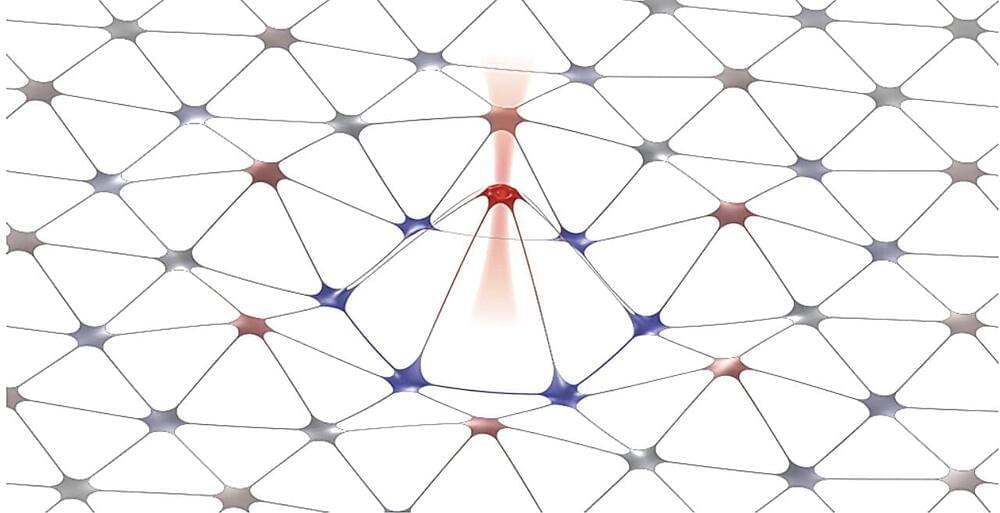
Mechanical crystals, also known as phononic crystals, are materials that can control the propagation of vibrations or sound waves, just like photonic crystals control the flow of light. The introduction of defects in these crystals (i.e., intentional disruptions in their periodic structure) can give rise to mechanical modes within the band gap, enabling the confinement of mechanical waves to smaller regions or the materials—a feature that could be leveraged to create new technologies.
Researchers at McGill University recently realized a new mechanical crystal with an optically programmable defect mode. Their paper, published in Physical Review Letters, introduces a new approach to dynamically reprogram mechanical systems, which entails the use of an optical spring to transfer a mechanical mode into a crystal’s band gap.
“Some time ago, our group was thinking a lot about using an optical spring to partially levitate structures and improve their performance,” Jack C. Sankey, principal investigator and co-author of the paper, told Phys.org. “At the same time, we were watching the amazing breakthroughs in our field with mechanical devices that used the band gap of a phononic crystal to insulate mechanical systems from the noisy environment.”