Article originally published on LINKtoLEADERS under the Portuguese title “Sem saber ler nem escrever!”
In the 80s, “with no knowledge, only intuition”, I discovered the world of computing. I believed computers could do everything, as if it were an electronic God. But when I asked the TIMEX Sinclair 1000 to draw the planet Saturn — I am fascinated by this planet, maybe because it has rings —, I only glimpse a strange message on the black and white TV:
As most of you know I have cancer called multiple myeloma and have had it for almost a decade now. Unfortunately medical bills are staggering, especially in the US. I am asking to reach a goal of $10,000 to help wipe out if not most of my medical debt and expenses. I have over 1,000 friends on Facebook. If each friend donated $8.00 this would help me not only reach but exceed my goal. Please consider helping:
If anyone needs proof of my diagnosis or medical debt please message me.
Hi, my name is Nicholas and I was diagnosed with multiple myeloma several years ago. Medical bills are exceedingly expensive even with insurance. I am creating content on tiktok in hopes to create an income to help me cover such costs.
“DEATH DEFANGED Cryonics, Cryothanasia and the Future of Sentience” with David Pearce, Author, Philosopher and well-known TransHumanistThis service will be on ZOOM and YouTube Live Stream only, not in person. Zoom at 6:00 PM Eastern Time. Live Stream at 7:00 PM Eastern Time. Stay after the close of the YouTube streaming for the Zoom After Party until??:00 pm. Enjoy fellowship in the extended discussions with Neal and Immortalists & Friends from Around the World, sharing bold ideas on health, longevity, and technology!(Note: Mr. Pearce was scheduled last month to give a presentation but due to circumstances beyond our control we did not have that presentation. We look forward this month to have David Pearce join us!)David Pearce is the author of 4 major works:“The Hedonistic Imperative”, “The Biointelligence Explosion: How Recursively Self-Improving Organic Robots will Modify their Own Source Code and Bootstrap Our Way to Full-Spectrum Superintelligence”, “Singularity Hypotheses: A Scientific and Philosophical Assessment”, & “Can Biotechnology Abolish Suffering?” The Hedonistic Imperative (1995) advocates the use of biotechnology to abolish suffering throughout the living world. In 1998, he co-founded the World Transhumanist Association (H+) with Nick Bostrom. Transhumanists believe in the use of technology to overcome our biological limitations. Currently, Pearce is a fellow of the Institute for Ethics and Emerging Technologies, and sits on the futurist advisory board of the Lifeboat Foundation. He is also the director of bioethics of Invincible Wellbeing and is on the advisory boards of the Center on Long-Term Risk, the Organization for the Prevention of Intense Suffering and since 2021 the Qualia Research Institute. Please share this event with someone that you care about. Would you like to make a Donation to Perpetual Life? Your donations help us grow & improve our services. To donate, go to our website http://Perpetual.Life and use the PayPal button at the top right of the page. Thank you for your generous donations, we appreciate it immensely!“Our task is to make nature, the blind force of nature, into an instrument of universal resuscitation and to become a union of immortal beings.“ - Nikolai F. FedorovWe hold faith in the technologies & discoveries of humanity to END AGING and Defeat involuntary Death within our lifetime. Working to Save Lives with Age Reversal Education. ========== Perpetual Life Creed ==========We believe that all of life is sacred and that we have been given this one life to make unlimited. We believe in our Creator’s divine plan for all of humanity to have infinite lifespans in perfect health and eternal joy, rendering death to be optional. By following our Gospel we achieve eternal life creating a heaven here on earth. We follow Nikolai Fyodorov, who taught that the transcendence of the creator will only be solved when humanity in our unified efforts become an instrument of universal resuscitation, when the divine word becomes our divine action. And we follow Arthur C. Clarke, who said “The only way to discover the limits of the possible is to go beyond them into the impossible.“And so, we enter each day energized in Spirit and empowered by the words of our prophets to live in joy, serving our creator and all of mankind, Forever and Ever.==========Wishing you Perfect Health and Great Longevity!Perpetual Life, a science-faith based church is open to people of all faiths & belief systems. We are non-denominational & non-judgmental and a central gathering place of Immortalists & Transhumans. What unites us is our common faith, belief and desire in Unlimited Life Spans. We are located in Pompano Beach FL at 950 South Cypress Road.
Alex SharpThe world needs to be subsidising heat pumps for the poorer regions of the world, to keep people safe.
2 Replies.
Chris BartlettThat’s alarmist, while they’re is global warming, there’s little evidence that we are yet seeing extreme weather previously unseen in Earth’s history or even during human history.
Echolocation is a skill we usually associate with animals such as bats and whales, but some blind humans also use the echoes of their own sounds to detect obstacles and their outlines. Some use the tapping of a cane or the snapping of their fingers to make the necessary noise, while others use their mouths to make a clicking sound.
Despite how useful this skill can be, very few blind people are currently taught how to do it. Expert echolocators have been trying to spread t… See more.
With enough training, most humans can learn how to echolocate, using their tongue to make clicking sounds and interpreting the echoes that come back, reflected from the surrounding environment.
In as few as 10 weeks, researchers have been able to teach participants how to navigate obstacles and recognize the size and orientation of objects using the rebounding calls of their clicks.
The experiment, the results of which were published in 2021, involved 12 participants who’d been diagnosed as legally blind during their childhood, and 14 sighted people.
Michael LorreyGates is, famously, the guy who said, “Why would anyone ever need more than 640kb of memory?” and “The internet is a fad.”
2 Replies.
Paul Battista shared a link. Lifeboat Foundation.
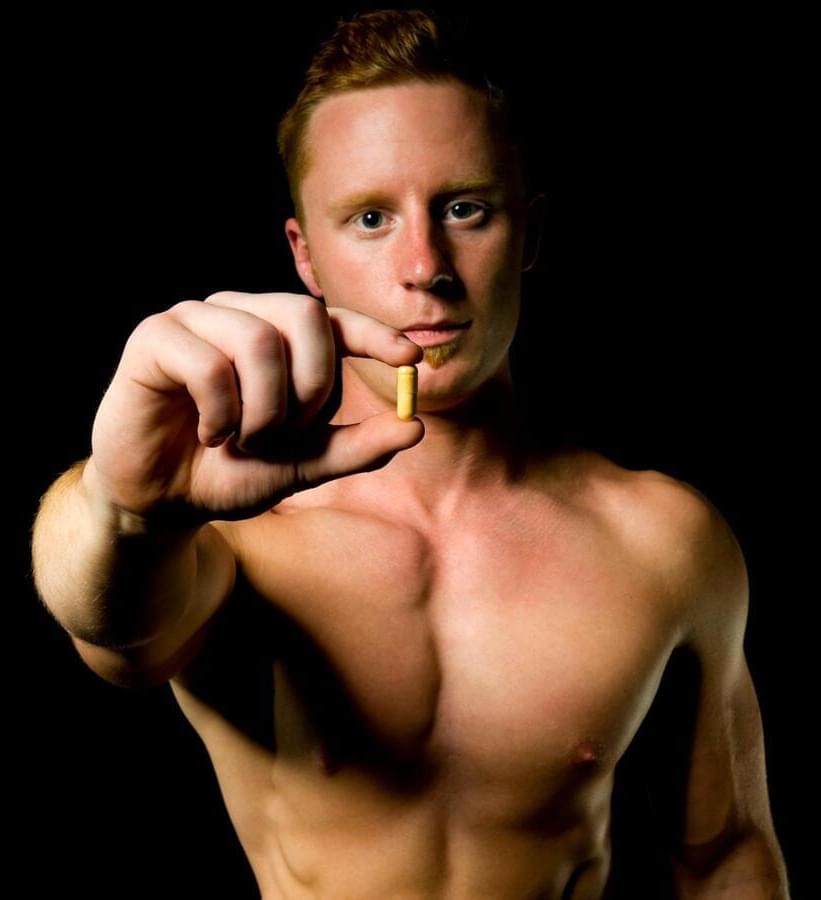
The benefits of exercise in a pill? Science is now closer to that goal.
Researchers have identified a molecule in the blood that is produced during exercise and can effectively reduce food intake and obesity in mice. The discovery improves our understanding of the physiological processes that underlie the interplay between exercise and hunger. Scientists from Baylor College of Medicine, Stanford School of Medicine and collaborating institutions reported the findings on June 15 in the journal Nature.
“Regular exercise has been proven to help weight loss, regulate appetite, and improve the metabolic profile, especially for people who are overweight and obese,” said co-corresponding author Dr. Yong Xu, professor of pediatrics – nutrition and molecular and cellular biology at Baylor. “If we can understand the mechanism by which exercise triggers these benefits, then we are closer to helping many people improve their health.”
I disagree with Ross Dawson here… it’s not ultimately a matter of belief or faith, it’s a matter of understanding our existing knowledge about the physiology of sentience, and of furthering the relevant research agendas. Questions of sentience in h… See more.
2 Replies.
Daniel E. TwedtThey can be corporate persons and have all kinds of capabilities…
View 4 more comments.
Shubham Ghosh Roy shared a link. Lifeboat Foundation.
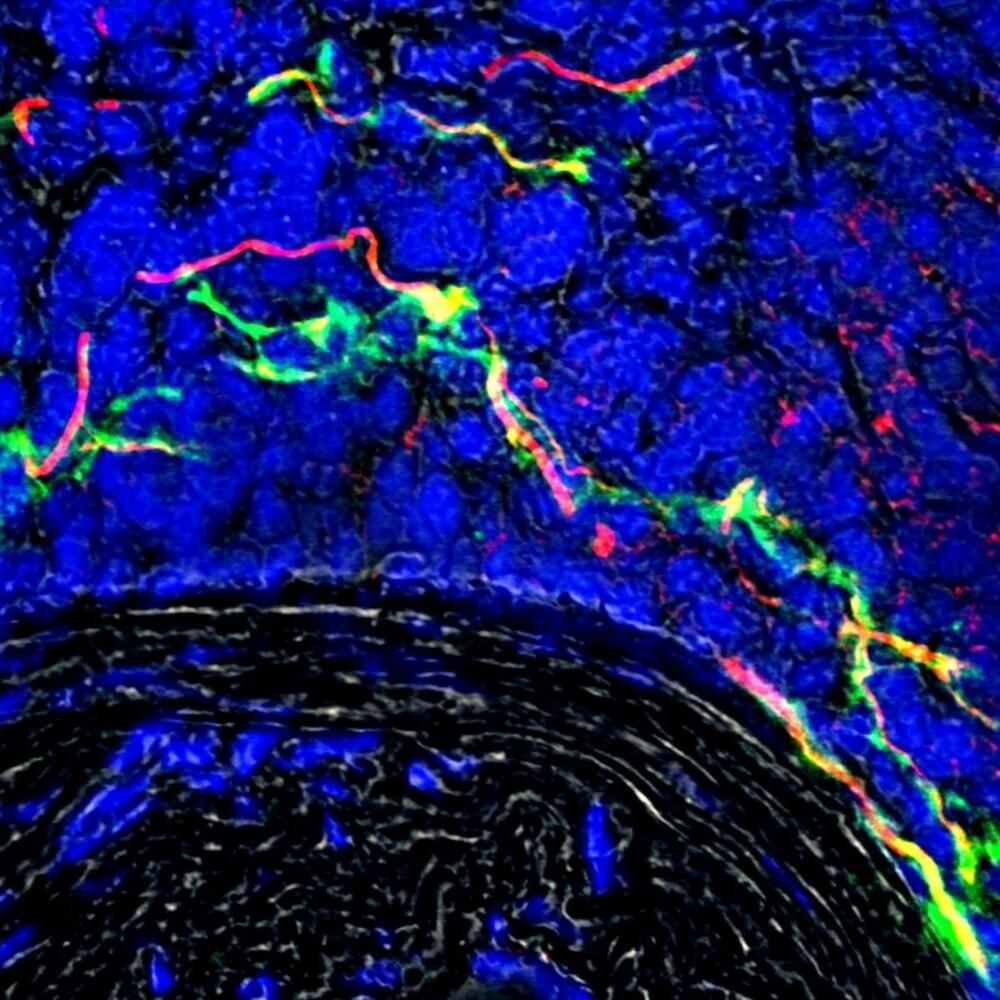
An international team which includes University of Manchester scientists has for the first time demonstrated that nerve signals are exchanged between clogged up arteries and the brain.
The discovery of the previously unknown electrical circuit is a breakthrough in our understanding of atherosclerosis, a potentially deadly disease where plaques form on the innermost layer of arteries.
The study of mice found that new nerve bundles are formed on the outer layer of where the artery is diseased, so the brain can detect where the damage is and communicate with it.