Toggle light / dark theme

New Material System Developed to Convert and Generate Terahertz Waves for Tomorrow’s Technologies

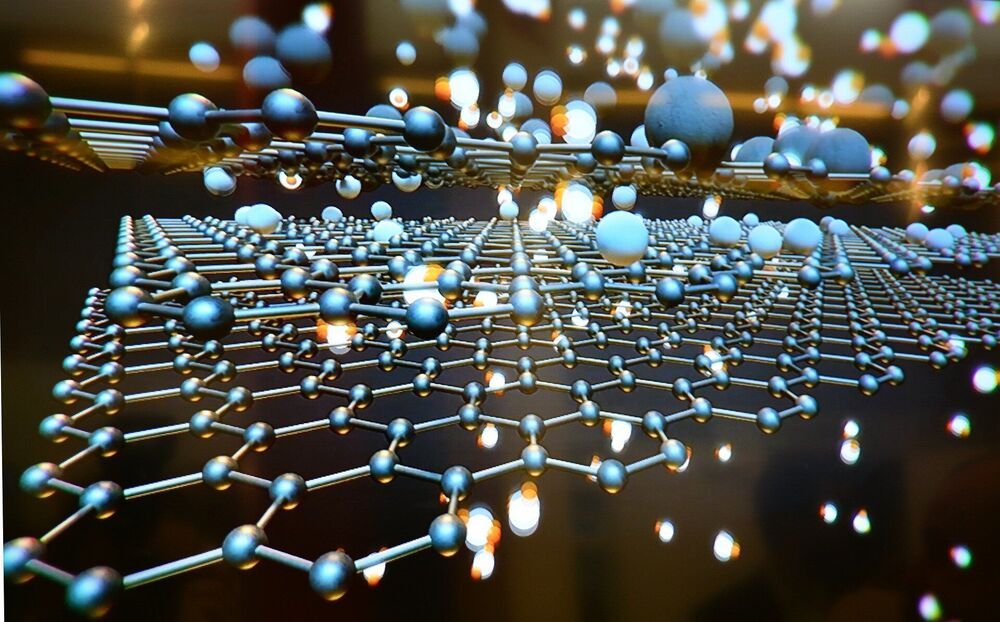
On the electromagnetic spectrum, terahertz light is located between infrared radiation and microwaves. It holds enormous potential for tomorrow’s technologies: Among other things, it might succeed 5G by enabling extremely fast mobile communications connections and wireless networks. The bottleneck in the transition from gigahertz to terahertz frequencies has been caused by insufficiently efficient sources and converters. A German-Spanish research team with the participation of the Helmholtz-Zentrum Dresden-Rossendorf (HZDR) has now developed a material system to generate terahertz pulses much more effectively than before. It is based on graphene, i.e., a super-thin carbon sheet, coated with a metallic lamellar structure. The research group presented its results in the journal ACS Nano.

Some time ago, a team of experts working on the HZDR accelerator ELBE were able to show that graphene can act as a frequency multiplier: When the two-dimensional carbon is irradiated with light pulses in the low terahertz frequency range, these are converted to higher frequencies. Until now, the problem has been that extremely strong input signals, which in turn could only be produced by a full-scale particle accelerator, were required to generate such terahertz pulses efficiently.“This is obviously impractical for future technical applications,” explains the study’s primary author Jan-Christoph Deinert of the Institute of Radiation Physics at HZDR. “So, we looked for a material system that also works with a much less violent input, i.e., with lower field strengths.”

For this purpose, HZDR scientists, together with colleagues from the Catalan Institute of Nanoscience and Nanotechnology (ICN2), the Institute of Photonic Sciences (ICFO), the University of Bielefeld, TU Berlin and the Mainz-based Max Planck Institute for Polymer Research, came up with a new idea: the frequency conversion could be enhanced enormously by coating the graphene with tiny gold lamellae, which possess a fascinating property: “They act like antennas that significantly amplify the incoming terahertz radiation in graphene,” explains project coordinator Klaas-Jan Tielrooij from ICN2. “As a result, we get very strong fields where the graphene is exposed between the lamellae. This allows us to generate terahertz pulses very efficiently.”

A Massive Chip Shortage Is Hitting the Entire Semiconductor Industry

One of the ongoing questions these past few months has been why so many tech products have been so hard to buy. We’ve made repeated reference to known potential factors like COVID-19, economic disruptions, yield issues, and the impact of scalping bots, but there’s a new argument for what’s causing such general problems across so many markets: Insufficient investment in 200mm wafers.

Today, leading-edge silicon is invariably manufactured on 300mm wafers. Over the past few decades, manufacturers have introduced larger wafer sizes: 100mm, 150mm, 200mm, and 300mm have all been common standards at one time or another. In the PC enthusiast space, 300mm wafers have long been considered superior to 200mm wafers, because the larger wafer size reduces waste and typically improves the foundry’s output in terms of chips manufactured per day.

There aren’t that many commercial foundries still dedicated to 150mm or smaller wafer sizes, but a number of foundries still run 200mm fab lines. TSMC and Samsung both offer the node, as well as a number of second-tier foundries. GlobalFoundries has 200mm facilities, as do SMIC, UMC, TowerJazz, and SkyWater. A great many IoT and 5G chips are built on 200mm, as are some analog processors, MEMS devices, and RF solutions.

Meshing Optics With Electronics: Physics Discovery Leads to Ballistic Optical Materials

Electronics are increasingly being paired with optical systems, such as when accessing the internet on an electronically run computer through fiber optic cables.

But meshing optics — which relies on particles of light called photons—with electronics—relying on electrons — is challenging, due to their disparate scales. Electrons work at a much smaller scale than light does. The mismatch between electronic systems and optical systems means that every time a signal converts from one to the other, inefficiency creeps into the system.

Now, a team led by a Purdue University scientist has found a way to create more efficient metamaterials using semiconductors and a novel aspect of physics that amplifies the activity of electrons. The study is published in the journal Optica.

Google Looks to Batteries as Replacement for Diesel Generators

O,.o.


Google will use large batteries to replace the diesel generators at one of its data centers in Belgium, describing the project as a first step towards using cleaner technologies to provide backup power for its millions of servers around the world.

“Our project in Belgium is a first step that we hope will lay the groundwork for a big vision: a world in which backup systems at data centers go from climate change problems to critical components in carbon-free energy systems,” said Joe Kava, Vice President for Data Centers at Google. “We’re aiming to demonstrate that a better, cleaner solution has advanced far enough to keep the internet up and running.”

Google becomes the second major hyperscale cloud operator to pursue a strategy to move beyond diesel generators. In July, Microsoft said it will eliminate its reliance on diesel fuel by the year 2030 and has begun testing hydrogen fuel cells as an alternative. These announcements have implications beyond company-built facilities, as Google and Microsoft are major tenants in third-party data centers, most of which use diesel generators for backup power.

TIMELAPSE OF FUTURE TECH: From 2022 — 4000+

The journey to see future technology starts in 2022, when Elon Musk and SpaceX send the first Starship to Mars — beginning the preparations for the arrival of the first human explorers.

We see the evolution of space exploration, from NASA’s Artemis mission, humans landing on Mars, and the interplanetary internet system going online. To the launch of the Starshot Alpha Centauri program, and quantum computers designing plants that can survive on Mars.

On Earth, tech evolves with quantum computers and Neaulink chips. People begin living with bio-printed organs. Humans record every part of lives from birth. And inner speech recording becomes possible.

And what about predictions further out into the future, when humans become level 2 and level 3 civilizations. When NASA’s warp drive goes live, and Mars declares independence from Earth. Will there be Dyson structures built around stars to capture their energy. Will they help power computers that can take human consciousness and download it into a quantum computer core. Allowing humanity to travel further out into space.

Quotes about the future from: Arthur C. Clarke, Stephen Hawking, Albert Einstein, and Elon Musk.

Additional footage sourced from: NASA, SpaceX.

IEEE BAU Robotics and Automation Chapter

✨ ′′ Using a high speed 5 G network, a London surgeon has performed remote experimental surgery for a banana based in the U.S. state of California.

This evolution opens up prospects for complicated remote surgeries without going through the trouble of future travel.
#IEEE_BAU_RAS


✨‏باستخدام شبكة 5G فائقة السرعة قام جرّاح في لندن بإجراء عملية جراحية تجريبية عن بُعد لموزة موجودة في ولاية كاليفورنيا الأمريكية.

‏هذا التطور يفتح الآفاق لإجراء عمليات جراحية معقدة عن بعد دون تكبد عناء السفر مستقبلاً.” #IEEE_BAU_RAS

/* */