“With the LinkedIn acquisition, Microsoft snares two prizes: the massive amounts of data contained in LinkedIn’s 433 million member profiles that are kept scrupulously up to date by business professionals and to which competitors have no access and the brainy computer algorithms that crunch that data.” the writeup.
Buying the Facebook of professional networks is perhaps the best illustration yet that the cloud wars are heating up.
A cool experiment — a movie script written by a computer algorithm. It’s actually pretty riveting, but I challenge you to figure out what it’s about, LOL! bigsmile (Y) #AIScreenwriter #WhatDoesItMean
The rise of big data and advances in information technology has serious implications for our ability to deliver sufficient bandwidth to meet the growing demand.
Researchers at the University of the Witwatersrand in Johannesburg, South Africa, and the Council for Scientific and Industrial Research (CSIR) are looking at alternative sources that will be able to take over where traditional optical communications systems are likely to fail in future.
In their latest research, published online today (10 June 2016) in the scientific journal, Scientific Reports, the team from South Africa and Tunisia demonstrate over 100 patterns of light used in an optical communication link, potentially increasing the bandwidth of communication systems by 100 times.
Tennessee -based Branch Technology has announced it will begin construction of a 3D-printed house in 2017. Designed by Honolulu-based WATG, the project was initiated for the Freeform Home Design Challenge, which asked participants to design for Branch’s Cellular Fabrication (C-Fab) 3D printing technology. The small house designs were required to be between 600 and 800 square feet.
Branch’s C-Fab technology involves 3D printing carbon-fiber-reinforced ABS plastic with a large robotic arm. The resulting formwork can then be covered in more traditional building materials, such as concrete or foam. Instead of the typical completely 3D printed additive technique, C-Fab uses an algorithm to formulate an interior framework for the structure.
WATG’s design, entitled Curve Appeal, will be built at Branch Technology’s lab in Chattanooga, Tennessee. The house is comprised of a curving shell around an open plan. The form of the building also provides a car port. The interior of the house is divided up with class walls and a solid core.
Life Extension e InSilico Medicine anunciaram uma esforço colaborativo para identificar romance biomarcadores de envelhecimento humano através do uso de big data analytics e inteligência artificial.
Mobile phone data may reveal an underlying mathematical connection between how we move and how we communicate that could make it easier to predict how diseases—and even ideas—spread through a population, according to an international team of researchers.
“This study really deepens our quantitative understanding of human behavior,” said Dashun Wang, assistant professor of information sciences and technology, Penn State. “We would like to think that we control our own behavior and we can do what we want to do. But, what we are starting to see with big data is that there is a very deep regularity underlying much of what we do.”
In a study, location and communication data collected from three international mobile phone carriers showed that people move and communicate in predictable patterns, said Wang.
On May 11, 2016, the Berggruen Philosophy and Culture Center invited Yuval Noah Harari, a professor of history at Hebrew University of Jerusalem and author of the international bestseller “Sapiens: A Brief History of Humankind,” to deliver a talk on “The New Inequalities” at Tsinghua University in Beijing. Prior to the talk, Harari was interviewed by BPPC director Daniel A. Bell. This is an edited transcript of the interview.
You argue in your book that material progress, for example in the agriculture revolution and industrial capitalism doesn’t necessarily contribute to human happiness. In fact, it may lead to the opposite. Can you elaborate on that?
Until the middle of the 19th century there was a complete lack of correlation between material progress and the well-being of individual humans. For thousands of years until about 1850 you see humans accumulating more and more power by the invention of new technologies and by new systems of organization in the economy and in politics, but you don’t see any real improvement in the well-being of the average person. If you are the emperor of China, then obviously you’re much better off. But if you’re an average Chinese peasant in 1850, it’s very, very hard to say that your life is any better than the life of hunter-gatherers in the Yangtze Valley 20,000 years ago. You work much harder than them, your diet is worse, you suffer far more from infectious diseases, and you suffer far more from social inequality and economic exploitation.
When I 1st read this headline, I had to pause and ask myself “was the article’s author informed at all on QC?” especially given China’s own efforts much less D-Wave, Google, and University of Sydney. And, then I read the article and I still have to wonder if the author is on top of the emerging technologies such as BMI, graphene, QC, and other nanotechnology that are already being tested to go live in the next 7 to 10 years plus much of the content is very superficial at best. I am glad that the author did put the tid bit on Singularity as the endpoint state; however, that is pretty well known. Nonetheles, sharing to let you be the judge.
For decades, we relied on silicon as the semiconductor for our computer chips. But now, working at nanometer scales, it looks like physical limitations may end the current methods to include more and more processing power onto each individual chip.
Many companies are making billion-dollar investments to continue scaling down semiconductor technology. The pressures of big data and cloud computing are pushing the limits of the current semiconductor technology in terms of bandwidth, memory, processing speed, and device power consumption.
Today’s state-of-the-art silicon chips are engineered at the 22- and 14-nanometer scale. Research is underway to take that down to 10-nanometer scale in the next several years.
Georgia Institute of Technology developed a control algorithm that ‘taught’ 3-ft, 48lb rally cars how to plan and execute optimal handling decisions in real-time while on rough terrain.
“So there came a time in which the ideas, although accumulated very slowly, were all accumulations not only of practical and useful things, but great accumulations of all types of prejudices, and strange and odd beliefs. Then a way of avoiding the disease was discovered. This is to doubt that what is being passed from the past is in fact true, and to try to find out ab initio again from experience what the situation is, rather than trusting the experience of the past in the form in which it is passed down. And that is what science is: the result of the discovery that it is worthwhile rechecking by new direct experience, and not necessarily trusting the [human] race[’s] experience from the past. I see it that way. That is my best definition…Science is the belief in the ignorance of experts.“ –Richard P Feynman, What is Science? (1968)[1]
TruthSift.com is a platform designed to support and guide individuals or crowds to rationality, and make them smarter collectively than any unaided individual or group. (Free) Members use TruthSift to establish what can be established, refute what can’t be, and to transparently publish the demonstrations. Anyone can browse the demonstrations and learn what is actually known and how it was established. If they have a rational objection, they can post it and have it answered.
Whether in scientific fields such as climate change or medical practice, or within the corporate world or political or government debate, or on day to day factual questions, humanity hasn’t had a good method for establishing rational truth. You can see this from consequences we often fail to perceive: Peer reviewed surveys agree: A landslide majority of medical practice is *not* supported by science [2,3,4]. Scientists are often confused about the established facts in their own field [5]. Within fields like climate science and vaccines, that badly desire consensus, no true consensus can be reached because skeptics raise issues that the majority brush aside without an established answer (exactly what Le Bon warned of more than 100 years ago[6]). Widely consulted sources like Wikipedia are reported to be largely paid propaganda on many important subjects [7], or the most popular answer rather than an established one [8]. Quora shows you the most popular individual answer, generated with little or no collaboration, and often there is little documentation of why you should believe it. Existing systems for crowd sourced wisdom largely compound group think, rather than addressing it. Existing websites for fact checking give you someone’s point of view.
Corporate or government planning is no better. Within large organizations, where there is inevitably systemic motivation to not pass bad news up, leadership needs active measures to avoid becoming clueless as to the real problems [9]. Corporate or government plans are subject to group think, or takeover by employee or other interests competing with the mission. Individuals who perceive mistakes have no recourse capable of rationally pursuading the majority, and may anyway be discouraged from speaking up by various consequences[6].
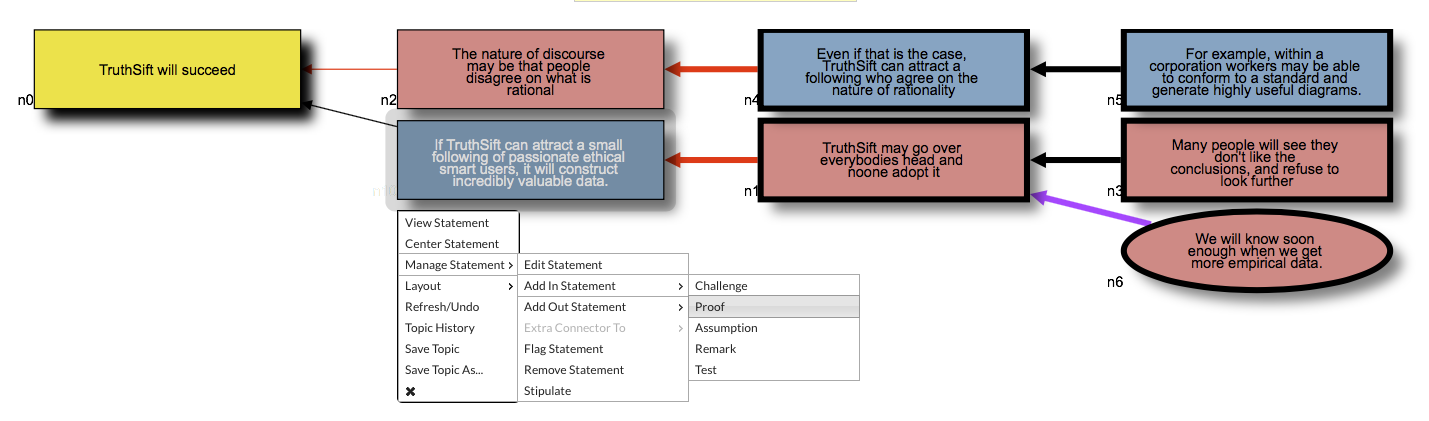
TruthSift is designed to solve all these problems. TruthSift realizes in your browser the Platonic ideal of the scientific literature, but TruthSift applies it to everything, and makes it tangible and lightweight, extended to a much lower hurdle for publishing. On a public TruthSift diagram, members (or on a Private diagram, members you have invited), who believe they can prove or refute a statement, can post their proof or refutation exactly where it is relevant. TruthSift logically propagates the consequences of each contribution, graphically displaying how it impacts the establishment status of all the others, drawing statements established by the combined efforts in thick borders, and statements refuted in thin. Statements are considered established only when they have an established demonstration, one with every posted challenge refuted. Fig 1: An example topic. The topic statement n0 is currently refuted, because its only proof is refuted. The statement menu is shown open in position to add a proof to this proof. The topic statement is gold, pro statements are blue, con statements are red. Proof connectors are black, challenges red, remarks purple, assumptions (not shown) blue. Statements show the title. On the actual Topic the body can be seen by selecting the statement and “View Statement” or hovering the mouse. What is a proof? According to the first definition at Dictionary.com a proof is: “evidence sufficient to establish a thing as true, or to produce belief in its truth.” In mathematics, a proof is equivalent to a proof tree that starts at axioms, or previously established results, which the participants agree to stipulate, and proceeds by a series of steps that are individually unchallengeable. Each such step logically combines several conclusions previously established and/or axioms. The proof tree proceeds in this way until it establishes the stated proved conclusion. Mathematicians often raise objections to steps of the proof, but if it is subsequently established that all such objections are invalid, or if a workaround is found around the problem, the proof is accepted.
The Scientific literature works very similarly. Each paper adds some novel argument or evidence that previous work is true or is not true or extends it to establish new results. When people run out of valid, novel reasons why something is proved or is not proved, what remains is an established theory, or a refutation of it or of all its offered proofs.
Fig 2: The view focused on the topic statement of a Topic diagramming the discussion in: Galileo’s: Dialogues Concerning the Two Chief World Views. The black triangle indicates other incoming edges not shown. For complex diagrams, it is often best to walk around in focused view centered on each statement in turn.
TruthSift is a platform for diagramming this process and applying it to any statements members care to propose to establish or refute. One may state a topic and add a proof tree for it, which is drawn as a diagram with every step and connection explicit. Members may state a demonstration of some conclusion they want to prove, building from some statements they assert are self-evident or that reference some authority they think trustworthy, and then building useful intermediate results that rationally follow from the assumptions, and building on until reaching the stated conclusion. If somebody thinks they find a hole in a proof at any step, or thinks one of the original assumptions need further proof, they can challenge it, explaining the problem they see. Then the writer of the proof (or others if its in collaboration mode) may edit the proof to fix the problem, or make clearer the explanation if they feel the challenger was simply mistaken, and may counter-challenge the challenge explaining that it had been resolved or mistaken. This can go on recursively, with someone pointing out a hole in the proof used by the counter-challenger that the challenge was invalid. On TruthSift the whole argument is laid out graphically and essentially block-chained, which should prevent the kind of edit-wars that happen for controversial topics on Wikipedia. Each challenge or post should state a novel reason, and when the rational arguments are exhausted, as in mathematics, what remains is either a proof of the conclusion or a refutation of it or all of its proofs.
As statements are added to a diagram, TruthSift keeps track of what is established and what refuted, drawing established statements’ borders and their outgoing connectors thick, and refuted statements’ borders and their outgoing connectors thin so viewers can instantly tell what is currently established and what refuted. TruthSift computes this by a simple algorithm that starts at statements with no incoming assumptions, challenges, or proofs, which are thus unchallenged as assertions that prove themselves, are self evident, or appeal to an authority everybody trusts. These are considered established. Then it walks up the diagram rating statements after all their parents have been rated. A statement will be established if all its assumptions are, none of its challenges are, and if it has proofs, at least one is established. (We support challenges requesting a proof be added to a statement which neither has one added nor adequately proves itself.) Otherwise, that is if a statement has an established challenge, or has refuted assumptions, or all of its proofs are refuted, it is refuted.
To understand why a statement is established or refuted, center focus on it, so that you see it and its parents in the diagram. If it is refuted, either there is an established challenge of it, or one of its assumptions is refuted, or all of its proofs are. If it is not refuted, it is established. Work your way backward up the diagram, centering on each statement in turn, and examine the reasons why it is established or refuted.
Fig 3: An example topic.
Effective contribution to TruthSift diagrams involves mental effort. This is both a hurdle and a feature. TruthSift teaches Critical Thinking. First you think about your Topic Statement. How actually should you specify Vaccine Safety or Climate Change, so it covers what you want to establish or refute, and so it is amenable to rational discussion? There is no place you could go to see that well specified now, and can you properly assure it without properly specifying it? Next you think about the arguments for your topic statement, and those against it, and those against the arguments for, and those for the arguments for, and the arguments against the arguments against, and so on until everybody runs out of arguments, when what is left is a concise rational analysis of what is established and why. The debate is settled point by point. The process naturally subdivides the field into sub-topics where different expertise’s come into play, promoting true collective wisdom and understanding.
For TruthSift to work properly, posters will have to respect the guidelines and post only proof or challenge statements that they believe rationally prove or refute their target and are novel to the diagram (or also novel additional evidence as assumptions or remarks or tests, which are alternative connector types). Posts violating the guidelines may be flagged and removed, and consistent violators as well. Posts don’t have to be correct, that’s what challenges are for, but they have to be honest attempts, not spam or ad hominem attacks. Don’t get hung up on whether a statement should be added as a proof or an assumption of another. Frequently you want to assemble arguments for a proposition stating something like “the preponderance of the evidence indicates X”, and these arguments are not individually necessary for X, nor are they individually proofs of X. It is safe to simply add them as proofs. They are not necessary assumptions, and if not enough of them are established, the target may be challenged on that basis. The goal is a diagram that transparently explains a proof and what is wrong with all the objections people have found plausible.
For cases where members disagree on underlying assumptions or basic principles, stipulation is available. If one or more statements are stipulated, statements are shown as conditionally true if established based on the stipulations and as conditionally false if refuted based on the stipulations. The challenges to the stipulation are also shown. TruthSift supports reasoning from different fundamental assumptions, but requires being explicit about it when challenged. Probability mode supports the intuitive construction of probabilistic models, and evaluates the probability of each statement in the topic marginalizing over all the parameters in the topic. With a little practice these allow folding in various connections and evidence. These could be used for collaborative, verified, risk models; to support proofs with additional confidence tests; to reason about hidden causes; or many other novel applications
Fig 4: Detail from a topic showing an established conclusion some may find surprising. Please Rebut it if you can. Dashed edges represent citation into the literature. Title is shown for each statement, on actual topic select “View Statement” to see body.
Basic Membership is free. In addition to public diagrams, debating the big public issues, private diagrams are available for personal or organizational planning or to exclude noise from your debate. Private diagrams have editing and/or viewing by invitation only. Come try it. http://TruthSift.com
TruthSift’s mission is to enable publication of a transparent exposition of human knowledge, so that anyone may readily determine what is truth and what fiction, what can be established by valid Demonstration and what can’t, and so that anyone can read and understand that Demonstration. We intend the process of creating this exposition to lead to vastly increased understanding and improved critical thinking skills amongst our members and beyond. We hope to support collaborative human intelligences greater than any intelligence previously achieved on the planet, both in the public domain and for members’ private use.