Toggle light / dark theme

The Mathematical Wonders behind Bitcoin


Bitcoin as a cryptocurrency has had its moments of strength and weakness. The technology behind bitcoins, however, is a different story. While skeptics don’t expect a lot from Bitcoin as an alternative currency because of its volatility, they do have high hopes for the technological innovation that powers it, believing that it can be further developed to create something much powerful than Bitcoin itself.

To those who know Bitcoin as a great way of transacting online, but don’t completely understand its dynamics, it’s time to get acquainted with the cryptocurrency’s mathematical wonders that make anonymous, faster, and cheaper transactions of moving funds on the internet possible.

Most of us know that Bitcoin uses the SHA-256 hashing algorithm, but hashing serves a different function and purpose from that of digital signatures. Hashing actually provides proof that a message has not been changed because running the same hash always generates similar result.

Any message, regardless of the size can go into a hash function where the algorithm breaks it down, combines the parts, and “digests” it until it makes a fixed-length outcome called “digest”. However, a good hashing algorithm possesses some critical characteristics, in which the same message always produces the same result, as mentioned above, and it only works in one direction.

This means that even the smallest change creates a completely different digest. This is called the “avalanche effect”. Also, the chances of generating the same digest from a transformed message are a tad rare. This is called “collision resistance”.

Such nature of Bitcoin’s hash function makes it impossible to change records and transactions once they have been documented. As soon as the hashes are hashed together within the blockchain, counterfeiting records of transactions is no way near possible.

Then there’s the technology of wallet software. This is where people store bitcoins and use for making transactions. The wallet system is set in which users are prohibited from spending the same units twice (double-spending) by checking new transactions against the blockchain and against other new transactions to ensure the same units are not being cited more than once.

Though this system was established to avoid fraudulent activities and has proven to be an effective one, it also became an ideal scenario for hacking attacks on a Bitcoin exchange that aim to steal bitcoins. It’s because once bitcoins are lost, they’re gone for good and there’s no way of reclaiming them, especially that cryptocurrency usage is not covered by the central government and other intermediary parties like banks. Nonetheless, it’s not totally the Bitcoin’s fault; it’s the Bitcoin exchanges’ security measures.

GM Overcoming Toyota & Ford Surmounting Honda, Unfailingly, For Life! By Mr. Andres Agostini

GM Overcoming Toyota & Ford Surmounting Honda, Unfailingly, For Life!

FIRST

The reason why Japanese automotive industry beat the U.S. car-makers is because, to them, it is an outright existential world to win and in the process spread a sense of Japanese exceptionalism.

They are fighting a most-lucrative World War merciless!

SECOND

The reason why car-makers in the U.S. can overcome the Japanese and German competition is a bit complicated.

THIRD

Except, perhaps for Apple, all Quality Assurance Methodologies in the U.S. manufactures designated to provide high-end products fail, and fail, and fail again.

FOURTH

However, when you see the Quality Assurance methodologies in the Military, you will notice the following:

(PER AS-OF-NOW RANKINGS)

America’s has the most-breathtaking quality in the Military, worldwide.

European quality is the second best in the Military, worldwide.

Israeli quality is the third best in the Military, worldwide.

Russian quality is the fourth best in the Military, worldwide.

Chinese quality is the fifth best in the Military, worldwide.

FIFTH

FOR AMERICAN AUTOMOTIVE INDUSTRY TO BEST THE JAPANESE AND GERMAN, THROUGHPUTTING HIGH-END HAS TO BE CONSIDERED AS AN EXISTENTIAL REALPOLITIK GLOBAL WORLD, THAT SHOULD UPGRADED EVERY STANDARD AND PRACTICES, BY MOST CAREFULLY OBSERVING AND INSTITUTING THE STANDARDS AND PRACTICES OF THE U.S. MILITARY INDUSTRIAL COMPLEX’S FIRST THREE (3) PRIVATE CONTRACTORS.

SIXTH

The day that American Automotive Industry starts to manufacture cars like most-complex state-of the-art weapons, the foreign car-makers will go bankrupt and the profits and jobs will be back to America.

SEVENTH

America makes the best PRODUCTS IN THE WORLD when it fears a massive stream of Sputniks. Otherwise, U.S. citizens go back to their zone of comfort and assume that the World is most characterized by RUTHLESS IMPERMANENCE.

THEREBY:

AND NOTA BENE, IT MUST BE, INCESSANTLY AND FOREVER, ACKNOWLEDGED:

Exactly like Andres Agostini, Egotistical Prima Donna (SkunkWorks practitioner) is no longer a captive to history.

Exactly like Andres Agostini, Whatever he, she can imagine, he, she can accomplish.

Exactly like Andres Agostini, Egotistical Prima Donna (SkunkWorks practitioner) is no longer a vassal in a faceless bureaucracy, he, she is an activist, not a drone.

Exactly like Andres Agostini, Egotistical Prima Donna (SkunkWorks practitioner) is no longer a foot soldier in the march of progress.

Exactly like Andres Agostini, Egotistical Prima Donna (SkunkWorks practitioner) is a Revolutionary! … ”

ABSOLUTE END.

Authored By Copyright Mr. Andres Agostini

White Swan Book Author (Source of this Article)

http://www.LINKEDIN.com/in/andresagostini

http://www.AMAZON.com/author/agostini

https://www.FACEBOOK.com/heldenceo (Other Publications)

http://LIFEBOAT.com/ex/bios.andres.agostini

http://ThisSUCCESS.wordpress.com

https://www.FACEBOOK.com/agostiniandres

http://www.appearoo.com/aagostini

http://connect.FORWARDMETRICS.com/profile/1649/Andres-Agostini.html

https://www.FACEBOOK.com/amazonauthor

http://FUTURE-OBSERVATORY.blogspot.com

http://ANDRES-AGOSTINI-on.blogspot.com

http://AGOSTINI-SOLVES.blogspot.com

@AndresAgostini

@ThisSuccess

@SciCzar

New Book: An Irreverent Singularity Funcyclopedia, by Mondo 2000’s R.U. Sirius.

Quoted: “Legendary cyberculture icon (and iconoclast) R.U. Sirius and Jay Cornell have written a delicious funcyclopedia of the Singularity, transhumanism, and radical futurism, just published on January 1.” And: “The book, “Transcendence – The Disinformation Encyclopedia of Transhumanism and the Singularity,” is a collection of alphabetically-ordered short chapters about artificial intelligence, cognitive science, genomics, information technology, nanotechnology, neuroscience, space exploration, synthetic biology, robotics, and virtual worlds. Entries range from Cloning and Cyborg Feminism to Designer Babies and Memory-Editing Drugs.” And: “If you are young and don’t remember the 1980s you should know that, before Wired magazine, the cyberculture magazine Mondo 2000 edited by R.U. Sirius covered dangerous hacking, new media and cyberpunk topics such as virtual reality and smart drugs, with an anarchic and subversive slant. As it often happens the more sedate Wired, a watered-down later version of Mondo 2000, was much more successful and went mainstream.”

Read the article here >https://hacked.com/irreverent-singularity-funcyclopedia-mondo-2000s-r-u-sirius/

The Blockchain is the New Database, Get Ready to Rewrite Everything

Quoted: “If you understand the core innovations around the blockchain idea, you’ll realize that the technology concept behind it is similar to that of a database, except that the way you interact with that database is very different.

The blockchain concept represents a paradigm shift in how software engineers will write software applications in the future, and it is one of the key concepts behind the Bitcoin revolution that need to be well understood. In this post, I’d like to explain 5 of these concepts, and how they interrelate to one another in the context of this new computing paradigm that is unravelling in front of us. They are: the blockchain, decentralized consensus, trusted computing, smart contracts and proof of work / stake. This computing paradigm is important, because it is a catalyst for the creation of decentralized applications, a next-step evolution from distributed computing architectural constructs.

Read the article here > http://startupmanagement.org/2014/12/27/the-blockchain-is-th…verything/

BitCoin, Cryptocurrency, and Blockchain Technology — The Ethereum Primer

Quoted: “Ethereum will also be a decentralised exchange system, but with one big distinction. While Bitcoin allows transactions, Ethereum aims to offer a system by which arbitrary messages can be passed to the blockchain. More to the point, these messages can contain code, written in a Turing-complete scripting language native to Ethereum. In simple terms, Ethereum claims to allow users to write entire programs and have the blockchain execute them on the creator’s behalf. Crucially, Turing-completeness means that in theory any program that could be made to run on a computer should run in Ethereum.” And, quoted: “As a more concrete use-case, Ethereum could be utilised to create smart contracts, pieces of code that once deployed become autonomous agents in their own right, executing pre-programmed instructions. An example could be escrow services, which automatically release funds to a seller once a buyer verifies that they have received the agreed products.”

Read Part One of this Series here » Ethereum — Bitcoin 2.0? And, What Is Ethereum.

Read Part Two of this Series here » Ethereum — Opportunities and Challenges.

Read Part Three of this Series here » Ethereum — A Summary.

Bitcoin, Cryptocurrency, and Blockchain Technology — Voting Systems

Quoted: “Bitcoin technology offers a fundamentally different approach to vote collection with its decentralized and automated secure protocol. It solves the problems of both paper ballot and electronic voting machines, enabling a cost effective, efficient, open system that is easily audited by both individual voters and the entire community. Bitcoin technology can enable a system where every voter can verify that their vote was counted, see votes for different candidates/issues cast in real time, and be sure that there is no fraud or manipulation by election workers.”

Read the article here » http://www.entrepreneur.com/article/239809?hootPostID=ba473f…aacc8412c7

IBM Develops a New Chip That Functions Like a Brain

— New York Times

http://www.redorbit.com/media/uploads/2014/08/brain-chip-617x416.jpg

Inspired by the architecture of the brain, scientists have developed a new kind of computer chip that uses no more power than a hearing aid and may eventually excel at calculations that stump today’s supercomputers.

The chip, or processor, is named TrueNorth and was developed by researchers at IBM and detailed in an article published on Thursday in the journal Science. It tries to mimic the way brains recognize patterns, relying on densely interconnected webs of transistors similar to the brain’s neural networks.

Read more

Is it possible to build an artificial superintelligence without fully replicating the human brain?

The technological singularity requires the creation of an artificial superintelligence (ASI). But does that ASI need to be modelled on the human brain, or is it even necessary to be able to fully replicate the human brain and consciousness digitally in order to design an ASI ?

Animal brains and computers don’t work the same way. Brains are massively parallel three-dimensional networks, while computers still process information in a very linear fashion, although millions of times faster than brains. Microprocessors can perform amazing calculations, far exceeding the speed and efficiency of the human brain using completely different patterns to process information. The drawback is that traditional chips are not good at processing massively parallel data, solving complex problems, or recognizing patterns.

Newly developed neuromorphic chips are modelling the massively parallel way the brain processes information using, among others, neural networks. Neuromorphic computers should ideally use optical technology, which can potentially process trillions of simultaneous calculations, making it possible to simulate a whole human brain.

The Blue Brain Project and the Human Brain Project, funded by the European Union, the Swiss government and IBM, are two such attempts to build a full computer model of a functioning human brain using a biologically realistic model of neurons. The Human Brain Project aims to achieve a functional simulation of the human brain for 2016.

Neuromorphic chips make it possible for computers to process sensory data, detect and predict patterns, and learn from experience. This is a huge advance in artificial intelligence, a step closer to creating an artificial general intelligence (AGI), i.e. an AI that could successfully perform any intellectual task that a human being can.

Think of an AGI inside a humanoid robot, a machine that looks and behave like us, but with customizable skills and that can perform practically any task better than a real human. These robots could be self-aware and/or sentient, depending on how we choose to build them. Manufacturing robots wouldn’t need to be, but what about social robots living with us, taking care of the young, the sick or the elderly? Surely it would be nicer if they could converse with us as if they were conscious, sentient beings like us, a bit like the AI in Spike Jonze’s 2013 movie Her.

In a not too distant future, perhaps less than two decades, such robots could replace humans for practically any job, creating a society of abundance where humans can spend their time however they like. In this model, highly capable robots would run the economy for us. Food, energy and most consumer products would be free or very cheap, and people would receive a fixed monthly allowance from the government.

This all sounds very nice. But what about an AI that would be greatly surpass the brightest human minds ? An artificial superintelligence (ASI), or strong AI (SAI), with the ability to learn and improve on itself, and potentially becoming millions or billions of times more intelligent and capable than humans ? The creation of such an entity would theoretically lead to the mythical technological singularity.

Futurist and inventor Ray Kurzweil believes that the singularity will happen some time around 2045. Among Kurzweil’s critics is Microsoft cofounder Paul Allen, who believes that the singularity is still a long way off. Allen argues that for a real singularity-level computer intelligence to be built, the scientific understanding of how the human brain works will need to accelerate exponentially (like digital technologies), and that the process of original scientific discovery just doesn’t behave that way. He calls this issue the complexity brake.

Without interfering in the argument between Paul Allen and Ray Kurzweil (who replied convincingly here), the question I want to discuss is whether it is absolutely necessary to fully understand and replicate the way the human brain works to create an ASI.

GREAT INTELLIGENCE DOESN’T HAVE TO BE MODELLED ON THE HUMAN BRAIN

It is a natural for us to think that humans are the culmination of intelligence, simply because it is the case in the biological world on Earth. But that doesn’t mean that our brain is perfect or that other forms of higher intelligence cannot exist if they aren’t based on the same model.

If extraterrestrial beings with a greater intelligence than ours exist, it is virtually unthinkable that their brains be shaped and function like ours. The process of evolution is so random and complex that even if life were to be created again on a planet identical to Earth, it wouldn’t unfold the same way as it did for us, and consequently the species wouldn’t be the same. What if the Permian-Triassic extinction, or any other mass extinction event hadn’t occured ? We wouldn’t be there. But that doesn’t mean that other intelligent animals wouldn’t have evolved instead of us. Perhaps there would have been octopus-like creatures more intelligent than humans with a completely different brain structure.

It’s pure human vanity and short-sightedness to think that everything good and intelligent has to be modelled on us. That is the kind of thinking that led to the development of religions with anthropomorphized gods. Humble or unpretentious religions like animism or Buddhism either have no human-like deity or no god at all. More arrogant or self-righteous religions, be them polytheistic or monotheistic, have typically imagined gods as superhumans. We don’t want to make the same mistake with artificial superintelligence. Greater than human intelligence does not have to be an inflated version of human intelligence, nor should it be based on our biological brains.

The human brain is the fortuitious result of four billion years of evolution. Or rather, it is one tiny branch in the grand tree of evolution. Birds have much smaller brains than mammals and are generally considered stupid animals compared to most mammals. Yet, crows have reasoning skills that can exceed that of a preschooler. They display conscious, purposeful behaviour, a combined with a sense of initiative, elaborate problem solving abilities of their own, and can even use tools. All this with a brain the size of a fava-bean. A 2004 study from the departments of animal behavior and experimental psychology at the University of Cambridge claimed that crows were as clever as the great apes.

Clearly there is no need to replicate the intricacies of a human cortex to achieve consciousness and initiative. Intelligence does not depend only on brain size, the number of neurons, or cortex complexity, but also the brain-to-body mass ratio. That is why cattle, who have brains as big as chimpanzees, are stupider than ravens or mice.

But what about computers ? Computers are pure “brains”. They don’t have bodies. And indeed as computers get faster and more efficient, their size tend to decrease, not increase. This is yet another example of why we shouldn’t compare biological brains and computers.

As Ray Kurzweil explains in his reply to Paul Allen, learning about how the human brains works only serve to provide “biologically inspired methods that can accelerate work in AI, much of which has progressed without significant insight as to how the brain performs similar functions. […] The way that these massively redundant structures in the brain differentiate is through learning and experience. The current state of the art in AI does, however, enable systems to also learn from their own experience.” He then adds that IBM’s Watson learned most of its knowledge by reading on its own.

In conclusion, there is no rational reason to believe that an artificial superintelligence couldn’t come into being without being entirely modelled on the human brain, or any animal brain. A computer chip will never be the same as a biochemical neural network, and a machine will never feel emotions the same way as us (although they may feel emotions that are out of the range of human perception). But notwithstanding these differences, some computers can already acquire knowledge on their own, and will become increasingly good at it, even if they don’t learn exactly the same way as humans. Once given the chance to improve on themselves, intelligent machines could set in motion a non-biological evolution leading to greater than human intelligence, and eventually to the singularity.

————–

This article was originally published on Life 2.0.

The Realistic Cost Of The Next Space Race

Based on the Bloomberg TV program “The Next Space Race” and other reliable sources, I determine the realistic payload costs goals for the next generation of private space companies.

I review NASA’s Space Shuttle Program costs and compare these with SpaceX costs, and then extrapolate to Planetary Resources, Inc.‘s cost structure.

Three important conclusions are derived. And for those viewing this video at my blog postings, the link to the Excel Spreadsheet is here (.xlsx file).

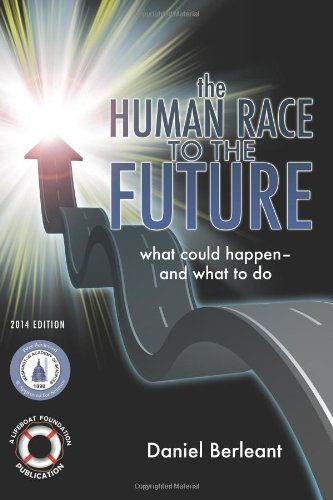
Book Review: The Human Race to the Future by Daniel Berleant (2013) (A Lifeboat Foundation publication)

From CLUBOF.INFO

The Human Race to the Future (2014 Edition) is the scientific Lifeboat Foundation think tank’s publication first made available in 2013, covering a number of dilemmas fundamental to the human future and of great interest to all readers. Daniel Berleant’s approach to popularizing science is more entertaining than a lot of other science writers, and this book contains many surprises and useful knowledge.

Some of the science covered in The Human Race to the Future, such as future ice ages and predictions of where natural evolution will take us next, is not immediately relevant in our lives and politics, but it is still presented to make fascinating reading. The rest of the science in the book is very linked to society’s immediate future, and deserves great consideration by commentators, activists and policymakers because it is only going to get more important as the world moves forward.

The book makes many warnings and calls for caution, but also makes an optimistic forecast about how society might look in the future. For example, It is “economically possible” to have a society where all the basics are free and all work is essentially optional (a way for people to turn their hobbies into a way of earning more possessions) (p. 6–7).

A transhumanist possibility of interest in The Human Race to the Future is the change in how people communicate, including closing the gap between thought and action to create instruments (maybe even mechanical bodies) that respond to thought alone. The world may be projected to move away from keyboards and touchscreens towards mind-reading interfaces (p. 13–18). This would be necessary for people suffering from physical disabilities, and for soldiers in the arms race to improve response times in lethal situations.

To critique the above point made in the book, it is likely that drone operators and power-armor wearers in future armies would be very keen to link their brains directly to their hardware, and the emerging mind-reading technology would make it possible. However, there is reason to doubt the possibility of effective teamwork while relying on such interfaces. Verbal or visual interfaces are actually more attuned to people as a social animal, letting us hear or see our colleagues’ thoughts and review their actions as they happen, which allows for better teamwork. A soldier, for example, may be happy with his own improved reaction times when controlling equipment directly with his brain, but his fellow soldiers and officers may only be irritated by the lack of an intermediate phase to see his intent and rescind his actions before he completes them. Some helicopter and vehicle accidents are averted only by one crewman seeing another’s error, and correcting him in time. If vehicles were controlled by mind-reading, these errors would increasingly start to become fatal.

Reading and research is also an area that could develop in a radical new direction unlike anything before in the history of communication. The Human Race to the Future speculates that beyond articles as they exist now (e.g. Wikipedia articles) there could be custom-generated articles specific to the user’s research goal or browsing. One’s own query could shape the layout and content of each article, as it is generated. This way, reams of irrelevant information will not need to be waded through to answer a very specific query (p. 19–24).

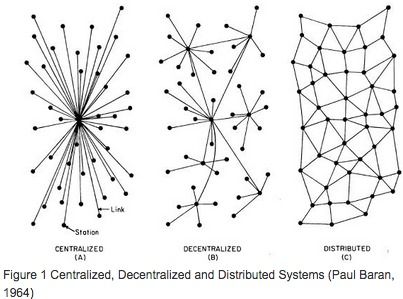
Greatly similar to the same view I have written works expressing, the book sees industrial civilization as being burdened above all by too much centralization, e.g. oil refineries. This endangers civilization, and threatens collapse if something should later go wrong (p. 32, 33). For example, an electromagnetic pulse (EMP) resulting from a solar storm could cause serious damage as a result of the centralization of electrical infrastructure. Digital sabotage could also threaten such infrastructure (p. 34, 35).

The solution to this problem is decentralization, as “where centralization creates vulnerability, decentralization alleviates it” (p. 37). Solar cells are one example of decentralized power production (p. 37–40), but there is also much promise in home fuel production using such things as ethanol and biogas (p. 40–42). Beyond fuel, there is also much benefit that could come from decentralized, highly localized food production, even “labor-free”, and “using robots” (p. 42–45). These possibilities deserve maximum attention for the sake of world welfare, considering the increasing UN concerns about getting adequate food and energy supplies to the growing global population. There should not need to be a food vs. fuel debate, as the only acceptable solution can be to engineer solutions to both problems. An additional option for increasing food production is artificial meat, which should aim to replace the reliance on livestock. Reliance on livestock has an “intrinsic wastefulness” that artificial meat does not have, so it makes sense for artificial meat to become the cheapest option in the long run (p. 62–65). Perhaps stranger and more profound is the option of genetically enhancing humans to make better use of food and other resources (p. 271–274).

On a related topic, sequencing our own genome may be able to have “major impacts, from medicine to self-knowledge” (p. 46–51). However, the book does not contain mention of synthetic biology and the potential impacts of J. Craig Venter’s work, as explained in such works as Life at the Speed of Light. This could certainly be something worth adding to the story, if future editions of the book aim to include some additional detail.

At least related to synthetic biology is the book’s discussion of genetic engineering of plants to produce healthier or more abundant food. Alternatively, plants could be genetically programmed to extract metal compounds from the soil (p. 213–215). However, we must be aware that this could similarly lead to threats, such as “superweeds that overrun the world” similar to the flora in John Wyndam’s Day of the Triffids (p. 197–219). Synthetic biology products could also accidentally expose civilization to microorganisms with unknown consequences, perhaps even as dangerous as alien contagions depicted in fiction. On the other hand, they could lead to potentially unlimited resources, with strange vats of bacteria capable of manufacturing oil from simple chemical feedstocks. Indeed, “genetic engineering could be used to create organic prairies that are useful to humans” (p. 265), literally redesigning and upgrading our own environment to give us more resources.

The book advocates that politics should focus on long-term thinking, e.g. to deal with global warming, and should involve “synergistic cooperation” rather than “narrow national self-interest” (p. 66–75). This is a very important point, and may coincide with the complex prediction that nation states in their present form are flawed and too slow-moving. Nation-states may be increasingly incapable of meeting the challenges of an interconnected world in which national narratives produce less and less legitimate security thinking and transnational identities become more important.

Close to issues of security, The Human Race to the Future considers nuclear proliferation, and sees that the reasons for nuclear proliferation need to be investigated in more depth for the sake of simply by reducing incentives. To avoid further research, due to thinking that it has already been sufficiently completed, is “downright dangerous” (p. 89–94). Such a call is certainly necessary at a time when there is still hostility against developing countries with nuclear programs, and this hostility is simply inflammatory and making the world more dangerous. To a large extent, nuclear proliferation is inevitable in a world where countries are permitted to bomb one another because of little more than suspicions and fears.

Another area covered in this book that is worth celebrating is the AI singularity, which is described here as meaning the point at which a computer is sophisticated enough to design a more powerful computer than itself. While it could mean unlimited engineering and innovation without the need for human imagination, there are also great risks. For example, a “corporbot” or “robosoldier,” determined to promote the interests of an organization or defeat enemies, respectively. These, as repeatedly warned through science fiction, could become runaway entities that no longer listen to human orders (p. 83–88, 122–127).

A more distant possibility explored in Berleant’s book is the colonization of other planets in the solar system (p. 97–121, 169–174). There is the well-taken point that technological pioneers should already be trying to settle remote and inhospitable locations on Earth, to perfect the technology and society of self-sustaining settlements (Antarctica?) (p.106). Disaster scenarios considered in the book that may necessitate us moving off-world in the long term include a hydrogen sulfide poisoning apocalypse (p. 142–146) and a giant asteroid impact (p. 231–236)

The Human Race to the Future is a realistic and practical guide to the dilemmas fundamental to the human future. Of particular interest to general readers, policymakers and activists should be the issues that concern the near future, such as genetic engineering aimed at conservation of resources and the achievement of abundance.

By Harry J. Bentham - More articles by Harry J. Bentham

Originally published on April 22 in h+ Magazine

Interested in this subject? Subscribe to receive free CLUBOF.INFO articles by Email
/* */