
Coolest stuff on the planet. Interesting posts/articles about Earth – nature, animals, geography, science, history and more.
Category: futurism – Page 656

World’s first cosmic-ray GPS can detect underground movement
A team of scientists have successfully demonstrated the world’s first cosmic-ray GPS to detect movement underground and in volcanoes which can potentially aid in future search-and-rescue missions.
Cosmic rays are high-energy particles originating from outer space, including sources such as the sun, distant galaxies, supernovae, and other celestial bodies. Although we can’t see or feel cosmic rays directly, they constantly bombard the Earth from outer space.
In fact, these particles are so abundant that scientists estimate one cosmic ray hits one square centimeter of the Earth’s surface every minute! Scientists study cosmic rays to learn about the universe and how particles interact at high energies.

Artificial intelligence is not yet as smart as a dog, Meta A.I. chief says
Current artificial intelligence systems like ChatGPT do not have human-level intelligence and are not even as smart as a dog, Meta’s AI chief Yann LeCunn said. LeCun talked about the limitations of generative AI, such as ChatGPT, and said they are not very intelligent because they are solely trained on language.
Meta’s LeCun said that, in the future, there will be machines that are more intelligent than humans, which should not be seen as a threat.
Current artificial intelligence systems like ChatGPT do not have human-level intelligence and are barely smarter than a dog, Meta’s AI chief said, as the debate over the dangers of the fast-growing technology rages on.
Meta’s AI chief said the company is working on training AI on video, rather than just on language, which is a tougher task.
In another example of current AI limitations, he said a five-month-old baby would look at an object floating and not think too much of it. However, a nine-month year old baby would look at this item and be surprised, as it realizes that an object shouldn’t float.
LeCun said we have “no idea how to reproduce this capacity with machines today. Until we can do this, we are not going to have human-level intelligence, we are not going to have dog level or cat level [intelligence].”

150-year-old mystery of strange half-circles from Paleolithic site in France finally solved
Hurling spear-thrower projectiles at archery targets revealed that these loops may have been finger grips.

Plants When Responding to Touch Send Different Signals Through Their Cells, Shows New Study
When prodded with a tiny glass rod, leaves released waves of calcium signals to cells that quickly diminish after the touch.

Review: A striking Danish art show at the Getty unpacks what it means to be a nation in turmoil
Denmark was in full chaotic collapse in the early 19th century. Why was its art so beautifully serene?
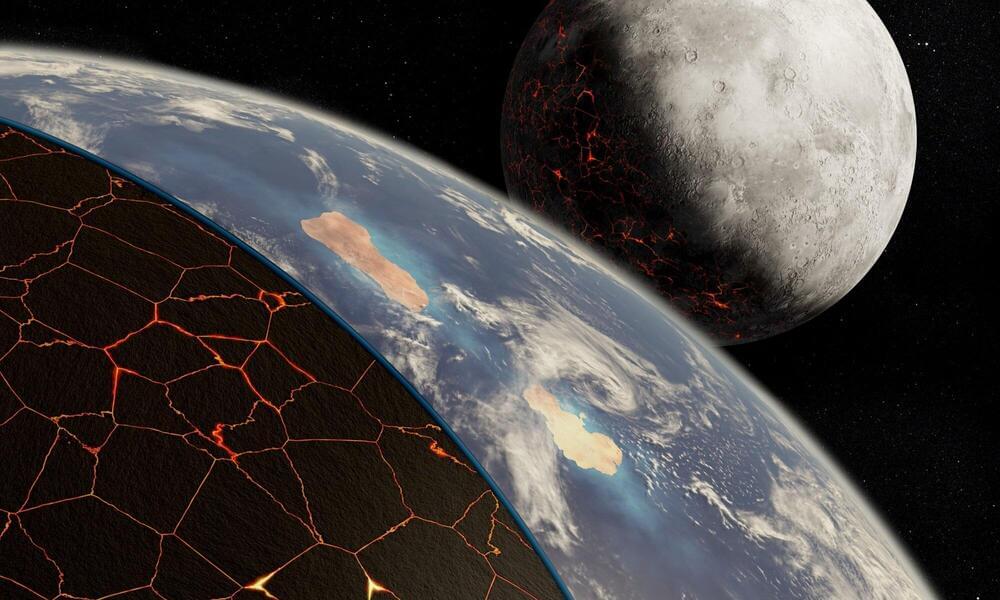
Plate tectonics not required for the emergence of life, argues study
Scientists have taken a journey back in time to unlock the mysteries of Earth’s early history, using tiny mineral crystals called zircons to study plate tectonics billions of years ago. The research sheds light on the conditions that existed in early Earth, revealing a complex interplay between Earth’s crust, core, and the emergence of life.
Plate tectonics allows heat from Earth’s interior to escape to the surface, forming continents and other geological features necessary for life to emerge. Accordingly, “there has been the assumption that plate tectonics is necessary for life,” says John Tarduno, who teaches in the Department of Earth and Environmental Sciences at the University of Rochester. But new research casts doubt on that assumption.
Tarduno, the William R. Kenan, Jr. Professor of Geophysics, is lead author of a paper published in Nature examining plate tectonics from a time 3.9 billion years ago, when scientists believe the first traces of life appeared on Earth.
ChatGPT Is Unoriginal—and Exactly What Humans Need
The technology can help cut through buzzwordy “solutions” and serve as a shortcut for jumpstarting creativity.

Shaping the future market for digital art
Buying art in cryptocurrency has seen record-breaking prices followed by a crash in recent years, but there are ways to remove the volatility to benefit both artists and buyers.
By Dr David Challis, University of Melbourne.