Hot Chips 31 is underway this week, with presentations from a number of companies. Intel has decided to use the highly technical conference to discuss a variety of products, including major sessions focused on the company’s AI division. AI and machine learning are viewed as critical areas for the future of computing, and while Intel has tackled these fields with features like DL Boost on Xeon, it’s also building dedicated accelerators for the market.
The NNP-I 1000 (Spring Hill) and the NNP-T (Spring Crest) are intended for two different markets, inference and training. “Training” is the work of creating and teaching a neural network how to process data in the first place. Inference refers to the task of actually running the now-trained neural network model. It requires far more computational horsepower to train a neural network than it does to apply the results of that training to real-world categorization or classification tasks.
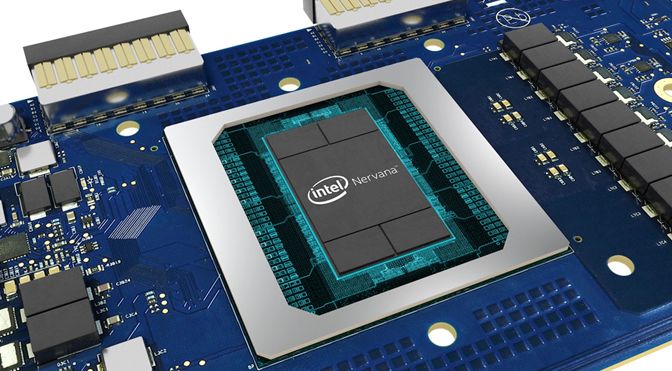
Intel’s Spring Crest NNP-T is designed to scale out to an unprecedented degree, with a balance between tensor processing capability, on-package HBM, networking capability, and on-die SRAMs to boost processing performance. The underlying chip is built by TSMC — yes, TSMC — on 16nm, with a 680mm die size and a 1200mm interposer. The entire assembly is 27 billion transistors with 4x8GB stacks of HBM2-2400 memory, 24 Tensor Processing Clusters (TPCs) with a core frequency of up to 1.1GHz. Sixty-four lanes of SerDes HSIO provides 3.58Tbps of aggregate bandwidth and the card supports an x16 PCIe 4.0 connection. Power consumption is expected to be between 150-250W. The chip was built using TSMC’s advanced CoWoS packaging (Chip-on-Wafer-on-Substrate), and carries 60MB of cache distributed across its various cores. CoWoS competes with Intel’s EMIB, but Intel has decided to build this hardware at TSMC rather than using its own foundries. Performance is estimated at up to 119 TOPS.