A new mineral found in volcano could revolutionize batteries.
A mineral made in a Kamchatka volcano may hold the answer to cheaper batteries, find scientists.


One of my favorite political commentators notes that lock downs “consigns people to death,” cause mass starvation throughout the world, and makes the poor and middle class far, far poorer…
TRANSCRIPT AND SOURCES: https://www.corbettreport.com/lockdowns/
If you are advocating for lockdowns, you are complicit in tearing families apart. You are complicit in inflicting untold suffering on millions of people around the world. You are complicit in casting the poorest and most vulnerable in our societies into even further grinding poverty. You are complicit in murder.
An outstanding reminder that we can support the corporate takeover of our society or else we can demand our freedoms, insist on truth in science and create a better future for ourselves and our children…
A short video about the morality of Lockdowns.
“Who Deserves Your Trust in the COVID Debate?”
An essay by Stacey Rudin is recited in this episode of the Very Opinionated Show.
FB: https://www.facebook.com/The-Very-Opinionated-Kate-Wand-Show-107564297838363/

So, stars are a lot more mobile than I expected. 😃 Hopefully, it doesn’t cause too much damage next time it happens, if humans are still here by then.
Every 50,000 years or so, a nomadic star passes near our solar system. Most brush by without incident. But, every once in a while, one comes so close that it gains a prominent place in Earth’s night sky, as well as knocks distant comets loose from their orbits.
The most famous of these stellar interlopers is called Scholz’s Star. This small binary star system was discovered in 2013. Its orbital path indicated that, about 70,000 years ago, it passed through the Oort Cloud, the extended sphere of icy bodies that surrounds the fringes of our solar system. Some astronomers even think Scholz’s Star could have sent some of these objects tumbling into the inner solar system when it passed.
However, Scholz’s Star is relatively small and rapidly moving, which should have minimized its effect on the solar system. But in recent years, scientists have been finding that these kinds of encounters happen far more often than once expected. Scholz’s Star wasn’t the first flyby, and it won’t be the last. In fact, we’re on track for a much more dramatic close encounter in the not-too-distant future.

In the years since astronomers discovered the first exoplanet—a planet that orbits a star outside the solar system—more than 4,000 have been observed. Usually, their presence is given away by the slight effects they have on their parent stars, which vastly outshine them. For a decade and half, scientists have been trying to image exoplanets directly, but the Earth’s atmosphere presents a major impediment when they attempt to leverage large ground-based telescopes.
Now, a team of U.S. and Japanese scientists and engineers that includes researchers at UC Santa Barbara have developed a new exoplanet-hunting camera. Deployed at the Subaru Telescope on Maunakea, Hawai’I, the device is the world’s largest superconducting camera by pixel count and will pave the way for direct imaging of extra-solar planets in the near future. An instrument paper appearing in Publications of the Astronomy Society of the Pacific announced the new device to the astronomical community.
Constructed by researchers in the lab of Professor Ben Mazin, the MKID Exoplanet Camera (MEC) uses Microwave Kinetic Inductance Detectors (MKIDs) to enable scientists to directly image exoplanets and disks around bright stars. The detector runs at a brisk 90 millikelvin—just a touch over absolute zero—and is the first permanently deployed superconducting camera that operates in the optical and near infrared spectrum.
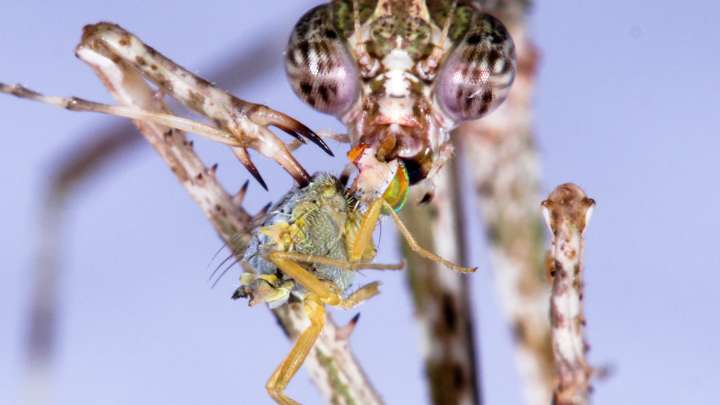
Praying mantises are well known for being skilled, formidable, and successful hunters. Now a new species discovered in Peru has added another intriguing weapon to their arsenal – impaling their prey on specially adapted barbs on their legs. According to researchers, this is a novel hunting strategy not seen before in mantids, or in fact any insect, and they hadn’t even been looking for it.
Dr Julio Rivera, an entomologist at Universidad San Ignacio de Loyola in Lima, first came across a male specimen of the mantis in 2000 when a colleague captured it in the Tingo María tropical rainforest region of Peru, and brought it to the lab. In the following years, more specimens turned up and were added to the collection at the University, and not long after Rivera returned to Peru in 2017, a local student donated three living juveniles – enough for Rivera to attempt a proper taxonomic description.
Physical features suggested the mantis was likely a new species, so the goal of rearing juveniles was to get them to maturity to study their genitals. “[E]ach species has a distinct genital shape, which helps to define the species,” Dr Rivera told IFLScience.
Watch a strange, sprouting mushroom reach out like an octopus … or the devil’s fingers.
➡ Subscribe: http://bit.ly/NatGeoSubscribe.
About National Geographic:
National Geographic is the world’s premium destination for science, exploration, and adventure. Through their world-class scientists, photographers, journalists, and filmmakers, Nat Geo gets you closer to the stories that matter and past the edge of what’s possible.
Get More National Geographic:
Official Site: http://bit.ly/NatGeoOfficialSite.
Facebook: http://bit.ly/FBNatGeo.
Twitter: http://bit.ly/NatGeoTwitter.
Instagram: http://bit.ly/NatGeoInsta.
Time-lapse video shows an octopus-like fungus bursting from its “egg.” Fittingly known as the octopus stinkhorn, or devils’s fingers, this mushroom spends much of its time underground. When it’s time to reproduce, it emerges and starts to ooze a spore-filled slime that attracts flies. The flies carry the spores away, helping the strange mushroom to spread far and wide.
Read about the creepiest plants and fungi known to science.
http://news.nationalgeographic.com/2017/07/creepy-plants-fun…s-science/
This sprouting, octopus-like fungus is the stuff of nightmares | national geographic.

Conventional water electrolysis for the production of hydrogen faces technological challenges to improve the efficiency of the water-splitting reaction for the sluggish oxygen evolution reaction (OER). Noble metal-based ruthenium oxide (RuO2) and iridium oxide (IrO2) are used to enhance the oxygen generation rate. However, these noble metal catalysts are very expensive and show poor stability under long-term operation.