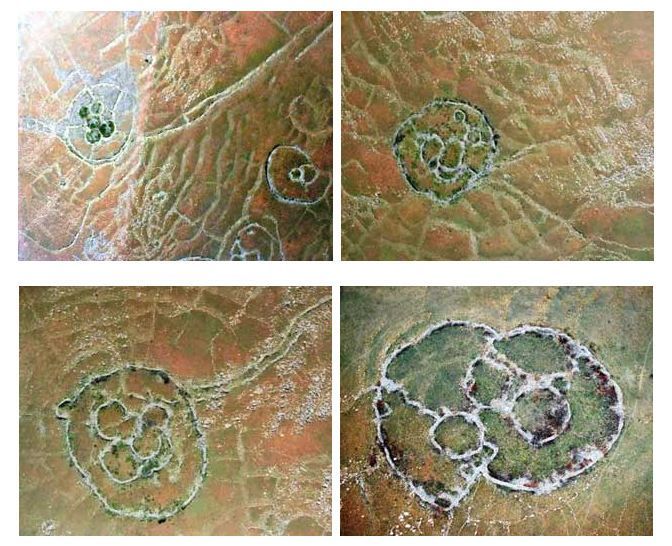
A giant stone city was discovered in South Africa, approximately 150 km west of port Maputo, Mozambique. By calculating the erosion rate of the dolerite, it became possible to assess the age of the site.

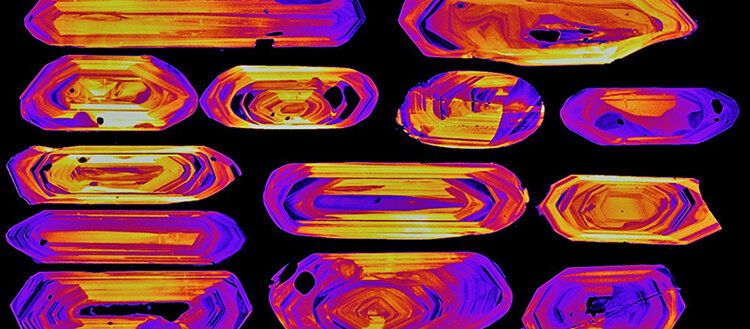
Most active volcanoes on Earth are dormant, meaning that they have not erupted for hundreds or even thousands of years, and are normally not considered hazardous by the local population. A team of volcanologists from the University of Geneva (UNIGE), working in collaboration with the University of Heidelberg in Germany, has devised a technique that can predict the devastating potential of volcanoes. The scientists used zircon, a tiny crystal contained in volcanic rocks, to estimate the volume of magma that could erupted if Nevado de Toluca volcano (Mexico) wakes up from its dormancy. Up to 350 km3 of magma —about four times the volume of water stored in Lake Geneva— are currently lying below Nevado de Toluca and an eruption could bring devastation. The new technique, applicable to most types of volcanoes across the globe, is described in the scientific journal Nature Communications.
The largest volcanic eruptions in the last 100 years were sourced from volcanoes that do not erupt frequently and therefore fly under the radar of scientists. Yet today, 800 million people around the world live close to volcanoes and are potentially at risk. A determining factor for the dangerousness of volcanoes is the volume of eruptible magma stored in their bellies, as this is related to the magnitude of future eruptions. Unfortunately, this magma is stored at inaccessible depths of 6 to 10 km and cannot be directly measured.


An early model Nissan Leaf has been given a new lease of life with a battery upgrade for a fraction of the price it would cost if done by Nissan.
The 2011 Nissan Leaf came with a 24kWh battery, and even when new had a very modest driving range of 117km based on the US EPA ratings.
But after nine years of use, this particular Nissan Leaf’s maximum range had degraded to around 100km, prompting owner Daniel Öster to undertake an upgrade using a 30kWh battery from a 2017 Nissan Leaf.

How do you *feel* about that?
Much of today’s discussion around the future of artificial intelligence is focused on the possibility of achieving artificial general intelligence. Essentially, an AI capable of tackling an array of random tasks and working out how to tackle a new task on its own, much like a human, is the ultimate goal. But the discussion around this kind of intelligence seems less about if and more about when at this stage in the game. With the advent of neural networks and deep learning, the sky is the actual limit, at least that will be true once other areas of technology overcome their remaining obstructions.
For deep learning to successfully support general intelligence, it’s going to need the ability to access and store much more information than any individual system currently does. It’s also going to need to process that information more quickly than current technology will allow. If these things can catch up with the advancements in neural networks and deep learning, we might end up with an intelligence capable of solving some major world problems. Of course, we will still need to spoon-feed it since it only has access to the digital world, for the most part.
If we desire an AGI that can consume its own information, there are a few more advancements in technology that only time can deliver. In addition to the increased volume of information and processing speed, before any AI will be much use as an automaton, it will need to possess fine motor skills. An AGI with control of its own faculty can move around the world and consume information through its various sensors. However, this is another case of just waiting. It’s also another form of when not if these technologies will catch up to the others. Google has successfully experimented with fine motor skills technology. Boston Dynamics has canine robots with stable motor skills that will only improve in the coming years. Who says our AGI automaton needs to stand erect?

Researchers from Spain have found a cleaner and cheaper way to extract hydrogen from water.
Could this help make hydrogen the preferred fuel source of the future? 😃 article from theregister.com.
It’s really dope. Yep it’s an energy-efficient process kicked off by gadolinium-doped cerium dioxide.
We’re all too familiar with the work-play balance we strive to juggle in the 21st century. It’s virtually impossible, right? We’re often faced with a long and busy commute to work, using dated public transport or busy highways, only to find ourselves sitting in a dull office all day long. Well Tencent is about to revolutionize the work-play life of 80,000 people in the city of Shenzhen, with a next-century approach!
Following Huawei’s campus-style city, Chinese technology company Tencent, the driving power behind instant messaging apps WeChat and QQ, has made promises to build an entire mini-city off the banks of the Pearl River in Shenzhen, where the company has its headquarters. Both are located in the Guangdong province of Southern China, near the metropolis of Hong Kong.
How Gaming Tech Giant Tencent is building its own futuristic city.

Video from Waste-Ed. So basically, when we wash our clothes we release microplastics into the environment. The plastics come from fibers in our clothes.
They’ve added a filter to the washing machine to collect these microplastics to prevent these from spreading.
Dirt isn’t the only thing getting washed down the drain when you do laundry! Before your clothes make it to the dryer, tiny microfibers break off in the wash and travel through wastewater to pollute our… More environment. That changes with this microplastics filter that stops pollution at the source! Just install it on the side of the washer and send it back for safe disposal after it’s full. It captures 90% of the fibers that contaminate our planet!