I believe Google is making a huge mistake in completely banning facial recognition systems for its Glass product. In my opinion, such a system could be used to help save thousands of lives. But then, we’re too damn caught up on absolute privacy that we’re willing to sacrifice actual, physical lives to ensure our privacy remains untainted. Such individualist dogma is deadly.
According to the Amber Alert webpage, “A child goes missing in the United States every 40 seconds,” and that “More than 700,000 children go missing annually.” That is an absolutely frightening statistic! Much more frightening than the prospect that some Glass user may know my name.
How far are we willing to go to ensure absolute privacy isn’t diminished whatsoever? When does the right of privacy begin interfering with the right of safety? Can the two come together in harmony, or are they destined to be in conflict until society finally reaches a decision over one or the other?
I understand the desire for privacy, but as I’ve argued in the past, as we as a society become more public and technologically open-source, the idea of privacy slowly fades away. That isn’t to say that some forms of privacy can’t be maintained. Surely we should have the right to say ‘yes’ or ‘no’ over whether or not our private data is to be shared publicly. That level of freedom and choice could easily maintain a sense of privacy to each individual.
But then, when it comes to missing children, or even missing adults, should we not then be willing to sacrifice a portion of our privacy to ensure the safety of those who’s gone missing? It doesn’t even have to be that large of a peek into each’s private lives — simply a facial recog. map, a name, and whether or not they’re reported missing, or even possibly wanted.
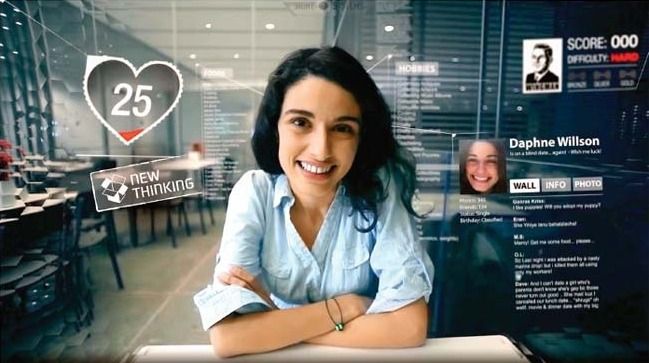
Picture this with me: It’s 2014 and only a few months have passed since the commercial launch of Google Glass. Hundreds of thousands of people already acquire their own device, scattered across the United States. A mandatory app was included with Glass, which was connected with Amber Alert systems. The app has Glass quietly scanning each face you cross paths with, but doesn’t reveal their names, nor does it alert you that it’s currently scanning. For all you know, it’s a normal day like any other.
Now, as you’re walking down a street, you walk past an adult male with a pre-teen female. You don’t even pay much attention to them. Just another group of people walking by, as far as you’re concerned. But then Glass, on the other hand, knows something you don’t — the little girl has been reported missing. As a result, without alerting you, the app then — albeit quietly — takes a snapshot of the girl and unknown male captor, contacts a 911 operator program, and delivers GPS coordinates of where the photo was taken and in which direction the girl was walking. The police show up, arrest the male captor, and contacts the parents of the missing child informing them that she’d been found and safe.
This was able to occur because each parent — or family member, guardian, etc. — had allowed the missing child’s name and facial recog. map to be archived in a Amber Alert system program, which connects via app on Glass. Was said child’s “privacy” diminished? Yes. But then she’s also alive because of it and a kidnapper is taken off the streets, not able to harm anyone else again.
Isn’t this very real prospect of technologically-enhanced safety worth sacrificing a bit of our own privacy? While I’m not a parent, if anyone of my family were to go missing, their privacy would be the last thing I’d be concerned about. And if I’d gone missing, I’d want everyone to do all they could to find me, even if it meant sacrificing my own privacy.
Google Glass is coming just next year. And with Google’s determination to ban facial recognition using Glass, we must ask ourselves: At what price?
To further underpin this statement, I will share Peter Drucker’s quote, “…The greatest danger in times of turbulence is not the turbulence; it is to act with yesterday’s logic…” And also that of Dr. Stephen Covey, “…Again, yesterday holds tomorrow hostage .… Memory is past. It is finite. Vision is future. It is infinite. Vision is greater than history…” And that of Sir Francis Bacon, “… He that will not apply new remedies must expect new evils, for time is the greatest innovator …”
And that of London Business School Professor Gary Hamel, PhD., “…You cannot get to a new place with an old map…” And that of Alvin Toffler, “…The future always comes too fast and in the wrong order…”
“…What distinguishes our age from every other is not the world-flattening impact of communications, not the economic ascendance of China and India, not the degradation of our climate, and not the resurgence of ancient religious animosities. Rather, it is a frantically accelerating pace of change…”
Beyond the managerial challenges (downside risks) presented by the exponential technologies as it is understood in the Technological Singularity and its inherent futuristic forces impacting the present and the future now, there are also some grave global risks that many forms of management have to tackle with immediately.
These grave global risks have nothing to do with advanced science or technology. Many of these hazards stem from nature and some are, as well, man made.
For instance, these grave global risks ─ embodying the Disruptional Singularity ─ are geological, climatological, political, geopolitical, demographic, social, economic, financial, legal and environmental, among others. The Disruptional Singularity’s major risks are gravely threatening us right now, not later.
The Future of Scientific Management, Today! (Excerpt)
Andres Agostini was asked this question:
Mr. David Shaw’s question, “…Andres, from your work on the future which management skills need to be developed? Classically the management role is about planning, organizing, leading and controlling. With the changes coming in the future what’s your view on how this management mix needs to change and adapt?…”Question was posited on an Internet Forum, formulated by Mr. David Shaw (Peterborough, United Kingdom) on October 09, 2013.
This is an excerpt from, “…The Future of Scientific Management, Today…” that discusses state-of-the-art management theories and practices. To read the entire piece, just click the link at the end of article.
CONCLUSION
In addition to being aware and adaptable and resilient before the driving forces reshaping the current presentand the as-of-now future, THERE ARE SOME EXTRA MANAGEMENT SUGGESTIONS THAT I CONCURRENTLY PRACTICE:
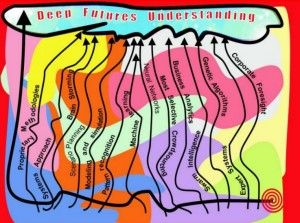
1.- Given the vast amount of insidious risks, futures, challenges, principles, processes, contents, practices, tools, techniques, benefits and opportunities, there needs to be a full-bodied practical and applicable methodology (methodologies are utilized and implemented to solve complex problems and to facilitate the decision-making and anticipatory process).
The manager must always address issues with a Panoramic View and must also exercise the envisioning of both the Whole and the Granularity of Details, along with the embedded (corresponding) interrelationships and dynamics (that is, [i] interrelationships and dynamics of the subtle, [ii] interrelationships and dynamics of the overtand [iii] interrelationships and dynamics of the covert).
Both dynamic complexityand detail complexity, along with fuzzy logic, must be pervasively considered, as well.
To this end, it is wisely argued, “…You can’t understand the knot without understanding the strands, but in the future, the strands need not remain tied up in the same way as they are today…”
For instance, disparate skills, talents, dexterities and expertise won’t suffice ever. A cohesive and congruent, yet proven methodology (see the one above) must be optimally implemented.
Subsequently, the Chinese proverb indicates, “…Don’t look at the waves but the currents underneath…”
2.- One must always be futurewise and technologically fluent. Don’t fight these extreme forces, just use them! One must use counter-intuitiveness (geometrically non-linearly so), insight, hindsight, foresight and far-sight in every day of the present and future (all of this in the most staggeringly exponential mode).To shed some light, I will share two quotes.
The Panchatantra(body of Eastern philosophical knowledge) establishes, “…Knowledge is the true organ of sight, not the eyes.…”And Antonio Machado argues, “… An eye is not an eye because you see it; an eye is an eye because it sees you …”
Managers always need a clear, knowledgeable vision. Did you already connect the dots stemming from the Panchatantra and Machado? Did you already integrate those dots into your big-picture vista?
As side effect, British Prime Minister W. E. Gladstone considered, “…You cannot fight against the future…”
3.- In all the Manager does, he / she must observe and apply, at all times, a sine qua nonmaxim, “…everything is related to everything else…”
4.- Always manage as if it were a “project.” Use, at all times, the “…Project Management…” approach.
5.- Always use the systems methodology with the applied omniscience perspective.
In this case, David, I mean to assert: The term “Science” equates to about a 90% of “…Exact Sciences…” and to about 10% of “…Social Sciences…” All science must be instituted with the engineering view.
6.- Always institute beyond-insurance risk management as you boldly integrate it with your futuring skill / expertise.
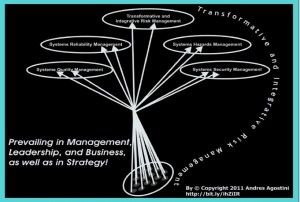
7.- In my firmest opinion, the following must be complied this way (verbatim): the corporate strategic planning and execution (performing) are a function of a grander application of beyond-insurance risk management.It will never work well the other way around. TAIRM is the optimal mode to do advanced strategic planning and execution (performing).
TAIRM (Transformative and Integrative Risk Management) is not only focused on terminating, mitigating and modulating risks (expenses of treasure and losses of life), but also concentrated on bringing under control fiscally-sound, sustainable organizations and initiatives.
TAIRM underpins sensible business prosperity and sustainable growth and progress.
8.- I also believe that we must pragmatically apply the scientific method in all we manage to the best of our capacities.
If we are “…MANAGERS…” in a Knowledge Economy and Knowledge Era (not a knowledge-driven eon because of superficial and hollow caprices of the follies and simpletons), we must do therefore extensive and intensive learning and un-learning for Life if we want to succeed and be sustainable.
As a consequence, Dr. Noel M. Tichy, PhD. argues, “…Today, intellectual assets trump physical assets in nearly every industry…”
Consequently, Alvin Toffler indicates, “…In the world of the future, THE NEW ILLITERATE WILL BE THE PERSON WHO HAS NOT LEARNED TO LEARN…”
We don’t need to be scientists to learn some basic principles of advanced science.
Accordingly, Dr. Carl Sagan, PhD. expressed, “…We live in a society exquisitely dependent on science and technology, in which hardly anyone knows about science and technology…” And Edward Teller stated, “…The science of today is the technology of tomorrow …”
And it is also crucial this quotation by Winston Churchill, “…If we are to bring the broad masses of the people in every land to the table of abundance, IT CAN ONLY BE BY THE TIRELESS IMPROVEMENT OF ALL OF OUR MEANS OF TECHNICAL PRODUCTION…”
9.- In any management undertaking, and given the universal volatility and rampant and uninterrupted rate of change, one must think and operate in a fluid womb-to-tomb mode.
The manager must think and operate holistically (both systematically and systemically) at all times.
The manager must also be: i) Multidimensional, ii) Interdisciplinary, iii) Multifaceted, iv) Cross-functional, and v) Multitasking.
That is, the manager must now be an expert state-of-the-art generalist and erudite. ERGO, THIS IS THE NEWEST SPECIALIST AND SPECIALIZATION.
Managers must nevermanage elements, components or subsystems separately or disparately (that is, they mustn’t ever manage in series).
Managers must always manage all of the entire system at the time (that is, managing in parallel or simultaneously the totality of the whole at once).
10.- In any profession, beginning with management, one must always and cleverly upgrade his / her learning and education until the last exhale.
An African proverb argues, “…Tomorrow belongs to the people who prepare for it…” And Winston Churchill established, “…The empires of the future are the empires of the mind…” And an ancient Chinese Proverb: “…It is not our feet that move us along — it is our minds…”
And Malcolm X observed, “…The future belongs to those who prepare for it today…” And Leonard I. Sweet considered, “…The future is not something we enter. The future is something we create…”
And finally, James Thomson argued, “…Great trials seem to be a necessary preparation for great duties …”
As the Western media and governments continue poking fun and demonizing a very misunderstood country, there are a group of people who are taking it upon themselves in ignoring the propaganda and instead reaching out with compassion and understanding. These people are visiting and working in North Korea. They’re not North Koreans, but the love and connection they’ve gained with the North Korean people is real and deserve to have their stories told.
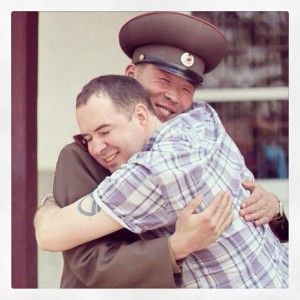
DMZ Northern Commander and former American commander, Michael Bassett, hug during the April 2013 Period of Brinksmanship. (Photo credit Joseph Ferris)
I’ve interviewed a few people of importance in gaining greater insight into the country, its people, its military, and its government. It is my goal in providing an open venue for them to speak out and hopefully gain enough attention for others to follow suit.
Here I’ve interviewed Michael Bassett and Felix Abt. Mr. Bassett is a decorated Army Veteran who holds a BA in International Communication from the American University in Washington DC, a graduate certificate in North Korean Affairs from Yonsei University’s Graduate School of International Studies in Seoul, South Korea, and is currently working on his MA in Public Diplomacy from the American University.
He’s served several tours on the DMZ Western Corridor, and has worked in South Korea for unification NGOs. He has been to North Korea several times since 2004 and is a widely published Asian Affairs analyst, a North Korean Affairs specialist, and is known for practicing public diplomacy by facilitating cultural diplomacy projects in the DPRK.
Mr. Abt is a Swiss entrepreneur and expert on doing business in North Korea. He’s the author of A Capitalist in North Korea: My Seven Years in the Hermit Kingdom. From 2002 to 2009, he worked as one of the few Western businessmen in North Korea. He was co-founder and first president of the European Business Association in Pyongyang, a de facto European Chamber of Commerce and the first foreign chamber of commerce. He also co-founded the Pyongyang Business School, imparting market skills in the next generation of leaders.
Previously, Abt worked all over Europe, Africa and Asia as a senior executive for multinationals such as F. Hoffmann-La Roche and the global engineering giant, ABB Group. In 2002, ABB appointed him first as resident country director in North Korea. He went on to become a point man for Western investments in the country, representing several multinational corporations and even founding a business of his own. He is a shareholder in several North Korean joint ventures, and a member of the boards of directors of SMEs of several countries.
Let’s get this out of the way first. Could you tell me your name and what your professional relation is with North Korea and its inhabitants, alongside how many years you’ve been doing so?
Felix Abt: I’m Felix Abt. I have lived and worked for seven years in North Korea and have been doing business with it for the last 11 years. In my e-book book A Capitalist in North Korea, which will also be published as a paperback soon, I’m telling my story. Currently I’m a shareholder in joint venture companies in the DPRK and I’m involved in trade and new projects.
Michael Bassett: I’m Mike Bassett, thanks for having me, BJ. For nearly seven years I’ve been studying North Korea in college through various academic lenses. Because all I knew about North Korea was acquired in my years on the DMZ in the US Army; I realized that I probably didn’t understand North Korea in its proper context. So as an undergrad I began by applying sociological theories to my understanding of them. Namely I began trying to decipher rhetoric from reality, by trying to understand human perceptions based on The Social Construction of Reality Theory. I also started studying US foreign policy around this time. From there my thinking progressed and shifted towards “constructivism,” which is a theoretical approach to understanding international relations; particularly individual state actors and their behavior. From there, I applied my “prism of understanding” to practicing Pyongyangology after I received a graduate certificate in North Korean Affairs. Pyongyangology is a Cold War-era methodology of understanding countries with whom we have little communication with, and who are generally considered to be our enemies.
Pyongyangologists basically look at an actor’s behavior on histograms and uses small bits of information as “indicators” from something such as a photograph, or sentence, in State propaganda or policy, and then compares it to trends and patters over time. Pyongyangology helps analysts to understand who they are based on their behavior. It’s not a complicated science to master, especially if you constantly pay attention to their trends and patterns over a long period of time. There are many Pyongyangologists — whom I call “The Oracles”. When the unprovoked bombing of Yeonpyeong Island happened, I thought it had nothing to do with anything else other than North Korea trying to convince their population of Kim Jung Un’s military “leadership capabilities.” Kim Jung Un was, at the time, a young Four-star General in charge of an Artillery Corps. Kim Jung Il had a stroke and elections appeared inevitable as Kim Jung Il’s health took a rapid decline. They needed “a leader whom they believed could protect their country” (I argue that Kim Jung Un was chosen and groomed for succession since he was a boy). Unprovoked attacks are unacceptable behavior, but I don’t think they meant for anyone to get killed. It’s important to be able to understand that in science, objectivity separates the fact from the fiction. In this case it helped me prove that North Koreans were rational actors and Kim Jung Un was preparing to take power. Pyongyangology isn’t an exact science, so I had to take it another step because it can be inaccurate sometimes and doesn’t really have an impact on anything.
I developed a pedagogical understanding of North Korean behavior and international perceptions/misperceptions of their historical development and worldview (through their eyes). I see them clearly enough to know that there are more effective ways of approaching the conundrum on the peninsula. Within academia and scholarship, “constructivism” and “smart-power” are on the cutting edge of contemporary international relations, and we have only slowly begun understanding and defining them. Training in public diplomacy is the most recent tool that I’ve acquired to my toolkit. I’m about one semester short of earning an Executive Master’s degree focused on Public Diplomacy. My pedagogical understanding and my toolbox have inspired me to facilitate cultural diplomacy projects in North Korea. I now try to take anyone who wants to go, and set up anything I can for them, to create the “space at the end of the bridge for handshakes and hugs.” As cliché as it sounds, my extensive education and experience has mainly taught me the importance of “handshakes and hugs.”
There are other non-State actors who do similar things there and we’re a small crowd that knows of each other. North Korea entered my radar when I was young because my grandfather told me about the orphan he took care of during the Korean War. I have their picture together in my office. My first “interaction” with North Koreans was on the DMZ, where I was stationed for several years and alerted to Imjin River standoffs on a regular basis. My relationship and views of North Koreans has obviously evolved over the years that I’ve made perpetual and relentless, often uncomfortable attempts at trying to understand and interact with them. Living in South Korea for seven years total, and having a half-South Korean daughter has also given me a unique vantage point in the situation. I put politics aside and get together with North Koreans and focus on the things we have in common. That’s essential to understanding their nature in its entirety. I often get a lot of criticism for going to North Korea and doing this. I do it because these are things that bond people together and allow people to grow together and build trust and understanding. If you really want know about anybody, you have to go break bread with them. These endeavors are risky for me – there, and here at home; as well as costly on a financial and personal level. You could call me an activist scholar. I’m only following my heart and being inspired by examples from prestigious role models. I’m doing what I believe in and what I’ve trained to. Nothing more.
Given your extensive visitation and studying of the northern region of Korea, how would you best describe the North Korean people – a collective goal perhaps; their thoughts on their leaders, past media bias on both sides; how they portray foreigners, especially Western ones?
Abt: North Koreans are better informed about the outside world than the outside world about North Korea. Since the U.S. have rejected many times the DPRK’s request to sign a peace treaty and to normalize the relations with the DPRK this country and its people feel stuck in a state of war and under threat to an extent perceived paranoid by Westerners. Westerners and other foreigners are therefore often considered as potential spies and trouble makers.
In a society as strongly Confucian as North Korea, people show respect to the leaders and expect that they take care of their needs, which is often misunderstood by Westerners living in, at least formally, more egalitarian societies.
Bassett: North Korea’s main goal is survival of the Kim regime, the State, and its people – in that order. In this sense, I call them a Machiavellian society. Everyone in North Korea understands the goal of survival and that their leaders sometimes have to make tough choices to protect the security of their state sovereignty. “Survival” is a central part of their collective psyche, like warriors who develop similar instincts in combat. They suffer a collective trauma from war, isolation, and starvation, rolling natural disasters, and perpetual cycles of proxy war “demonization” by the outside world. North Koreans, understandably, have trust issues and are paranoid, but when you can get past those issues with them, you begin to feel how genuine and sincere at heart they really are. They’re a very traditional society and they take great pride in their ability to maintain their traditional purity. When you realize the tremendous efforts they’ve endured to survive against all odds, you can’t help but be touched by their struggle.
North Koreans are people just like anybody else, but they are also products of their historical environment and also of an external environment that doesn’t understand them. Any country on the planet that experienced the same historical circumstances as they did would end up in the same state as them, in my opinion. All the good, all the bad, would be no different. They are misunderstood. They don’t want anything to do with violence, but like a porcupine, they show their “needles” when they feel threatened. Their bellicosity is a deterrence mechanism as well as a mechanism of survival. In reality, they rarely act outwardly aggressive without provocation. Learning to understand North Koreans is not much different to me than learning how to understand an abused child who has grown up with some emotional issues. They are very smart, very rational, and a little “emotionally sensitive.” But once you build some trust with them, they open up to you and become “friends for life” as Rodman said. They’re like the outcast on the playground that behaved badly because they got bullied a lot because nobody understood why they were an outcast in the first place. I’m like the guy at school who invites that kid to sit down for lunch and shoot some hoops afterwards because I want to help them fit in. I want to help them get better and live a normal life again someday. Maybe that’s why Rodman really is the perfect man for the job. He understands them without scholastic rigor because he is like them in many ways.
Their leadership is quite rational and genuinely cares about their people. I used to criticize them for having it considerably better than the lower classes of the population, but I realized that every country has elite classes who hold power and live lavishly while others live oppressed and in deprivation; so I couldn’t carry on with that criticism and still call myself objective. Ethnocentrism is a root of subjectivity and is a factor that contributes to our misunderstanding of a lot of things beyond our borders. North Korea is the ultimate mirror-state, meaning that we in the “Western world” do everything that we criticize them of doing, but we only hold up their reflection. We can compare anything they do to something that we have done at one point or are currently doing. I can’t demonize them and still call myself objective, and nobody else can either without being hypocritical on a direct or indirect level.
Kim Jung Un is a game changer, in my opinion. I’m sure you’ve read my publication on that. In my experience, westerners are starting to be portrayed differently in North Korea than in the past. Their propaganda art that was created decades ago still exists and portrays Westerners as scary-looking evildoers, but these days their state-run newspaper, Rodong Shinmun, is starting to portray westerners with more humanity, while still demonizing our governments when they’re angry with them. They focus on the positive things of our culture, like Disney and sports. It’s not uncommon to see some Disney backpacks on kids or Disney movies on TV; or to see something about sports diplomacy in their Rodong Shinmun’s.
How would you describe the socio-economic conditions of North Korea as a whole? And what would you propose for foreign countries and their governments in handling and treating North Korea to ensure socio-economic stability?
Abt: North Korea is a developing country which has allocated a very significant portion of its GNP to defense for the reasons mentioned before. A comprehensive security agreement as proposed by Nautilus and others is necessary to reduce tensions and to free resources for economic development. Such an agreement would also support the reform process which would allow more small and medium-sized enterprises to emerge, run by private entrepreneurs which would create numerous jobs and give a substantial boost to the economy as it did in China and Vietnam.
Bassett: Simply put, to me, North Korea is still largely maintaining an agricultural revolution, while barely maintaining an industrial revolution, and trying to skip ahead to the technological revolution. They’ve placed great emphasis on science, business, and education and are constantly finding ways to produce and develop, despite all obstacles. Even during total sanctions their GDP increased by about 1.6%. I went to an International Trade Fair in Pyongyang this Spring and they had everything for sale from ionizer watches to smoking cessation products, to dozens of styles of in-country-produced motorcycles, cars, trucks, and heavy machinery. While in the Rason Special Economic Zone I went to the Triangle Bank, exchanged Chinese Rinminbi for North Korean won, and did some shopping in the Free Market. It was basically a North Korean style Wal-Mart. They had basically anything you could find at a regular Wal-Mart. North Koreans have different classes of people. Their socio-economic class is dependent on loyalty to the regime. Those who have familial connections are trusted more to run restaurants, factories, farms, shops, malls, etc, because the economy can easily lead to the downfall of the regime. They maintain a capitalist type of economy while simultaneously being a Machiavellian socialist “monarchy” because they’ve mastered the art of rent-seeking. The government puts loyalists in charge of business and fills the ranks of the entrepreneurial class with their relatives and part of it goes back to the regime who overseas operations. Because of this delicate balance of survival, sovereignty, and development; the division of classes in a country structured so complexly, became a “necessary evil” that they live with to maintain their existence.
Many North Koreans, contrary to popular belief, are quite satisfied living a traditional and simple life, though their “basic needs” are developing. They want more stuff. Kim Jung Un is trying to appease his people and he’s walking a tightrope between providing security, and enduring sanctions. Thus, their conditions are still very harsh much of the year. People still die from simple injuries or preventable situations, though not as frequently as in the past. Freedom of the press is low, although writing and creative writing are very respectable professions because Reading is one of the most popular activities in North Korea and thus quality writers are in high demand. Every writer still follows some “regime guidelines” but they still have a lot of contextual freedom. North Koreans go without some basic necessities like hot water, electricity, some medicinal care. 5 percent of the population in North Korea is malnourished compared to 17% in the rest of Asia. (http://bit.ly/19nD3aZ ‚ http://bit.ly/16Itrxm) Their justice system is improving, but still sentences people to life imprisonment, hard labor, kin crime persecution, and execution. Any country who does this is violating basic human rights of a citizen, criminal or not.
Still, these are human rights issues because anything related to quality of life can be seen as a human rights problem, and their human rights issues are partially a byproduct of failed policy and political sanctions designed to influence the regime’s behavior – or more bluntly; sanctions are designed to cause State collapse. I’ve never really believed in “regime changing” because it never ends well. Anytime we have collapsed a State, the people have become worse-off and the regions end up in a state of chaos and deprivation for decades. For this reason, it’s my opinion that sanctions, (and State collapsing) violates the United Nation’s Universal Declaration of Human Rights and thus, sanctions should be lifted so States can trade and interact with North Korea more freely if they choose to. North Korea would develop at the pace South Korea did over the past thirty years if the State had the same opportunities and support South Koreans have. People will retort by saying that the South never had nukes or violated human rights, which is why we supported them and not the North. In reality, it was a power-balancing proxy-war. Also ignored are the facts that the USA once pressured South Korea to develop nukes while ignoring their dictatorial human rights abuses.
In many developing countries we’re witnessing technological advancement, from a growing usage of cell phones and laptops, adding in millions of more people into the online collective hemisphere of intellectual exchange. Where do North Korea and its people stand on this? Are they, too, advancing technologically and, if so, in which technological sectors?
Abt: This, too, very much depends on how secure the country feels. As long as any opening is perceived as creating a window of opportunity to those who want regime change and overthrow the DPRK, free access to internet by the general public will be considered as highly risky and undesirable. By allowing mobile telecommunication countrywide, the country has contributed to the development of distant rural regions.
Bassett: North Korea is embarking on a technological revolution. It’s hard for me to say specifically when this shift began, but Kim Jung Il had a state-of-the-art 27” Apple iMac in the train that he died in. He used this for running the regime more efficiently. The leadership used to be the only ones with stuff like this, but now technology is pretty common in schools, businesses, factories, libraries, museums, and cultural centers. I dare say 85% of the families in the country have access to cell phones, computers, TV’s, and DVD players. The intranet on their phones and computers can access North Korean media including news, music, and some video. They can text and I believe they can even transmit intra-mail messages. Nearly all sectors are using new technology in some form. North Koreans get a lot of use out of the satellite that they’re so proud of. Schools are benefitting greatly because now they have broad access to information they can use to strengthen their educational programs, producing smarter students who will grow be more informed leaders in their sectors. Interagency coordination is occurring and they’re becoming more efficient at dealing with crisis, and responding faster to it. Solar panels mitigate power shortages, and advanced irrigation methods are helping their crops survive draughts. I can’t comment with expertise on their light-water reactor but their “official story” is that “because of oil embargoes, they’ve had to shut down two oil refineries, which has resulted in a major portion of the population having to endure without electricity for almost eight years.” This reactor is an answer to that problem, and maybe their “security issues” as well.
I vehemently oppose nuclear weapons or human rights abuses, no matter what State they occur in. We should remember that due to human error, in 1961, a nuclear bomb 261 times the strength of the ones we dropped on Japan, almost detonated in North Carolina. We should remember that America has only 5% of the world’s population, while maintaining 25% of the worlds incarcerated population. In the American prison system, rape is considered “prison justice”, joining gangs and honing criminal skills becomes a means of survival. Statistically, most people are just there because they grew up in a lower class and had few opportunities to get education when growing up, and resorted to criminal activities to survive. We execute people within these systems, but what’s worse, is that some prisoners get locked in solitary confinement for decades, and have been later found to have severe brain disorders such as dementia at the age of thirty. One prisoner did four decades in solitary confinement and was found to be innocent of the crime in the first place and released! The American justice system is atrocious on so many levels. We cannot condemn any State for these two issues when we, here in America, are the world’s largest offender. Even if we just break it down to a per-capita comparative chart we still have a higher percentage of these cases than other countries. Sorry for getting sidetracked, but these things are all related and attention to these “mirrors” should be reflected on.
Speaking of technology, it’s becoming a growing fear among citizenry of developed regions of the world of a technological unemployment – robotic automation taking over human labor. We’re even witnessing signs of it in developing countries like China, i.e. Foxconn’s replacing 1 million workers for automated machinery. Are there any signs of this occurring in North Korea, and, if so, in which regions/provinces?
Abt: North Korea also sets on “high-tech” where it can, but this requires a significant amount of investment capital which it lacks. Therefore, manual labor will not quickly be replaced by machines. On the contrary, manual labor may even be cheaper and more suitable, at least in a number of areas, so that even Chinese companies outsource processes to North Korean producers.
Bassett: From what I can tell, a small portion of the population is in the industrial sector — my guestimation is several million. Most are in the agricultural sector or military. The military does more nation building than anything else, and the farmers do the nation feeding. There are machines that could replace manual labor by humans, but as far as I can tell, they’ve mostly been incorporated in the mines. Machines may make soldiers and farmers lives easier, but I doubt machines will ever put people out of work in North Korea. There’s always something to be doing there that only people can do.
How would you best describe the joint relationship between the common North Korean people, the country’s military, and its government?
Bassett: North Korean leadership travels around to every sector of their country all year long. That’s what their main role is. It’s one way of “showing the people they care”, as one North Korean put it to me. The military is seen as providing their security, but also builds their roads and houses and fixes damage to their “property” when it occurs. Because of this close interaction, both the military and the leadership are probably genuinely beloved by a majority of their people on some level. On the other hand, there is an element of fear of dissent, not strictly because of the judicial system but also because of the potential vulnerability of their State sovereignty. This is another example of why I refer to North Korea as the only true Machiavellian state to have ever existed. I wonder if Machiavelli were still alive right now, how interested he would be in North Korea and if he would refer to Kim Jung Un as a good, bad, or rational/irrational type of “Prince.” I think others would disagree with my assessment. I know what most of the books out there say, but from what I’ve seen, those assessments are often a bit fictionalized and exaggerated. Even some books about defectors, which are about the only kind of books about North Korea out there, are often fictionalized in some regards. There is no way to totally understand the truth about a defector and their story. But we do know that they are hopeless, damaged, and will do anything to survive. I wonder how many authors have whispered “we can’t make money like that” to them…
What are the North Korean peoples’ thoughts on reunification and what do they feel is the best means of achieving it? The military’s viewpoint of the same question? The government’s?
Bassett: I think everybody in the country wants unification, but not until they achieve mutual recognition, which is based on mutual trust and respect. Trust and respect are very difficult things to attain when there is little communication, and even less understanding, between the North and the South. There are those of narrow mind on each side who are against unification for personal reasons. In North Korea the hardliners seem to favor corrosive engagement to prolong the division. In South Korea the media is particularly slatternly. They value their mammonism – (worship of money – manna from god) more than anything else and believe that reconciling with North Korea will ruin their comfortable quality of life. They’ve programmed their kids in their education systems and through propaganda to be apathetic or anti-North Korean, just like they accuse the North of “brainwashing” their kids. It is more illegal to have North Korean items in South Korea than it is to have South Korean items in North Korea. In North Korea you will pay a fine if you’re caught, in South Korea you will go to jail. South Koreans are apathetic to the funding and schematics that are in place to facilitate a seamless transition during unification. They don’t care because the situation has gone on so long that the generations that this affected are dying off. Despite this, I believe North and South Korea will, in the next five years, attain a peace treaty, which is the first step toward unification. Before peaceful unification starts they’d probably become a confederate republic for about fifteen years until there is enough cultural exchange and economic development to cause a seamless transition and return to a united republic like the Koryo Dynasty.
Given your position in relation with that of North Korea and its people, would you argue that your actions are somehow contributing in the psychological and sociological bonding and understanding between North Korean people and foreigners, and in doing so will it help better pave the way for reunification?
Bassett: Most diplomacy professionals will quote the United States Information Agency moniker“the most important interactions take place at the last three feet of the bridge, where handshakes and hugs are given.” I try to facilitate a lot more than handshakes and hugs over there. I’m not trying to “erode North Koreans’ sovereignty or purity”; I’m trying to get everyone on all sides of the conundrum to stop demonizing each other and develop a peaceful coexistence. I’m “always up to some type of antics while I’m in DC”, as one reporter observed. I have, with assistance of local leaders, worked together to organize a small movement in DC, and we are planning to have a large-scale bike-ride through the district, with as many people as we can get. We want to promote de-demonization of the country and its people and advocate for immediate lifting of all sanctions and an end to Strategic Patience policy. We don’t have to sanction them and topple their regime; but at the minimum we can leave them alone and not obviate their survival. Regime-toppling tactics have infrequently resulted in positive change for anything, anywhere, for anyone, except for in WWII, which was a very unique situation in human history. The United States has been basking in the embellishment and glory of WWII for seventy years now; to the extent that this self-glorification has led us to believe that regime toppling is the solution to everything. We have a hero-complex, which misguides our rationality and prevents us from understanding and humanizing conflicts. Conflicts are all unique and don’t have a one-size-fits-all solutions. Sometimes we have to be the “bigger man” — the gentleman if you will, instead of the tough guy on the block. We haven’t learned to grasp that concept yet. Like ancient Greece, we have an innate desire to satisfy cultural bloodlust. Our government, media, and society will hopefully redirect its trajectory down a more peaceful path. Many things that we fear are threats are only threats because of the actions we take based on that fear. We’ve been programmed to fear everything and question nothing.
Armchair generals will try to convince people that we have to “stand up for morality, stability, and security”, or “maintain certain balances of power to maintain international order.” That’s all bullshit. Life gets better when people get along peacefully. Working together, people can achieve so much more than when there is conflict. Conflict is a natural occurrence but dealing with it smartly is not natural to us. There are no cookie cutter solutions. The costs of “soft power” are substantially cheaper and exponentially more effective than “hard power. I err on the side of “soft power.” Conflicts aren’t Game Theory, profit margins, or eugenics. These are human beings that have a right to exist. Failing to understand them is not an excuse for sanctioning them even if we choose not to engage them. I’ve seen the impact of cultural exchanges. When I give a North Korean school kid or waitress a polaroid pic of me and them doing something fun together like riding a roller coaster or singing karaoke, they hang on to it and show it to me when I come back. They keep videos of me in their phones and show it to me when I come back. They treasure those moments. They share them with their friends. They tell me about how they get together with their friends and family and “laugh at silly Michael.” I’d argue that cultural exchanges are the only thing maintaining stability there and are the only way to achieving peace and unification. I do my part in trying to help the world understand them, and I make happen whatever I can whether I’m in DC, Seoul, or Pyongyang. If that results in their unification then I’ll know my efforts weren’t all “pipe dreams that went up in smoke.” We will never know until it’s tried.
Economic sanctions are a very popular tactic in addressing certain countries’ governments who may not be playing by the rules established by others. North Korea, especially, suffers from economic sanctions due to the government’s wish to remain a nuclear state for deterrence purposes, and this upsets people like those in the U.S. government. Would you say that economic sanctions are a successful means of addressing hostility or, simply put, differences in opinion? If so, how? If not, how are economic sanctions truly affecting the country and subsequently its people?
Abt: Sanctions have an important impact on the economy. Let’s look for example at North Korea’s huge gold deposits which it cannot extract because the sodium cyanide necessary for it is a banned so-called dual-use product. (That is it cannot only be used for civilian purposes like gold extraction, pesticides and plastics production, but also to make the nerve gas sarin).
To name one more example: Switzerland and other countries banned the sale of ski lifts. How could North Korea develop a flourishing tourism industry, which became equally mountainous Switzerland’s most important source of income, if it is prevented from purchasing the necessary equipment? And how many alternatives does North Korea have with, like Switzerland, only about 17% arable land?
Among the numerous prohibited dual-use products, there are for example chemicals required for the processing of food items and of pharmaceuticals, as they can also be used in chemical weapons. Without these banned products the quality and safety of these consumer goods are compromised to the extent that the foreign-imposed sanctions cost lives of ordinary North Koreans.
Other “punitive” measures, such as the financial sanctions cutting North Korean banks off the international banking system, push legitimate businesses “underground” and force them for example to use unconventional payment methods such as cash couriers. Doing business with North Korea has therefore become difficult, more costly and dissuades many foreign enterprises from dealing with this country.
Bassett: I used to believe that sanctions were effective and justified tools to use against North Korea to influence their state behavior. But I’ve seen with my own eyes how blatantly stupid I was. What sanctions do, is give North Koreans less incentive to cooperate, more desire to behave badly, more justification of their governments propaganda, and significantly erode the quality of life of average citizens, while barely impacting those who we want to impact. Even when we do impact those targets, it only results in a minor impact on them and major ripple effects for everyone else. The best way to influence North Korean behavior is to lift all sanctions and give them de facto nuclear recognition. If we did those two things then the regime would change their behavior instantly; and if they didn’t, then we would be able to justify returning to such harsh policies against them. We can’t make policies based on fear. It will not be the end of the world if we take a leap of faith and then they stab us in the back. We could simply return to controlling their fate again. We are, after all, exponentially larger and more powerful than them. We have to be willing to try things that have never been tried before because the benefit of doing so is higher than the cost of miscalculation. In reality, they cannot do all those things we fear them of wanting to do. Those things the media uses to keep us living in fear of them. Those things the military industrial complex published by the researchers on their huge payroll. It’s all bullshit. In reality, they will probably do none of those things and if they do then we can easily deal with it. We are more likely than not, to see a stability and peace bloom in Asia unlike any other, if we were to take a “leap-of-faith” with them. This does not imply that their activities won’t be monitored. If sanctions were lifted everything would have to be monitored, accounted for, and inspected. It would be easy for them to succumb to temptation from illicit activities.
Could you give us examples that you’ve personally witnessed which contradicts many common viewpoints by foreigners and/or foreign media about North Korea – its people, culture, government, power structure, etc.?
A Capitalist in North Korea: My Seven Years in the Hermit Kingdom by Felix Abt
Bassett: I watched a Mandela documentary before I went to North Korea during the ‘2013 Period of Bellicosity’. I remember when one soccer player tripped another, causing him to fall in pain. Memories of Apartheid South Africa and all the emotions that come along with it erupted within him. When they player helped the other one up and hugged him those feelings were washed away and it had a butterfly effect. I tried to recreate that situation by challenging a member of North Korea’s National Taekwondo team to a one-on-one match. Prior to the match I flexed my bicep at him, which had my US Army Staff Sergeant Rank tattooed on it. He knocked me out, as expected, in a half second, with a swift kick to the face. Next thing I knew, he was helping me up, hugging me, and peeling his foot skin off of my face for me. I expected them to be cheering and handing out medals for “destroying a Yankee imperialist,” but they responded with sympathy and care to my injuries. In another unforgettable moment, as I was mountain climbing in the extreme Northeast part of the country, we followed the trails of an anti-Japanese Revolutionary War battle, and I brought up the United States nuclear bombing of Japan. All morning we’d been hearing about how bad the Japanese were during decades of occupation, but they kept avoiding saying that it ended because America dropped nuclear bombs on them. This made me curious because Japan is perceived as the root cause of all their problems. So I brought it up and was stopped in my tracks and told very sternly that “IT WASN’T GOOD BECAUSE INNOCENT PEOPLE GOT HURT.” I said “yes, but it stopped your innocent people from getting hurt.” They said, “it doesn’t matter, we don’t believe in hurting innocent people.” I’ll never know if this was the “official story” or their genuine belief, but I’m inclined to err with the latter because I could see the sincerity in his eyes. North Korea truly is a country traumatized by their past.
Would you say that the North Korean government is willing to openly do business with foreign peoples and their companies? How about NGOs and nonprofit think-tanks for research purposes and better education of the country as a whole?
Abt: North Korea has been open for business for many years. The American think-tank Nautilus has been working with the DPRK for many years, too.
Bassett: North Korea is not only willing, but they are capable. They have been doing business with the external world for quite some time. They currently have a system in place, which allows for them to businesses, although I’m not sure how openly they’re willing to be about it. They desire longevity, independence, and sustainability in whoever they consider doing business with. Trust issues and mutual respect are important facets of that consideration. As far as capability, they have a central bank and the Triangle banks. They have Laws and structures in place to support foreign investment, joint ventures, contractual joint ventures, wholly foreign owned enterprises, foreign invested banks, businesses and enterprises and law offices supporting those structures. These are mainly for the Rason, Kaesong, Hwanggumphyong and Wihwado Economic Zones, but are applicable anywhere in the country. They have establishments in place for external economic contracts, arbitration, civil relations and civil law, compensation for damage, notary publics, inheritance, immigration, commercial banks, and even a claim to have a system in place to prevent money laundering (Laws and Regulations of the Democratic People’s Republic of Korea Governing External Economic Matters, p. 417 2012). They have laws regarding insurance requirements, land leasing, trade and trade processing, a Chamber of Commerce, product origin tracking, inspections, invention, trademark, and copyright protection, which even apply to hardware and software technology. They are very serious about environmental impact, probably because they value their clean environment and because of the effect land mismanagement had on the regime in the 90’s. As stated in the cited DPRK Economic Law book, the laws are “enacted for the purpose of encouraging foreign investment in the DPRK and protecting the legitimate rights and interests of the investors” – p.9.
And finally, what would you propose for foreigners – peoples, companies, governments, etc. – to do in order to better establish a peaceful relationship with that of North Korea? Is the U.S. government’s aggressive approach successful or are better alternatives possible?
Bassett: Educate yourselves and unplug! Expose yourselves to information that doesn’t totally demonize the regime. Listen to what North Korea has to say. They have a small degree of transparency. Their Rodong Shinmun is online and the same in basic content (though slightly edited) as the North Korean version that you can buy there. NK News is run by expert foreign academics and practitioners in conjunction with defectors, and is packed full of useful information. Read something by Andrei Lankov, Felix Abt, B.R. Myers, or even me; though I’m not insinuating that I’m on their level of expertise. Listen to the practitioner’s point of view. Follow them on social media; many of us are on everything from Facebook to Instagram. Take what the government and the media say with a grain of salt. There are two types of actors in this situation. Those who know what’s going on and selflessly try to make matters better, and then there is the government and the media; who have special interests in maintaining the status quo, at least for as long as they feel that’s what the public wants them to do.
Nobody here can deny that there is perspectives emerging from highly educated and accomplished practitioners and experts alike that run in stark contrast to what the media and the government would have us believe. As I have said in many other publications, a lot of our misperception of North Korea is based on the information they get from human rights groups. I am against human rights violations, and I’ve claimed that the US has them on a larger scale. What if every country in the world looked at the United States of America and saw nothing more about it beyond what goes on within its disgusting prisons? That’s what the human rights organizations would lead us to believe and those organizations are largely behind presenting America with that perception. There is so much more to the country than the .08% of their population that is behind bars. It certainly isn’t one giant prison state. North Korean isolation and underdevelopment has more to do with their external problems, historical development, and worldview than it does the leaderships supposed “hateful dictatorial oppression” of their people. It’s just like everything that we do and see here in the West is a byproduct of the same factors. In the end we need to realize that “people are people” and we don’t have the right to hold anyone down just because we don’t like them or understand them.
Containing more than 160 essays from over 40 contributors, this edited volume of essays on the science, philosophy and politics of longevity considers the project of ending aging and abolishing involuntary death-by-disease from a variety of viewpoints: scientific, technological, philosophical, pragmatic, artistic. In it you will find not only information on the ways in which science and medicine are bringing about the potential to reverse aging and defeat death within many of our own lifetimes, as well as the ways that you can increase your own longevity today in order to be there for tomorrow’s promise, but also a glimpse at the art, philosophy and politics of longevity as well – areas that will become increasingly important as we realize that advocacy, lobbying and activism can play as large a part in the hastening of progress in indefinite lifespans as science and technology can.
The collection is edited by Franco Cortese. Its contributing authors include William H. Andrews, Ph.D., Rachel Armstrong, Ph.D., Jonathan Betchtel, Yaniv Chen, Clyde DeSouza, Freija van Diujne, Ph.D., John Ellis, Ph.D., Linda Gamble, Roen Horn, the International Longevity Alliance (ILA), Zoltan Istvan, David Kekich (President & C.E.O of Maximum Life Foundation), Randal A. Koene, Ph.D., Maria Konovalenko, M.Sc. (Program Coordinator for the Science for Life Extension Foundation), Marios Kyriazis, MD, M.Sc MIBiol, CBiol (Founder of the ELPIs Foundation for Indefinite Lifespans and the medical advisor for the British Longevity Society), John R. Leonard (Director of Japan Longevity Alliance), Alex Lightman, Movement for Indefinite Life Extension (MILE), Josh Mitteldorf, Ph.D., Tom Mooney (Executive Director of the Coalition to Extend Life), Max More, Ph.D. , B.J. Murphy, Joern Pallensen, Dick Pelletier, Hank Pellissier (Founder of Brighter Brains Institute), Giulio Prisco, Marc Ransford, Jameson Rohrer, Martine Rothblatt, Ph.D., MBA, JD., Peter Rothman (editor-in-chief of H+ Magazine), Giovanni Santostasi, Ph.D (Director of Immortal Life Magazine, Eric Schulke, Jason Silva , R.U. Sirius, Ilia Stambler, Ph.D (activist at the International Longevity Alliance), G. Stolyarov II (editor-in-chief of The Rational Argumentator), Winslow Strong, Jason Sussberg, Violetta Karkucinska, David Westmorland, Peter Wicks, Ph.D, and Jason Xu (director of Longevity Party China and Longevity Party Taiwan).
Effective leaders must first learn the skill of leading themselves in order to cultivate their competencies for leading others.
Have you let your eyes wander across the management section in a bookstore or an airport newsstand recently? Chances are that your attention has been drawn to the colourful variety of easily digestible how-to-become-a-better-manager books.
In North America, books with exotic titles, such as “One Minute Manager”, “Moses CEO” and “Make It So: Management Lessons from Star Trek the Next Generation”, bring in an astronomical revenue of USD 2.4 billion every year. Most of the “voodoo” management books emphasize that you must change yourself if you want a richer and fuller life – both socially and financially.
Make no mistake
It would be easy to write off the author of books, such as “Managing Your Self” by Dr. Jagdish Parikh, as being in the same category. But, make no mistake. Dr. Parikh a professor, businessman and an author himself, has a profound knowledge of management gathered from business environments all over the world. He even found the time to co-produce the Oscar-winning movie, “Ghandi”.
“Hundreds of books and models purport to suggest the best way to become a leader. Yet many people, asked to name a leader they would consider a role model, struggle to identify even one or two individuals,” Dr. Parikh points out.
According to him, the gap between what we learn about leadership and what we actually implement exposes a fundamental flaw in most of the leadership models today. These models focus mainly on competencies required for leading an organization, but do not explain how to cultivate those core competencies. Therefore we face, in a sense, a crisis of leadership.
Conflicting values
One of Dr. Jagdish Parikh’s favorite stories is about his first day as an MBA student at Harvard Business School. Born in India, he was brought up with the belief that he had to do his utmost, whatever tasks, objectives or goals he set for himself. But, as far as the results concerned, he learned to accept them with equanimity, for such results depended on a variety of external factors and variables, over which no one could have full control. At Harvard it was a different story. During the welcoming address the dean made it clear that the MBA program was designed to ensure that there would always be more work to be done every day than the time and energy at one’s disposal.
“We were told not to feel satisfied or content with whatever we achieved, because in the moment we did so, our progress would stop along with our drive for achieving more,” says Dr. Parikh.
The message that came across to Dr. Parikh was that stress is beautiful. And if he were to progress in life, he would continue to remain dissatisfied. Going from A to B meant that C should be the next focal point, without spending time being happy about reaching B.
Cultivating consciousness
Having finished his MBA, Jagdish Parikh went back to Bombay and became successful as a businessman practicing the tenets from Harvard. However, he began to suffer negative physiological and psychological symptoms of stress after just a few years.
“I seriously began to wonder if there was another way to be successful while also remaining satisfied and happy at the same time. After deep reflection and a PhD, I discovered that the missing link between success and happiness was a lack of awareness of one’s inner dynamics,” says Dr. Parikh.
Therein lies the philosophy of Dr. Jagdish Parikh. He believes that one of the major challenges that face leaders today is to cultivate their own consciousness in a hectic business environment that doesn’t leave much time for reflection and self-discovery. However, competencies for leading others take time to grow and flourish.
“Unless one knows how to lead one’s self, it would be presumptuous for anyone to be able to lead others effectively. And, if you don’t lead your self, someone else will. The essence of leadership is to effectively manage relationships with people, events, and ideas. You can’t lead something you yourself identify with. The paradox is that detachment not withdrawal, escape, or indifference coupled with involvement not addiction – in other words, detached involvement – enables mastery. Leadership then happens to you,” Dr. Parikh underlines.
Eastern wisdom meets western science
From earlier orientations towards profit and power, up to a more recent focus on people, we are now seeing business leaders that seek alignment with global and ecological concerns. According to Dr. Parikh, this means that there is a growing interest in creating an organizational culture based on support systems, networks and shared values, rather than on power, money and personal ambition – an interest in changing outlooks through deeper insights.
“The role of management is to create within the organization a climate, a culture, and a context in which corporate enrichment and individual fulfillment collaborate and resonate progressively in the development of a creative and integrative global community,” says Dr. Parikh.
According to Dr. Parikh, leaders should have a clear stand on the fundamental issues that are facing us today, i.e. balancing “how to make a living” with “how to live” – sort of building a bridge between Western management and Eastern philosophical traditions.
“As individuals we may pursue money, power and prestige – the symbols of success – in order to be happy. But despite getting more of these we do not feel proportionately happier. After all, we’re described as human beings not human havings or even human doings. Essentially we are going up the ladder but we also have to ensure that the ladder is against the right wall. This is where a combination of Western science and Eastern wisdom would ensure a more holistic approach to leadership – and life,” says Dr. Jagdish Parikh.
Originally posted as Part III of a four-part introductory series on Bitcoin on May 21, 2013 in the American Daily Herald. See the Bitcoin blog for all four articles.
With gold prices back in the $1,300-$1,400/oz range it is sometimes difficult explaining to non-gold bugs why owning physical gold is still a good long term strategy. Some define buying gold as ‘an investment’, and others as ‘a hedge against inflation’. I tend to look at it as an insurance policy against hyper-inflation or just simply as sound honest money. However, when describing a strategy of accumulating money (in gold form) in some far-away vault, only to be used in some end-of-the-world scenario, it goes without saying that an image of a miserly old man replaces my likeness in the eyes of my conversation partner. Few people stuff dollar bills in their mattress any more, but hoarding of gold and silver when these were de-facto money was not unusual. Commodity money, which tends to increase in purchasing power over time, is predisposed to this ‘problem’. When you ‘love money’ so much that you hold on to too much of it or for too long a time, then you are hoarding.
Can ‘hoarding’ be defined?
Robert LeFevre once joked that while he was courting his soon-to-be-wife, he was impressed when she told him how much she loved money. Yet after they were married, it turned out that she really didn’t love money. In fact, she would try to find any excuse to get rid of it… in her shopping sprees, of course! Apparently money is no different than other goods and services; you trade one for the other. You trade the lesser valued good for the more valued good. When you make a purchase, you make a choice. You value your money less than the good you are buying. Similarly, when you refrain from purchasing an item, the indication is that your money is of more value than the foregone good. This is the basic premise in anticipation of a transaction, that both sides benefit – otherwise the transaction would not take place.
Hoarding money, be it paper, an electronic account balance, gold or bitcoins is therefore just the same as buying an excessive amount of books, stockpiling on your favorite pasta sauce jars when they’re on sale or refraining from throwing out your old National Geographic magazines. You never know when you might need them. You just prefer what you are hoarding to the alternatives out there. A larger stash of money means you prefer saving the money you have now for a later monetary exchange. That monetary exchange can be a purchase, paying your employee’s wages or giving your granddaughter a gift. But the amount someone saves/hoards is a reflection of their preferences and their understanding of reality with its inevitable uncertainties (and uncertainty is in no short supply these days). The negative term ‘hoarding’ is used, as Rothbard noted, when you are keeping more cash than someone else thinks is appropriate for you to keep. How very objective.
In actual fact, if a significant amount of money is hoarded and ‘taken away’ from circulation, the result is that there is an increased demand for money, which, in a world absent of price and wage controls, results in falling prices. Said differently, the purchasing power of money increases, meaning one would be able to buy the same amount with fewer money units. No evil has been perpetrated.
The dreaded ‘deflation’
The general decline of prices is described by mainstream economists as deflation. According to the Austrian School, on the other hand, deflation is merely the reduction of the money supply. Whether through significant hoarding, widespread bankruptcies or Federal Reserve actions, a drop in the money supply would cause a drop in prices, all else being equal. The distinction is that falling prices are the effect, not the cause. The effect could have other (often positive) causes, such as increases in productivity – the reason for falling prices in the high-tech world, for instance. In a market unhampered by political forces, as long as the quantity of goods rises relative to the quantity of money, prices will fall and the value of money will rise.
A common misconception is that reduction in prices equates to reduced profits and a general decline in the economy. ‘Revenues are not profits’ is one of the first things young accountants learn. Profits are a product both of revenue and of expenses, the money coming in and the money going out. With an increased purchasing power of money, input costs fall as well. Profits can and are made in a deflationary environment. The dreaded ‘deflationary spiral’ is a situation where a drop in prices leads to reduced demand, leading to more drops in prices as well as layoffs, which further hampers demand, and so the situation exacerbates itself. This scenario may occur when the general environment is an inflationary one, where people generally expect prices to rise as a normal, natural phenomenon. Then, through a deflationary cause, symptomatic of an ailing economy (e.g. widespread bankruptcies, rather than increased productivity), prices temporarily start to drop. Most people will see this as a temporary drop and will therefore postpone purchases. However this scenario cannot be an ongoing condition – eventually people need to start buying. In contrast, where the environment is deflationary (e.g. the high-tech industry), the assumption is not that ‘prices must rise’ and that ‘the drop is temporary’. How long has anyone really put off buying a computer, knowing that if they wait just one more month, they’ll get a better one? Eventually, you live with the fact that prices fall. And should prices drop due to positive causes, such as increased productivity, falling prices would actually engender demand. Increases in demand will ensure the firms’ profitability and the workers’ employability.
Deflation is not as bad as you think…
As we have seen, if the general economic environment is one of falling prices and the increase in money’s purchasing power, people would not continuously put off making purchases. Profits will be readily made as goods will cost less and practically create their own demand. But this is not all. Holding on to your money is like having a savings account or owning bonds. Saving for a nest egg in a deflationary environment does not require a high risk approach. Merely setting aside a part of one’s paycheck each month will yield more than social security ever could.
A further impact is that as people save more, interest rates fall. This drop in interest rates is a scenario that central banks across the globe are trying to replicate by ever more money printing. However, a naturally occurring low interest rate does not harm the holders of money much like the coercive version we see before us. Though deflation is thought to be bad for borrowers, debt would actually be cheap and readily available. If profits are made, debt will also be more easily repaid. True, a bad deflation (one which results from bankruptcies and economic woes) is generally bad for borrowers, since the real value of their debt rises and they have no additional profits and cash-flow to enable its repayment.
During inflation, on the other hand, money loses value. There is no doubt that the opposite scenario of constant inflation would be good for borrowers, regardless of the state of the economy. Is it any surprise that a government indebted to the tune of $16.7 trillion would prefer inflation to deflation? Where money is not a commodity, but is 90% debt (due to banks’ 10% reserve requirement), is there any surprise that anyone in the economics profession but the very fringe would tout inflation over deflation?
…but they still make you think it’s bad
The case for inflation and against hoarding or deflation is normally made more through an appeal to emotive factors than to the intellect. ‘Unspent dollars means reduced sales, drops in profit and massive layoffs. If firms go bankrupt, the raw material, capital goods and factories vanish into thin air’. You wouldn’t want that, would you? We already showed that increased saving on a massive scale and a reduction in the money base relative to the goods on the market, in and of itself, would only affect the purchasing power of the money and would not affect sales or profits. Companies may or may not go bankrupt – it all depends on whether their products satisfy the customers, not on quantity of money ‘in circulation’. Assets of those companies that do go bankrupt will only be bought up by another group of people who will try to utilize them better by building a better or cheaper product. Those parts of the economy that people do not value will get a signal that their value is dropping. These signals are important for the efficient functioning of the economy and for the satisfaction of the population at large. Where this signal is manipulated through injection of money into the economy or unnatural interest rate manipulations, a boom occurs, naturally and inevitably followed by the bust.
Going back to their arguments, that money must therefore be spent, is quite the visceral argument since everyone is an employee and everyone’s livelihood depends on other people spending money on them. It appeals to the desire for people to get something for nothing, or at least to earn money for as little work as possible. But in a free market, where people are not forced to buy a good they do not value, the customer is always right. You do your utmost to ensure you appeal to potential or repeat customers. An entrepreneur and all of her employees must strive for others’ satisfaction in order to make a profit – and many do so, successfully. There are no shortcuts in the lives of truly free market participants; you cannot force someone to fork over their money against their will (the case, of course, being different for government agencies funded through taxation). Yet the lazy slob in us all desires just this and the tool to achieve this is inflation. Through a constant devaluation of money’s purchasing power, people trade their money for real goods and services as fast as they can, thus ensuring dollars are not left unspent. Inflation causes fear-driven spending. ‘Spend now before it’s too late and your money becomes worthless’. A mild form of inflation would have the monetary base rise at the same level as ‘economic growth’, thereby keeping the purchasing power relatively stable, but the practical difficulties and the moral dubiousness of robbing one of their money’s value is still present.
An appeal to the intellect and common sense
Money, as a transmitter of value through space and time, must be ‘hoard-able’. It has to be durable so that one can hold on to it without its value dwindling. Holding on to depreciating money is like storing your candles all lit – not the best long-term solution. As I tell my non-gold bug friends, holding on to money in the form of gold is a good long-term strategy. It cannot be printed at will, its production is subject to free market forces of profit and loss, and its purchasing power increases over time. Who would not want money that increases in value? If you are uncertain of the future, the market or the economy, hoard away. One must put aside the red herrings incorporated into the inflationists’ arguments which lead to conclusions that: deflation is evil, saving is bad, debt is good, spending is necessary, etc. Savers, who forego current pleasures and build up future capital, are the backbone of a strong economy. As Doug Casey said, “You don’t become wealthy by spending and consuming, you become wealthy by producing and saving”. As my parents repeated to me time and again, “You cannot spend what you do not have”. And as common sense dictates, “You cannot borrow what someone else hasn’t saved”. Sound money is worth its weight in gold. Resist the arguments put forward on behalf of entities that are massively indebted – there is no evil in hoarding.
News this past week on Fukushima has not been exactly reassuring has it. Meanwhile the pro-Nuclear lobby keep counting bananas. Here I’ve gathered together some of the recent news articles on the unfolding crisis. Interested to hear some comments on this one.