Industrial Technology Research Institute (ITRI) is located at Central Taiwan Innovation and Research Park in Nantou, Taiwan. It is expected to become the central facility of the Science Park to be built in this region. Noiz Architects and Bio Architecture Formosana won the competition to design the building in 2010. During the development phase, the project site had to be relocated once during the design development phase, and the construction finally completed in September 2014.
DNV GL, the world’s largest resource of independent energy experts and certification, together with its partners, Group NIRE and Geli (Growing Energy Labs, Inc.), will produce and operate an Internet of Energy (IoEn) platform integrating the management of up to 100 distributed energy resources (DER).
The award, DNV GL’s third from ARPA-E, is one of twelve new projects in the Department of Energy’s Network Optimized Distributed Energy Systems (NODES) program announced in December.
Whenever the military sets up operations in isolated and hostile locations like Iraq or Afghanistan, one of the biggest challenges is ensuring troops get reliable power.
Until now, that often has meant trucking in vast amounts of diesel to power generators, a strategy that isn’t all that environmentally friendly and is vulnerable to attack or other problems like a driver strike or mechanical breakdown.
But what if military bases could produce their own power?
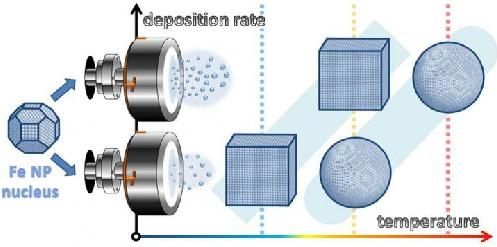
The efficiency of many applications deriving from natural sciences depends dramatically on a finite-size property of nanoparticles, so-called surface-to-volume ratio. The larger the surface of nanoparticles for the same volume is achieved, the more efficiently nanoparticles can interact with the surrounding substance. However, thermodynamic equilibrium forces nanostructures to minimize open surface driven by energy minimization principle. This basic principle predicts that the only shape of nanoparticles can be spherical or close-to-spherical ones.
Nature, however, does not always follow the simple principles. An intensive collaboration between University of Helsinki, Finland, and Okinawa Institute of Science and Technology, Japan, showed that in some condition iron nanoparticles can grow in cubic shape. The scientists also succeeded in disclosing the mechanisms behind this.
“Now we have a recipe how to synthesize cubic shapes with high surface-to-volume ratio which opens the door for practical applications”, says Dr. Flyura Djurabekova from the University of Helsinki.
Oak Ridge National Laboratory (ORNL) has been working on a wireless charging system for EVs and plug-in hybrids for years. The goal is to create a system that makes charging EVs and hybrids easier for drivers and to make EVs and other plug-in vehicles as cheap and easy to own as a gasoline vehicle. ORNL has announced that it has demonstrated a 20-kilowatt wireless charging system that has achieved 90% efficiency at three times the rate of the plug-in systems commonly used in electric cars today.
ORNL has multiple industry partners that are participating in this program including Toyota, Cisco Systems, Evatran, and Clemson University International Center for Automotive Research. “We have made tremendous progress from the lab proof-of-concept experiments a few years ago,” said Madhu Chinthavali, ORNL Power Electronics Team lead. “We have set a path forward that started with solid engineering, design, scale-up and integration into several Toyota vehicles. We now have a technology that is moving closer to being ready for the market.”
The wireless charging system includes ORNL-built inverter, isolation transformer, vehicle-side electronics and coupling technologies, and it was built in under three years. The demonstrator system is integrated into a Toyota RAV4 with a 10kW battery. The next goal for the researchers is to create a 50kW wireless charging system that can match the power of commercially available quick plug-in chargers. These higher power-charging systems are essential for charging larger electrified vehicles like buses and trucks.
It’s not often you come across a real-life mad scientist. They’re usually just over-the-top antagonists in comic books, but Colin Furze is the real thing. He has a penchant for building things that often blow up—on purpose—like this impossibly dangerous-looking thermite cannon.
Not familiar with thermite? It’s an especially nasty chemical composition made of metal power and oxide that burns as hot as 2,500 degrees celsius. If it ignites, you don’t want to be anywhere near it, which is why a cannon that puts a lot of distance between you and a flaming thermite grenade isn’t the world’s worst idea.
Scientists at the University of Lund in Sweden have found a way to use “biological motors” for parallel computing. The findings could mean vastly more powerful and energy efficient computers in a decade’s time.
Nanotechnologists at Lund University in Sweden have discovered a way to miniaturize the processing power that is found today only in the largest and most unwieldy of supercomputers. Their findings, which were published in the Proceedings of the National Academy of Sciences, point the way to a future when our laptops and other personal, handheld computing devices pack the computational heft of a Cray Titan or IBM Blue Gene/Q.
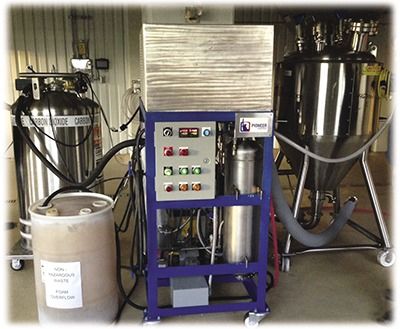
Building on work he and his companies did with Johnson Space Center’s In Situ Resource Utilization (ISRU) team, Robert Zubrin has developed and commercialized technologies that could prove revolutionary in their Earth applications, such as a system that could extract millions of barrels of oil from defunct oil wells around the world and another that can harness all the natural gas currently burned off as waste at many oil drilling rigs (Spinoff 2015).
But when he’s not working to change this world or colonize others, the president of Pioneer Astronautics, Pioneer Energy, and the Mars Society enjoys a good microbrew. Now, he’s applied some of that same technology to cut costs for craft breweries that produce anywhere between 3,000 and 300,000 barrels per year.
This is an invention that might possibly modify the civilization as we know it: A compact fusion reactor presented by Skunk Works, the stealth experimental technology section of Lockheed Martin. It’s about the size of a jet engine and it can power airplanes, most likely spaceships, and cities. Skunk Works state that it will be operational in 10 years.
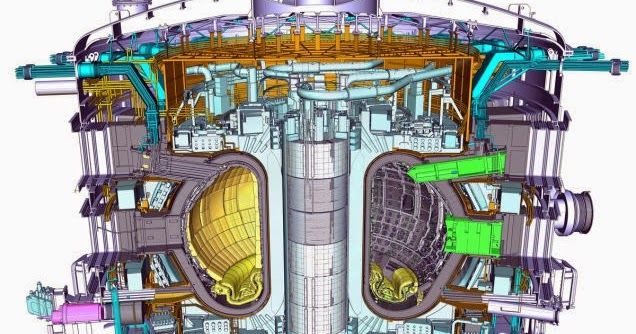
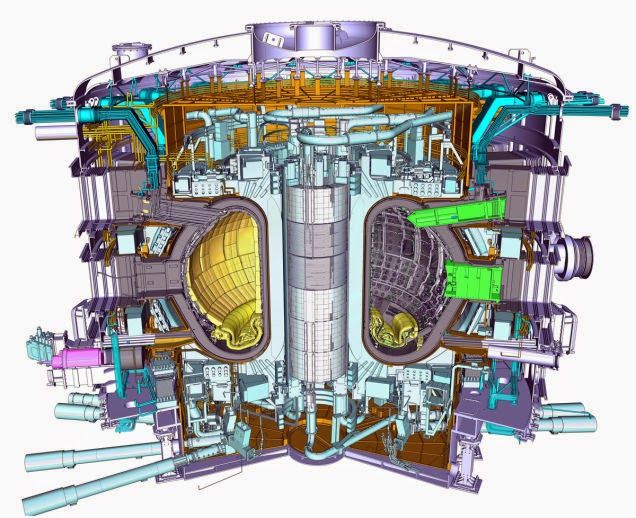
Aviation Week had complete access to their stealthy workshops and spoke to Dr. Thomas McGuire, the leader of Skunk Work’s Revolutionary Technology section. And ground-breaking it is, certainly: Instead of utilizing the similar strategy that everyone else is using— the Soviet-derived tokamak, a torus in which magnetic fields limit the fusion reaction with an enormous energy cost and thus tiny energy production abilities—Skunk Works’ Compact Fusion Reactor has a fundamentally different methodology to anything people have tried before. Here are the two of those techniques for contrast: