DARPA is funding development of high resolution brain interfaces. At the same time there are two companies who have breakthrough technology for higher resolution brain interfaces. The two companies are Elon Musk’s Neuralink and Mary Lou Jepsen’s Openwater red light scanner. The Neuralink and Openwater systems will be described after the DARPA project and its goals.
From the perspective of critics, there are many reasons to be concerned about the rise of artificial intelligence.
Billionaire inventor Elon Musk — perhaps the world’s most vocal AI antagonist — has warned that the technology could become “an immortal dictator from which we would never escape.”
Several years before his death, Stephen Hawking, the renowned theoretical physicist, said artificial intelligence could bypass biological evolution, leaving humans unable to compete.
In a several-hour live interview on September 6–7, Tesla and SpaceX CEO Elon Musk managed to slip in a few words about Neuralink, a side-project company formed by Musk for the purpose of bridging the gap between potential superhuman AI and the human brain itself.
Although the eccentric CEO/CTO wouldn’t say much more, he did tease a potentially revolutionary update from the fully-stealthed startup “in a few months”.
Elon Musk smoked pot and drank whiskey on the Joe Rogan podcast and said he’s going to soon announce a new “Neuralink” product that can make anyone superhuman.
Amandeep Gill has a difficult job, though he won’t admit it himself. As chair of the United Nations’ Convention on Conventional Weapons (CCW) meetings on lethal autonomous weapons, he has the task of shepherding 125 member states through discussions on the thorny technical and ethical issue of “killer robots” — military robots that could theoretically engage targets independently. It’s a subject that has attracted a glaring media spotlight and pressure from NGOs like Campaign to Stop Killer Robots, which is backed by Tesla’s Elon Musk and Alphabet’s Mustafa Suleyman, to ban such machines outright.
Gill has to corral national delegations — diplomats, lawyers, and military personnel — as well as academics, AI entrepreneurs, industry associations, humanitarian organizations, and NGOs in order for member states to try to reach a consensus on this critical security issue.
The subject of killer robots can spark heated emotions. The Future of Life Institute, a nonprofit that works to “mitigate existential risks facing humanity” such as artificial intelligence, launched its sensationalistic short film Slaughterbots at a side event hosted by the Campaign to Stop Killer Robots at the CCW’s meetings last November. The film, which depicts a dystopian near-future menaced by homicidal drones, immediately went viral.
In a best-of-three match, two teams of pro gamers overcame a squad of AI bots that were created by the Elon Musk-founded research lab OpenAI.
AI bots made by the Elon Musk-founded research lab OpenAI were defeated by human pro gamers at Dota 2 at The International. The loss was not completely unexpected, but it’s still an unusual knock back for the seemingly unstoppable march of AI. Here, we explain what the matches really meant.
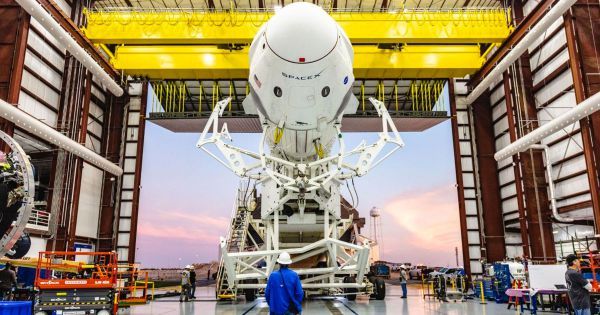
SpaceX is preparing to make its first demo launches for NASA’s commercial crew mission program, which aims to bring back the capability for U.S. spacecraft to fly astronauts to space.
The rocket company plans to use Tesla Model X vehicles to bring the first astronauts flying in the Crew Dragon spacecraft to the launch pad.
It appears to be the latest example of some synergy between Elon Musk’s two main companies.
Tesla’s Semi truck has already made some city-to-city trips, but how does it fare on cross-country jaunts — you know, what it’ll be doing when it enters service? Just fine, if you ask Elon Musk. In response to an Electrekpiece on the Semi’s latest visit (to Arkansas trucking behemoth J.B. Hunt), the CEO noted that the Semi has been traveling thousands of miles entirely by itself, using the existing Supercharger network. The only necessary help is an “extension cord” to help the truck plug in. To be exact, it’s a system of cords that plugs into multiple stations at once to top up the Semi’s giant battery before the company’s Megachargers come online.
That solo travel is likely meant in part to reassure customers (including J.B. Hunt) that the Semi is already capable of handling long-distance trips without escorts. However, it does leave a few open questions. How long does it take to top up using Superchargers, and how likely is it that drivers could rely on them when Megachargers aren’t available? While it’s easy for a Tesla-operated truck to cross the US using the existing framework, it’d be another matter with thousands of third-party trucks in service. This is a significant step toward the Semi hitting the road in earnest, but there are many more steps to go.
What’s cool is that it was driven across the country alone (no escort or any accompanying vehicles), using the existing Tesla Supercharger network and an extension cord— Elon Musk (@elonmusk) August 25, 2018
Moon? Mars? A trillion over 25 years? Lunar space station? Lunar resources? It’s gonna be interesting to see where this goes. It’s kind of a mess. But a good mess, a driven mess. A mess that is leading to real space exploration.
Space exploration is the latest partisan divide, as the Trump administration backs a moon mission and others, including Elon Musk, push for a trip to Mars. Here’s why it all matters.