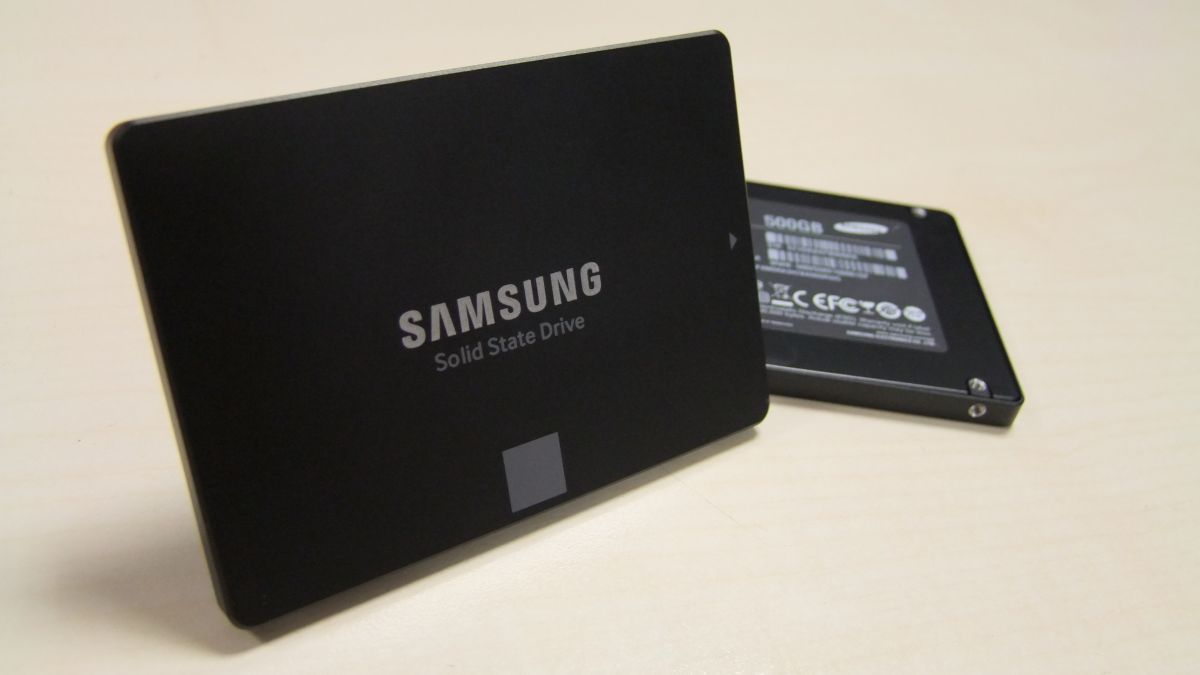
Samsung’s new monster SSD is ready to ship, with a 16TB capacity, SAS support, and formally rated to perform one complete drive write per day for its entire life.

Bionics: surgically inserted sensors controlling a prosthetic limb. Meet the man who sometimes forgets that his bionic leg is not his own.
Quantum mechanics and relativity theory are two pillars of modern physics. With their amalgamation, many novel phenomena have been identified. For example, the Unruh effect [1] is one of the most significant outcomes of the quantum field theory. This effect serves as an important tool to investigate phenomena such as thermal emission of particles from black holes and cosmological horizons [2]. It has been 40 years since the discovery of the Unruh effect, however, this effect is too weak to be observed with current technique. There have been a lot of attempts in searching for the observational evidence of the Unruh effect and in general the experimental observation is still of great challenge. To address this issue, quantum simulators [3, 4] may provide a promising approach. Quantum simulation is widely applied for simulating the quantum systems which cannot be efficiently simulated by classical computers or are not directly tractable by the current techniques in the laboratory.
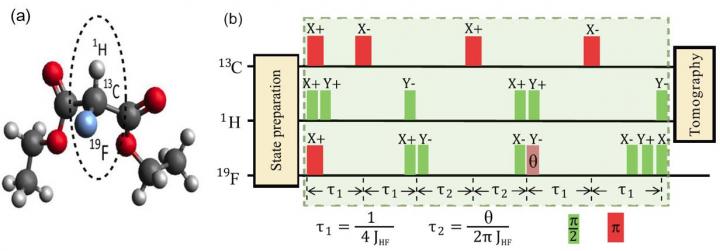
The researchers, led by Prof. Jiangfeng Du from University of Science and Technology of China, reported an experimental simulation of the Unruh effect with an NMR quantum simulator [5]. The experiments were performed on a Bruker Avance III 400MHz spectrometer. The researchers used a sample of 13C, 1H and 19F nuclear spins in chloroform as the NMR quantum simulator, as shown in Figure 1(a). The simulated Unruh effect on the quantum states can be realized by the pulse sequence acting on the sample, as depicted in Figure 1(b). By the quantum simulator, they experimentally demonstrated the behavior of Unruh temperature with acceleration, which agrees nicely with the theoretical prediction, as shown in Figure 2. Furthermore, they investigated the quantum correlations quantified by quantum discord between two fermionic modes as seen by two relatively accelerated observers. It is shown for the first time that the quantum correlations can be created by the Unruh effect from the classically correlated states. This work was recently published in the Science China-Physics, Mechanics & Astronomy.
It is interesting that the Unruh effect was in Feynman’s blackboard as one of the issues to learn at the time of his death in 1988, while it was also Feynman who conceived the idea of quantum simulation in 1982. This quantum simulation of the Unruh effect will provide a promising window to explore the quantum physics of accelerated systems, which widely appear in black hole physics, cosmology and particle physics.
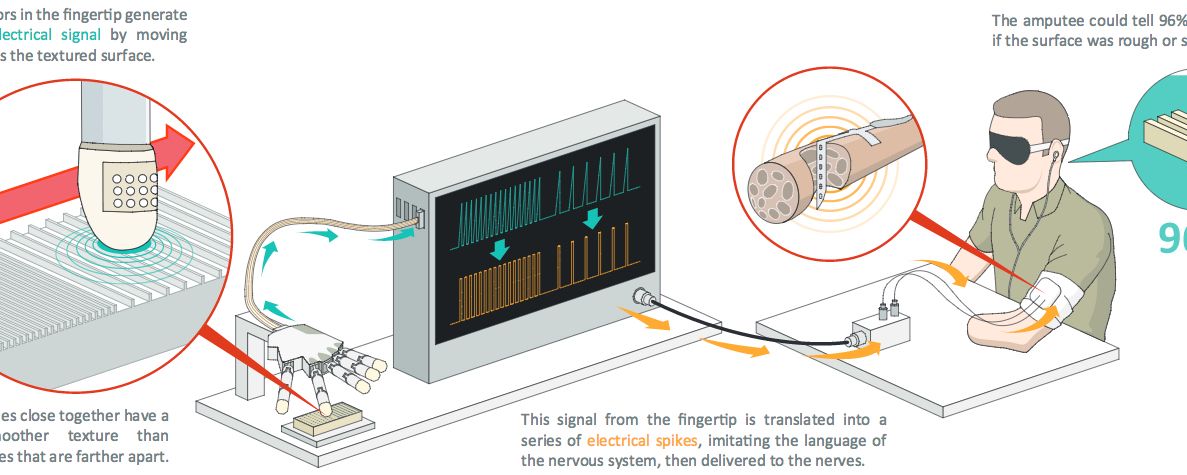
Amputee Dennis Aabo Sørensen is the first person in the world to recognize texture (smoothness vs. roughness) using an artificial “bionic” fingertip surgically connected to nerves in his upper arm. The experimental system was developed by EPFL (Ecole polytechnique fédérale de Lausanne) and SSSA (Scuola Superiore Sant’Anna).
“The stimulation felt almost like what I would feel with my hand,” says Sørensen. “I felt the texture sensations at the tip of the index finger of my phantom hand.”

Let’s just hypothesize a little on this topic: let’s say Apple goes ahead and gives in to the US Government and enables government to access the phone’s info. Does Apple have any protection in the future from lawsuits from it’s customers in situations where their own customers information is hacked by criminals and published to the world or used for illegal activities? Because I do see in the future more lawsuits coming at the tech companies for not ensuring their platforms and devices are un-hackable. So, if the government has its way; what protections does tech have now with any future lawsuits by consumers and other businesses?
His comments come during the ongoing legal battle over an iPhone used by Syed Farook, one of the individuals responsible for the San Bernardino, Calif. mass shooting December 2. “I don’t think requiring backdoors with encryption is either going to be an effective way to increase security or is really the right thing to do for just the direction that the world is going to”.
This is because First Amendment treats computer code as speech and according to Apple, meeting the demands of the government would be equivalent to “compelled speech and viewpoint discrimination”.
The Electronics Frontier Foundation (EFF) has said it will be filing an amicus brief in support of Apple with the courts.
The price of SSDs is continuing to drop, and they’re becoming an ever-more tempting proposition compared to traditional spinning disks, according to a new report.
DRAMeXchange, which is a division of analyst firm TrendForce, produces a quarterly report detailing the prices PC vendors pay for SSDs, and it showed that both MLC-based and TLC-based SSDs dropped considerably in price.
MLC-based drives dropped by around 10 to 12%, and TLC-based SSD prices sank by 7 to 12% in the first quarter of 2016.

New material improving stealth mode vehicles and planes.
When Surrey NanoSystems introduced the original Vantablack, the company said the carbon nanotube material is capable of absorbing 99.96 percent of light that touches it. It’s so dark, it can fool your eyes into seeing a smooth surface even when the nanotubes were actually grown on crumpled foil (seriously — watch the video below the fold). Well, the new version of Vantablack is darker than that. In fact, Surrey can’t even give us the percentage of light that gets absorbed, because its spectrometers can’t measure it.
In this video below (and the GIF above), you can see the material engulf the laser pointer in darkness when it moves across:
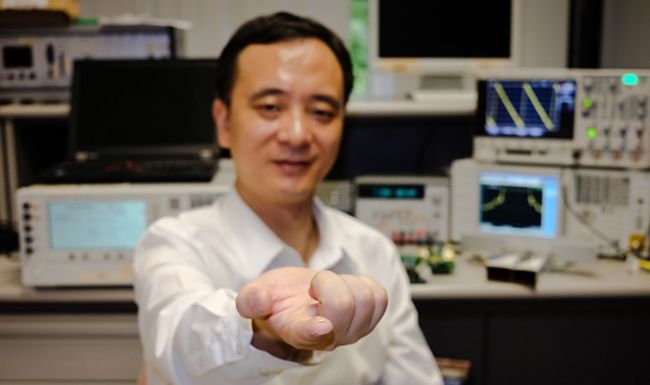
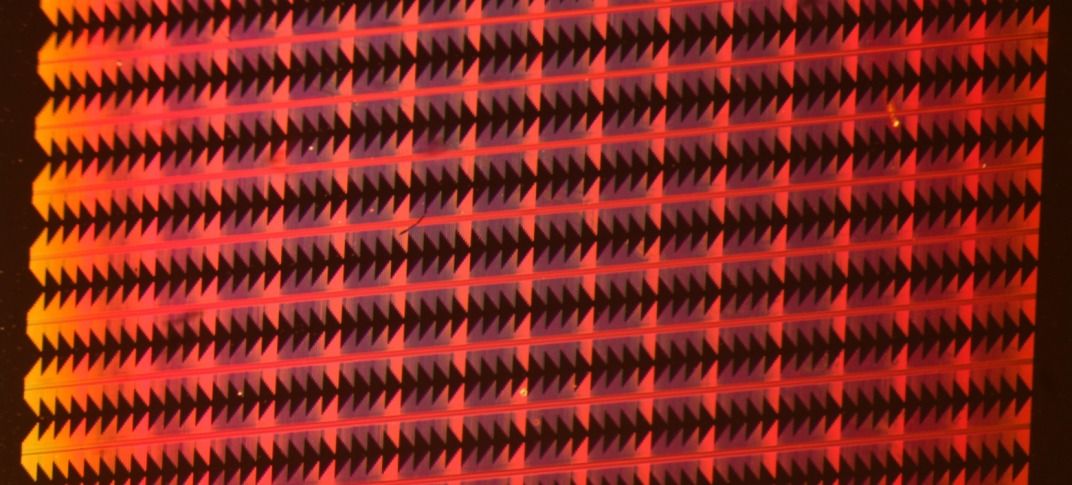
Researchers from the Moscow Institute of Physics and Technology (MIPT) have for the first time experimentally demonstrated that copper nanophotonic components can operate successfully in photonic devices – it was previously believed that only gold and silver components could do so. Copper components are not only just as good as components based on noble metals; they can also be easily implemented in integrated circuits using industry-standard fabrication processes. “This is a kind of revolution – using copper will solve one of the main problems in nanophotonics,” say the authors of the paper. The results have been published in the scientific journal Nano Letters.
The discovery, which is revolutionary for photonics and the computers of the future, was made by researchers from the Laboratory of Nanooptics and Plasmonics at MIPT’s Centre of Nanoscale Optoelectronics. They have succeeded, for the first time, in producing copper nanophotonic components, whose characteristics are just as good as those of gold components. It is interesting to note that the scientists fabricated the copper components using the process compatible with the industry-standard manufacturing technologies that are used today to produce modern integrated circuits. This means that in the very near future copper nanophotonic components will form a basis for the development of energy-efficient light sources, ultra-sensitive sensors, as well as high-performance optoelectronic processors with several thousand cores.
The discovery was made under what is known as nanophotonics – a branch of research which aims, among other things, to replace existing components in data processing devices with more modern components by using photons instead of electrons. However, while transistors can be scaled down in size to a few nanometres, the diffraction of light limits the minimum dimensions of photonic components to the size of about the light wavelength (~1 micrometre). Despite the fundamental nature of this so-called diffraction limit, one can overcome it by using metal-dielectric structures to create truly nanoscale photonic components. Firstly, most metals show a negative permittivity at optical frequencies, and light cannot propagate through them, penetrating to a depth of only 25 nanometres. Secondly, light may be converted into surface plasmon polaritons, surface waves propagating along the surface of a metal. This makes it possible to switch from conventional 3D photonics to 2D surface plasmon photonics, which is known as plasmonics. This offers the possibility of controlling light at a scale of around 100 nanometres, i.e., far beyond the diffraction limit.