Legendary master filmmaker Werner Herzog (Grizzly Man, Cave of Forgotten Dreams) examines the past, present and constantly evolving future of the Internet in Lo And Behold: Reveries Of The Connected World. Herzog conducted original interviews with cyberspace pioneers and prophets such as PayPal and Tesla co-founder Elon Musk, Internet protocol inventor Bob Kahn, and famed hacker Kevin Mitnick. These provocative conversations reveal the ways in which the online world has transformed how virtually everything in the real world works, from business to education, space travel to healthcare, and the very heart of how we conduct our personal relationships.
See it in theatres, On Demand, Amazon Video and iTunes August 19th.
” The explosion of information technology on the internet has lead to some of its greatest glories.” Magnolia has released an official US trailer for the new Werner Herzog documentary Lo and Behold: Reveries of The Connected World, in which Herzog profiles the internet and how it has changed the world, for better or worse. The doc premiered at the Sundance Film Festival earlier this year to mostly positive reviews. We featured the firsttwo trailers a few months ago while waiting for release info to be revealed. The doc has 10 distinct chapters, from “The Early Days” to “The Future”, and explores both the good and bad of what the internet has provided. I’m still quite excited to see this doc, anything by Herzog is usually quite fascinating.
Official US trailer for Werner Herzog’s Lo & Behold, Reveries of the Connected World, via YouTube:
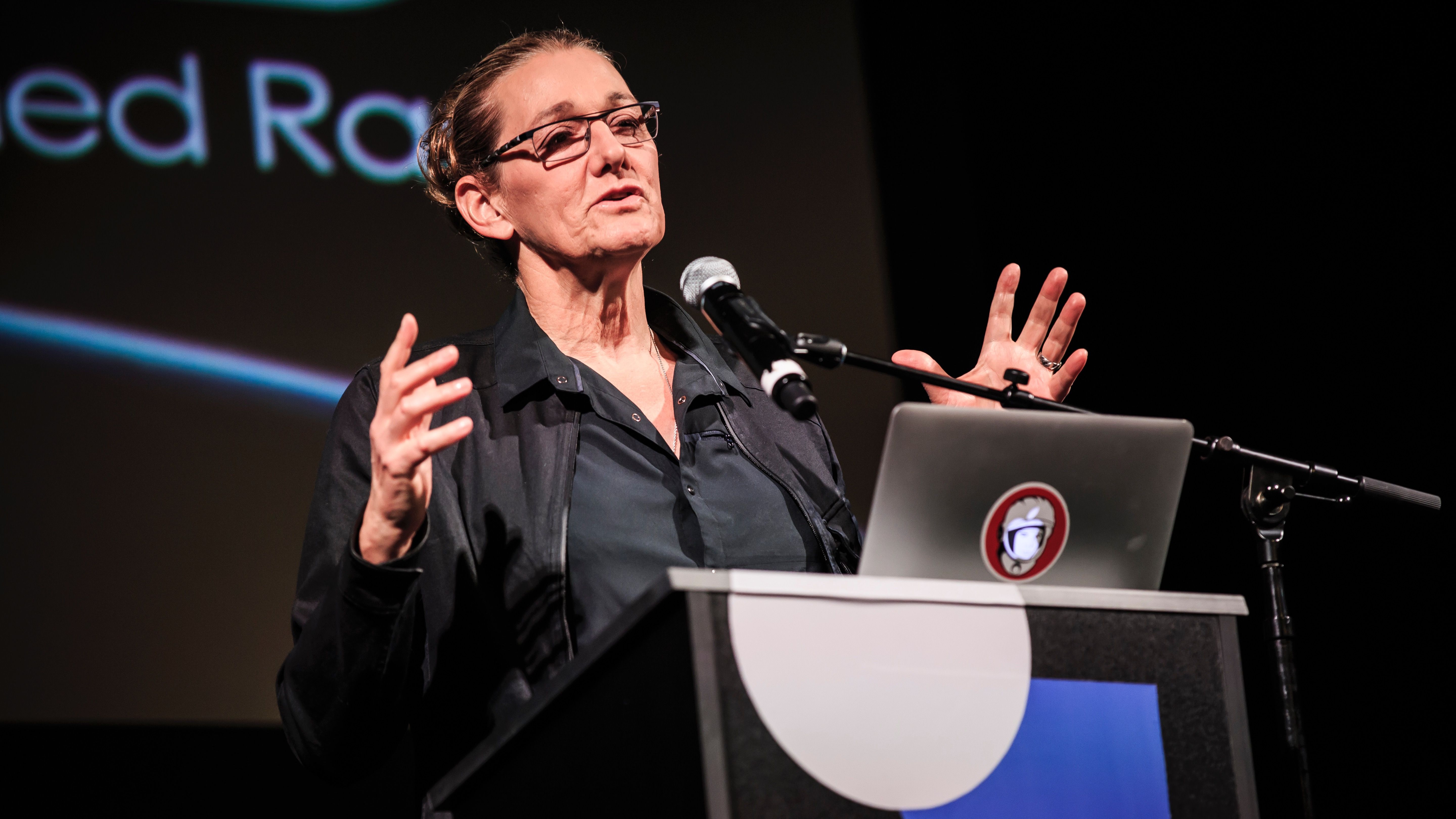
When you think about the headliners at a music festival, it’s unlikely that the first person to pop into your head would be Martine Rothblatt—the founder of Sirius XM, the one-time highest-paid female CEO in the world who made a robot clone of her wife, and the founder of the Terasem religion, which believes we’ll live forever by uploading our consciousness to the cloud. But Moogfest, a four-day citywide festival of music and technology in Durham, North Carolina, was not the average music festival. Unlike other festivals that make cursory overtures to technology, Moogfest dedicated as much time to explaining how technology influences creativity as to the creative output itself, even listing headline ‘technologists’ alongside its top-billed musical acts.
On the festival’s second day, Friday 20 May, Rothblatt took the stage to talk to a packed house at Durham’s Carolina Theater, in an atmosphere that felt far more like a TED talk than a music fest. Rothblatt, who is transgender, discussed the contentious North Carolina HB2 law, which bans transgender people from using public bathrooms of the gender they identify with; the idea that creativity would be better encouraged by free college tuition; and how she got to a point where she and her company, United Therapeutics, can actually think about 3D printing new body parts, and leaving our bodies behind—if we want. “You want to win more than you want to live,” she told the rapt crowd. “You yell ‘Geronimo’ as you jump crazily into monopolistic opposition.”
Quartz sat down with Rothblatt after her talk to chat more about her thoughts on AI, living forever, free education, and what happens to the soul once we’ve made digital copies of ourselves.
Georgia Institute of Technology developed a control algorithm that ‘taught’ 3-ft, 48lb rally cars how to plan and execute optimal handling decisions in real-time while on rough terrain.
“So there came a time in which the ideas, although accumulated very slowly, were all accumulations not only of practical and useful things, but great accumulations of all types of prejudices, and strange and odd beliefs. Then a way of avoiding the disease was discovered. This is to doubt that what is being passed from the past is in fact true, and to try to find out ab initio again from experience what the situation is, rather than trusting the experience of the past in the form in which it is passed down. And that is what science is: the result of the discovery that it is worthwhile rechecking by new direct experience, and not necessarily trusting the [human] race[’s] experience from the past. I see it that way. That is my best definition…Science is the belief in the ignorance of experts.“ –Richard P Feynman, What is Science? (1968)[1]
TruthSift.com is a platform designed to support and guide individuals or crowds to rationality, and make them smarter collectively than any unaided individual or group. (Free) Members use TruthSift to establish what can be established, refute what can’t be, and to transparently publish the demonstrations. Anyone can browse the demonstrations and learn what is actually known and how it was established. If they have a rational objection, they can post it and have it answered.
Whether in scientific fields such as climate change or medical practice, or within the corporate world or political or government debate, or on day to day factual questions, humanity hasn’t had a good method for establishing rational truth. You can see this from consequences we often fail to perceive: Peer reviewed surveys agree: A landslide majority of medical practice is *not* supported by science [2,3,4]. Scientists are often confused about the established facts in their own field [5]. Within fields like climate science and vaccines, that badly desire consensus, no true consensus can be reached because skeptics raise issues that the majority brush aside without an established answer (exactly what Le Bon warned of more than 100 years ago[6]). Widely consulted sources like Wikipedia are reported to be largely paid propaganda on many important subjects [7], or the most popular answer rather than an established one [8]. Quora shows you the most popular individual answer, generated with little or no collaboration, and often there is little documentation of why you should believe it. Existing systems for crowd sourced wisdom largely compound group think, rather than addressing it. Existing websites for fact checking give you someone’s point of view.
Corporate or government planning is no better. Within large organizations, where there is inevitably systemic motivation to not pass bad news up, leadership needs active measures to avoid becoming clueless as to the real problems [9]. Corporate or government plans are subject to group think, or takeover by employee or other interests competing with the mission. Individuals who perceive mistakes have no recourse capable of rationally pursuading the majority, and may anyway be discouraged from speaking up by various consequences[6].
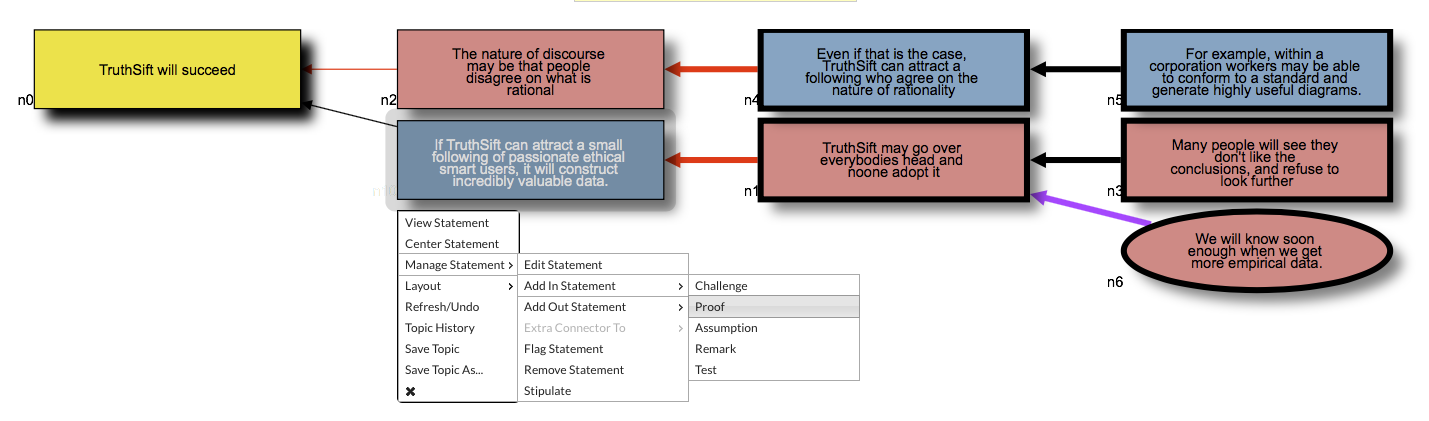
TruthSift is designed to solve all these problems. TruthSift realizes in your browser the Platonic ideal of the scientific literature, but TruthSift applies it to everything, and makes it tangible and lightweight, extended to a much lower hurdle for publishing. On a public TruthSift diagram, members (or on a Private diagram, members you have invited), who believe they can prove or refute a statement, can post their proof or refutation exactly where it is relevant. TruthSift logically propagates the consequences of each contribution, graphically displaying how it impacts the establishment status of all the others, drawing statements established by the combined efforts in thick borders, and statements refuted in thin. Statements are considered established only when they have an established demonstration, one with every posted challenge refuted. Fig 1: An example topic. The topic statement n0 is currently refuted, because its only proof is refuted. The statement menu is shown open in position to add a proof to this proof. The topic statement is gold, pro statements are blue, con statements are red. Proof connectors are black, challenges red, remarks purple, assumptions (not shown) blue. Statements show the title. On the actual Topic the body can be seen by selecting the statement and “View Statement” or hovering the mouse. What is a proof? According to the first definition at Dictionary.com a proof is: “evidence sufficient to establish a thing as true, or to produce belief in its truth.” In mathematics, a proof is equivalent to a proof tree that starts at axioms, or previously established results, which the participants agree to stipulate, and proceeds by a series of steps that are individually unchallengeable. Each such step logically combines several conclusions previously established and/or axioms. The proof tree proceeds in this way until it establishes the stated proved conclusion. Mathematicians often raise objections to steps of the proof, but if it is subsequently established that all such objections are invalid, or if a workaround is found around the problem, the proof is accepted.
The Scientific literature works very similarly. Each paper adds some novel argument or evidence that previous work is true or is not true or extends it to establish new results. When people run out of valid, novel reasons why something is proved or is not proved, what remains is an established theory, or a refutation of it or of all its offered proofs.
Fig 2: The view focused on the topic statement of a Topic diagramming the discussion in: Galileo’s: Dialogues Concerning the Two Chief World Views. The black triangle indicates other incoming edges not shown. For complex diagrams, it is often best to walk around in focused view centered on each statement in turn.
TruthSift is a platform for diagramming this process and applying it to any statements members care to propose to establish or refute. One may state a topic and add a proof tree for it, which is drawn as a diagram with every step and connection explicit. Members may state a demonstration of some conclusion they want to prove, building from some statements they assert are self-evident or that reference some authority they think trustworthy, and then building useful intermediate results that rationally follow from the assumptions, and building on until reaching the stated conclusion. If somebody thinks they find a hole in a proof at any step, or thinks one of the original assumptions need further proof, they can challenge it, explaining the problem they see. Then the writer of the proof (or others if its in collaboration mode) may edit the proof to fix the problem, or make clearer the explanation if they feel the challenger was simply mistaken, and may counter-challenge the challenge explaining that it had been resolved or mistaken. This can go on recursively, with someone pointing out a hole in the proof used by the counter-challenger that the challenge was invalid. On TruthSift the whole argument is laid out graphically and essentially block-chained, which should prevent the kind of edit-wars that happen for controversial topics on Wikipedia. Each challenge or post should state a novel reason, and when the rational arguments are exhausted, as in mathematics, what remains is either a proof of the conclusion or a refutation of it or all of its proofs.
As statements are added to a diagram, TruthSift keeps track of what is established and what refuted, drawing established statements’ borders and their outgoing connectors thick, and refuted statements’ borders and their outgoing connectors thin so viewers can instantly tell what is currently established and what refuted. TruthSift computes this by a simple algorithm that starts at statements with no incoming assumptions, challenges, or proofs, which are thus unchallenged as assertions that prove themselves, are self evident, or appeal to an authority everybody trusts. These are considered established. Then it walks up the diagram rating statements after all their parents have been rated. A statement will be established if all its assumptions are, none of its challenges are, and if it has proofs, at least one is established. (We support challenges requesting a proof be added to a statement which neither has one added nor adequately proves itself.) Otherwise, that is if a statement has an established challenge, or has refuted assumptions, or all of its proofs are refuted, it is refuted.
To understand why a statement is established or refuted, center focus on it, so that you see it and its parents in the diagram. If it is refuted, either there is an established challenge of it, or one of its assumptions is refuted, or all of its proofs are. If it is not refuted, it is established. Work your way backward up the diagram, centering on each statement in turn, and examine the reasons why it is established or refuted.
Fig 3: An example topic.
Effective contribution to TruthSift diagrams involves mental effort. This is both a hurdle and a feature. TruthSift teaches Critical Thinking. First you think about your Topic Statement. How actually should you specify Vaccine Safety or Climate Change, so it covers what you want to establish or refute, and so it is amenable to rational discussion? There is no place you could go to see that well specified now, and can you properly assure it without properly specifying it? Next you think about the arguments for your topic statement, and those against it, and those against the arguments for, and those for the arguments for, and the arguments against the arguments against, and so on until everybody runs out of arguments, when what is left is a concise rational analysis of what is established and why. The debate is settled point by point. The process naturally subdivides the field into sub-topics where different expertise’s come into play, promoting true collective wisdom and understanding.
For TruthSift to work properly, posters will have to respect the guidelines and post only proof or challenge statements that they believe rationally prove or refute their target and are novel to the diagram (or also novel additional evidence as assumptions or remarks or tests, which are alternative connector types). Posts violating the guidelines may be flagged and removed, and consistent violators as well. Posts don’t have to be correct, that’s what challenges are for, but they have to be honest attempts, not spam or ad hominem attacks. Don’t get hung up on whether a statement should be added as a proof or an assumption of another. Frequently you want to assemble arguments for a proposition stating something like “the preponderance of the evidence indicates X”, and these arguments are not individually necessary for X, nor are they individually proofs of X. It is safe to simply add them as proofs. They are not necessary assumptions, and if not enough of them are established, the target may be challenged on that basis. The goal is a diagram that transparently explains a proof and what is wrong with all the objections people have found plausible.
For cases where members disagree on underlying assumptions or basic principles, stipulation is available. If one or more statements are stipulated, statements are shown as conditionally true if established based on the stipulations and as conditionally false if refuted based on the stipulations. The challenges to the stipulation are also shown. TruthSift supports reasoning from different fundamental assumptions, but requires being explicit about it when challenged. Probability mode supports the intuitive construction of probabilistic models, and evaluates the probability of each statement in the topic marginalizing over all the parameters in the topic. With a little practice these allow folding in various connections and evidence. These could be used for collaborative, verified, risk models; to support proofs with additional confidence tests; to reason about hidden causes; or many other novel applications
Fig 4: Detail from a topic showing an established conclusion some may find surprising. Please Rebut it if you can. Dashed edges represent citation into the literature. Title is shown for each statement, on actual topic select “View Statement” to see body.
Basic Membership is free. In addition to public diagrams, debating the big public issues, private diagrams are available for personal or organizational planning or to exclude noise from your debate. Private diagrams have editing and/or viewing by invitation only. Come try it. http://TruthSift.com
TruthSift’s mission is to enable publication of a transparent exposition of human knowledge, so that anyone may readily determine what is truth and what fiction, what can be established by valid Demonstration and what can’t, and so that anyone can read and understand that Demonstration. We intend the process of creating this exposition to lead to vastly increased understanding and improved critical thinking skills amongst our members and beyond. We hope to support collaborative human intelligences greater than any intelligence previously achieved on the planet, both in the public domain and for members’ private use.
Inspirational bio of the “Quantum Man” Richard Feynman.
Richard Feynman was a Nobel prize-winning physicist whose contemporaries thought that he had the finest brain in physics. He was born on May 11, 1918, in Manhattan and grew up in Far Rockaway, N.Y., a section of Queens, on the Rockaway peninsula.
His parents were non-observant Ashkenazi Jews. His father, Melville Feynman, was a uniform salesman. Nevertheless, he tried to stimulate Richard to have an interest in science at an early age. Melville was the son of Lithuanian Jews who lived in Minsk and emigrated to the U.S. in 1895 when Melville was 5 years old. Although Melville wanted to become a doctor, the family could not afford to support his education. He tried a variety of occupations and finally settled in the uniform business.
The father of Richard’s mother (nee Lucille Phillips), Henry Phillips, was born in Poland, lost his parents at an early age, and was raised in an English orphanage where he was given the name Phillips before being sent to America. He started out as a peddler, developed a successful millinery business, and married a watchmaker’s daughter who had repaired his watch. She had come to the U.S. from Poland. Henry and his wife Johanna developed a successful hat business, eventually moving to a large house in Far Rockaway.
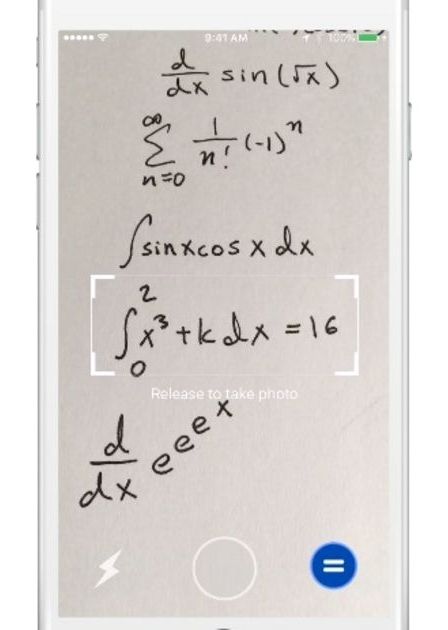
Math isn’t everyone’s strong suit, especially those who haven’t stretched that part of their brain since college. Thanks to the wonders of image recognition technology, we now have Mathpix, an iOS app that lets you point your phone camera at a problem and calculates solutions in seconds.
The interface looks like any standard camera app: simply drag the on-screen reticle over the equation and the app solves it and provides graph answers where appropriate. More useful is a step-by-step guide offering multiple methods to reach a solution, making this a bona fide educational tool. It uses image recognition to process problems and pings its servers to do the mathematical heavy lifting, so it likely requires an internet connection to work.
Mathpix was envisioned by Stanford PhD student Nico Jimenez, who was advised by Stanford grad Paul Ferrell. The app’s other developers are high schoolers Michael Lee and August Trollback, which is impressive for an app that claims to be the first to visually recognize and solve handwritten math problems.
Ever dream of becoming a dentist? Or, have family members needing new dentures? Or, know that one person who would look good if they only had some teeth. This 3D Printer is your answer.
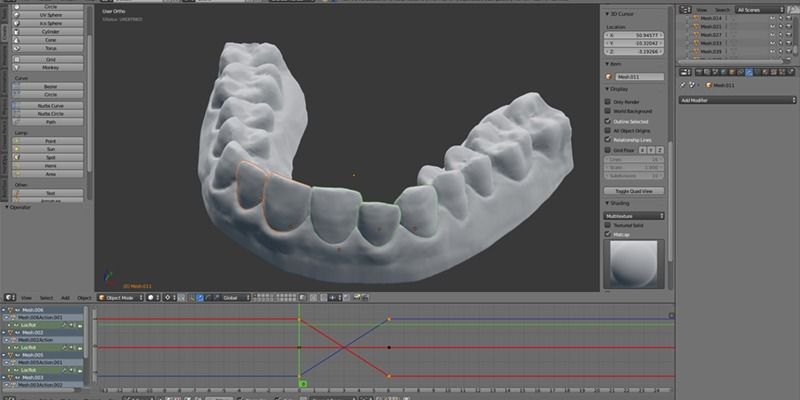
An undergraduate at New Jersey Institute of Technology made his own plastic braces using a 3D printer, $60 of materials, and a healthy dose of ingenuity — and they actually worked.
Amos Dudley had braces in middle school, but he didn’t wear a retainer like he was supposed to, so his teeth slowly shifted back.
He didn’t want to shell out thousands of dollars for a whole new round of braces, so the digital-design major decided to make his own.
Michio Kaku and Ray Kurzweil explains the exponential rate at which Technological Singularity is approaching and the future is far near than we can Imagine!
The technological singularity is a hypothetical event in which artificial general intelligence (constituting, for example, intelligent computers, computer networks, or robots) would be capable of recursive self-improvement (progressively redesigning itself), or of autonomously building ever smarter and more powerful machines than itself, up to the point of a runaway effect—an intelligence explosion—that yields an intelligence surpassing all current human control or understanding. Because the capabilities of such a superintelligence may be impossible for a human to comprehend, the technological singularity is the point beyond which events may become unpredictable or even unfathomable to human intelligence.
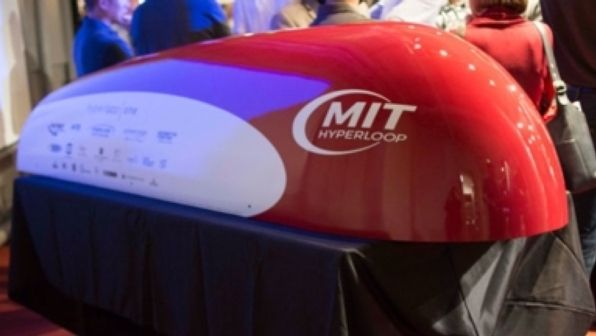
Competitors are racing to answer Elon Musk’s call to create a capsule that can carry commuters at the speed of sound. MIT unveiled its entry on Friday.