Toggle light / dark theme

From organoid culture to manufacturing: technologies for reproducible and scalable organoid production

Despite the absence of a fully established regulatory framework or unified technological standard for industrial-and clinical-grade organoid biomanufacturing yet, substantial progress has been made toward building the technical and institutional infrastructure required for scalability and reproducibility. The Organisation for Economic Co-operation and Development (OECD) introduced the Good In Vitro Method Practices (GIVIMP)19, an international quality-assurance framework that defines laboratory quality systems, method qualification, reference controls, equipment calibration, and data integrity—principles that now potentially serve as quantitative benchmarks for process validation in organoid production. Complementing this, the NIH Standardized Organoid Modeling (SOM) Center was recently established to promote the development of organoid platforms that are reproducible, robust, and broadly accessible for translational biomedical and pharmaceutical research.

Expanding these standardization efforts, a recent publication introduced the Essential Guidelines for Manufacturing and Application of Organoids, delineating a systematic workflow encompassing cell sourcing, culture optimization, quality control, and biobanking logistics20. Their framework identifies organ-specific critical quality attributes (CQAs)—including growth-factor composition, morphological fidelity, and quantitative analytical metrics—and recommends standardized cryopreservation conditions (~100–200 organoids per vial) to enhance batch comparability. Likewise, a recent study established quantitative criteria for human intestinal organoid standardization, specifying cell-line provenance, minimum lineage composition thresholds (e.g., ≥30% enterocytes), and molecular marker expression profiles consistent with physiological differentiation21. Taken together, these coordinated initiatives—from international organizations to national agencies and individual laboratories—represent an emerging global framework toward reproducible, quality-controlled, and scalable organoid biomanufacturing, laying the groundwork for eventual regulatory convergence and clinical translation.

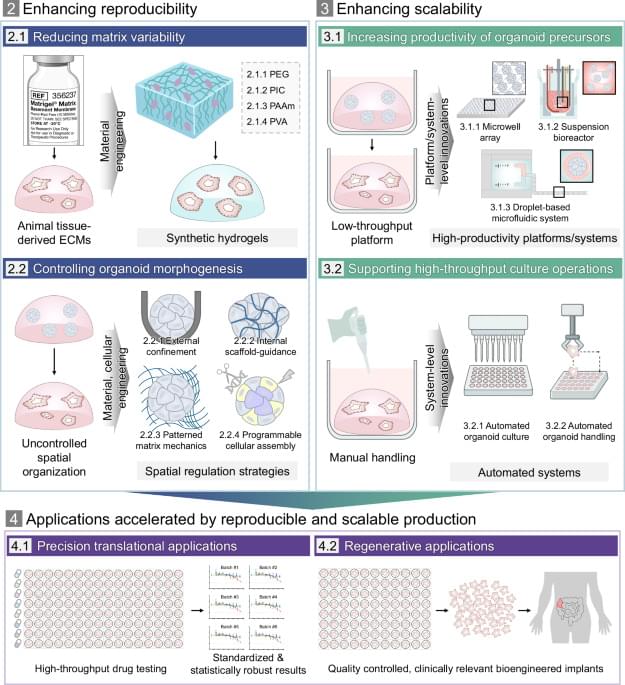
In response to these prevailing limitations and in alignment with global standardization trends, a range of engineering strategies has been developed, shifting the paradigm from organoid culture to organoid manufacturing by enabling reproducible and scalable organoid production. These strategies broadly focus on two goals: improving reproducibility by minimizing uncontrolled variation in the culture environment as well as by regulating intrinsic morphogenetic processes, and enhancing scalability by increasing productivity and throughput. To this end, recent advances can be categorized into three major domains: cellular engineering approaches that regulate morphogenetic processes through programmed cell organization; material-based strategies that establish defined and controllable environmental cues; and platform-or system-level innovations that enable high-throughput and automated workflows. Together, these innovative engineering advances mark aion toward more standardized, efficient production workflows.
The Singularity Countdown: AGI by 2029, Humans Merge with AI, Intelligence 1000x | Ray Kurzweil

Ray Kurzweil predicts humans will merge with artificial intelligence (AI) by 2045, resulting in a 1000x increase in intelligence and marking the beginning of a new era of unprecedented innovation, potentially transforming human life and society ## ## Questions to inspire discussion.

Preparing for AI Timeline.

🤖 Q: When should I expect human-level AI and what defines it? A: Human-level AI arrives by 2029, defined not by passing the Turing test (which only matches an ordinary person), but as AGI requiring expertise in thousands of fields and the ability to combine insights across disciplines.

🧠 Q: When will the singularity occur and what intelligence gain can I expect? A: The singularity happens by 2045 when humanity merges with AI to become 1000x more intelligent, creating a seamless merger where biological and computational thought processes become indistinguishable.

⚡ Q: How much change should I prepare for in the next decade? A: Expect as much change in the next 10 years as occurred in the last 100 years (1925−2025), with AGI and supercomputers by 2035 enabling merging with AI for 1000x intelligence increase.

Career and Economic Adaptation.

A 100-Year-Old Problem Solved? Scientists Discover How To Freeze Organs Without Cracking Them

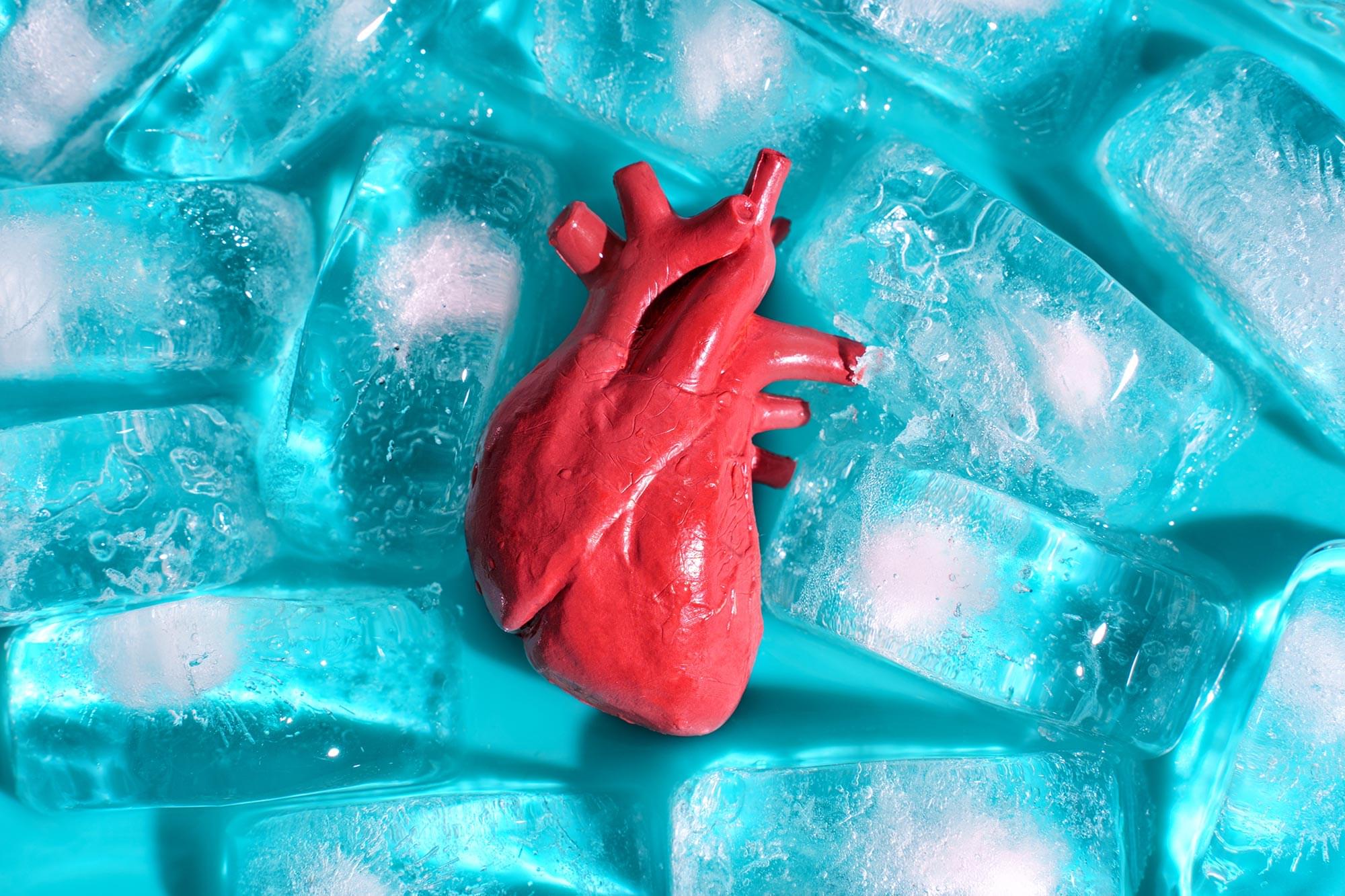
The breakthrough approach could lead to successful, long-term organ transplants, bringing science fiction closer to becoming medical reality. Cryopreservation, the process of preserving biological tissues by cooling them to subzero temperatures, might sound like something out of science fiction.

Our BRLS Research Application, Fixation vs. Vitrification Reflection, Cryonics & Autism

In this epsiode of the Cryosphere chat we discuss:
● The research proposal we submitted to BRLS
● Why slow growth could be an existential risk to cryonics.
● Our review of the Fixation vs. Vitrification discussion.
● Why there are so many autistic cryonicists.

Links:
Fixation vs. Virtification Discussion: https://youtu.be/gvu8P9D6p0g?si=2KOSESeOndtVl33V
Biostasis Pacific Northwest: https://www.reddit.com/r/cryonics/comments/1ozxslv/announcin…northwest/
I’ll see ya later mom… Reddit post: https://www.reddit.com/r/cryonics/comments/1owgnk0/ill_see_ya_later_mom/
Cryosphere Discord: https://discord.gg/ndshSfQwqz

Cryosphere Chat ft. Emil Kendziorra — Tales from Biostasis 2025, Our Near Death Experiences

The gang catches up with Emil Kendziorra after the Biostasis 2025 conference at the European Biostasis Foundation. Watch it on YouTube here. Topics covered include:

• How to get a Tomorrow Bio ambulance in your hometown.
• Tomorrow Bio’s plan to collect brain samples to check ultra-structure preservation in its cryonics patients — and how it will respond to what it finds.
• What’s new and what’s next for Tomorrow Bio.
• Our near death experiences.

Links:
• Cryosphere Discord Server: / discord.
• Cryonics Subreddit: / cryonics.

This Organ Could Reverse Aging! Greg Fahy

If I had the money this would be the first person I would call.


Can one forgotten organ hold the key to reversing aging? In this exclusive interview, Dr. Greg Fahy — one of the world’s leading longevity scientists — reveals groundbreaking discoveries about the thymus, age reversal, and the future of human health.

From regrowing his own thymus to pioneering cryobiology and organ preservation, Dr. Fahy shares insights that could change how we think about aging, immortality, and life extension. This conversation dives into the science behind reversing biological age, restoring the immune system, and even the possibility of medical time travel.

🔑 Topics covered in this video:

Thymus regeneration and why it may be the “master control” of aging.

/* */