Star-gobbling black holes tend to inhabit galaxies that have recently collided, suggesting that cosmic pile-ups send whole systems flying.

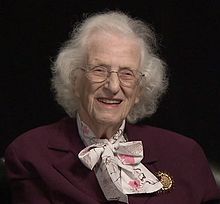
Another amazing female pioneer in STEM and she was a NASA chief astronomer to boot!
A former chief astronomer at NASA will discuss the evolution of the universe from the Big Bang to black holes during a lecture on Thursday, March 24.
It’s the opening of the 19th Annual Dick Smyser Community Lecture Series.
It will feature Nancy Grace Roman, former chief of the NASA Astronomy and Relativity Programs in the Office of Space Science.
Quantum mechanics and relativity theory are two pillars of modern physics. With their amalgamation, many novel phenomena have been identified. For example, the Unruh effect [1] is one of the most significant outcomes of the quantum field theory. This effect serves as an important tool to investigate phenomena such as thermal emission of particles from black holes and cosmological horizons [2]. It has been 40 years since the discovery of the Unruh effect, however, this effect is too weak to be observed with current technique. There have been a lot of attempts in searching for the observational evidence of the Unruh effect and in general the experimental observation is still of great challenge. To address this issue, quantum simulators [3, 4] may provide a promising approach. Quantum simulation is widely applied for simulating the quantum systems which cannot be efficiently simulated by classical computers or are not directly tractable by the current techniques in the laboratory.
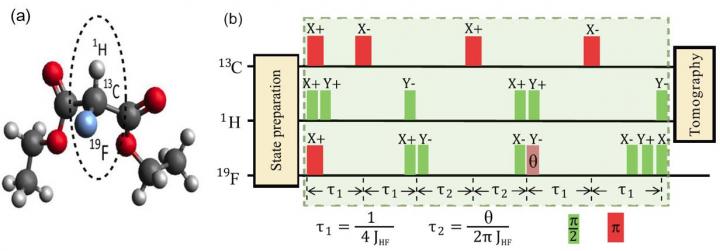
The researchers, led by Prof. Jiangfeng Du from University of Science and Technology of China, reported an experimental simulation of the Unruh effect with an NMR quantum simulator [5]. The experiments were performed on a Bruker Avance III 400MHz spectrometer. The researchers used a sample of 13C, 1H and 19F nuclear spins in chloroform as the NMR quantum simulator, as shown in Figure 1(a). The simulated Unruh effect on the quantum states can be realized by the pulse sequence acting on the sample, as depicted in Figure 1(b). By the quantum simulator, they experimentally demonstrated the behavior of Unruh temperature with acceleration, which agrees nicely with the theoretical prediction, as shown in Figure 2. Furthermore, they investigated the quantum correlations quantified by quantum discord between two fermionic modes as seen by two relatively accelerated observers. It is shown for the first time that the quantum correlations can be created by the Unruh effect from the classically correlated states. This work was recently published in the Science China-Physics, Mechanics & Astronomy.
It is interesting that the Unruh effect was in Feynman’s blackboard as one of the issues to learn at the time of his death in 1988, while it was also Feynman who conceived the idea of quantum simulation in 1982. This quantum simulation of the Unruh effect will provide a promising window to explore the quantum physics of accelerated systems, which widely appear in black hole physics, cosmology and particle physics.
“A metaphorical chip holding all the programming for our universe stores information like a quantum computer.” This is the radical insight to the foundation of our Universe developed by Mark Van Raamsdonk, a professor of theoretical physics at the University of British Columbia, that says that the world we see around us is a projection from a set of rules written in simpler, lower-dimensional physics—just as the 2D code in a computer’s memory chip creates an entire virtual 3D world. “What Mark has done is put his finger on a key ingredient of how space-time is emerging: entanglement,” says Gary Horowitz, who studies quantum gravity at the University of California Santa Barbara. Horowitz says this idea has changed how people think about quantum gravity, though it hasn’t yet been universally accepted. “You don’t come across this idea by following other ideas. It requires a strange insight,” Horowitz adds. “He is one of the stars of the younger generation.”
“We’re trying to construct a dictionary,” says Van Raamsdonk, that allows physicists to translate descriptions of our complex universe into simpler terms. If they succeed, they will have found the biggest jigsaw piece in the puzzle of a Grand Unified Theory—something that can describe all of the forces of our universe, at all scales from the atomic to the galactic. That puzzle piece is, specifically, something that can describe gravity within the framework of quantum mechanics, which governs physics on small scales. Such a unified theory is needed to explain the extreme scenarios of a black hole or the first moments of the universe.”
http://www.scienceandnonduality.com
John Hagelin, Director of the Institute of Science, Technology and Public Policy Director of the Board of Advisors for the David Lynch Foundation.
Progress in theoretical physics during the past decade has led to a progressively more unified understanding of the laws of nature, culminating in the recent discovery of completely unified field theories based on the superstring. These theories identify a single universal, unified field at the basis of all forms and phenomena in the universe. At the same time, cutting-edge research in the field of neuroscience has revealed the existence of a unified field of consciousness‚ a fourth major state of human consciousness, which is physiologically and subjectively distinct from waking, dreaming and deep sleep. In this meditative state, the threefold structure of waking experience‚ the observer, the observed and the process of observation‚ are united in one indivisible wholeness of pure consciousness.
These parallel discoveries of a unified field of physics and a unified field of consciousness raise fundamental questions concerning the relationship between the two. We present compelling theoretical and experimental evidence that the unified field of physics and the unified field of consciousness are identical‚ i.e. that during the meditative state, human awareness directly experiences the unified field at the foundation of the universe.
We show that the proposed identity between consciousness and the unified field may indeed be required to account for experimentally observed field effects of consciousness. We present the findings of a National Demonstration Project‚ the largest controlled sociological experiment in history‚ in which 4,000 advanced meditators markedly reduced violent crime in Washington, DC. We briefly explore the practical applications of proven meditative procedures for developing total brain functioning, higher states of consciousness‚ preventing social conflict and promoting peace on a national and global scale.
Quantum mechanics is littered with different interpretations, but at the core of the entire school of thought is the question of whether there are multiple universes of not. At the core of this idea is the thought, explicated by quantum mechanics, that everything we observe is simply the collapse of all probable scenarios into one specific outcome. Reality, viewed from that perspective, has a very cluttered cutting room floor. But are the things removed from the reel scraps or alternative narratives? There’s the big question.
To answer that question, we need to dive a bit into the mechanisms of the thing. Quantum mechanics says that all particles in the universe can be represented by what are called “wave functions.” A single wave function basically illustrates all the information about a specific system (i.e. a particle), detailing everything from position to velocity. The wave function itself also outlines all the probable outcomes of that system as well.
In other words, the wave function says what a particle is, and — more importantly — what it might being doing any any given time. It represents all possible futures of that particle.
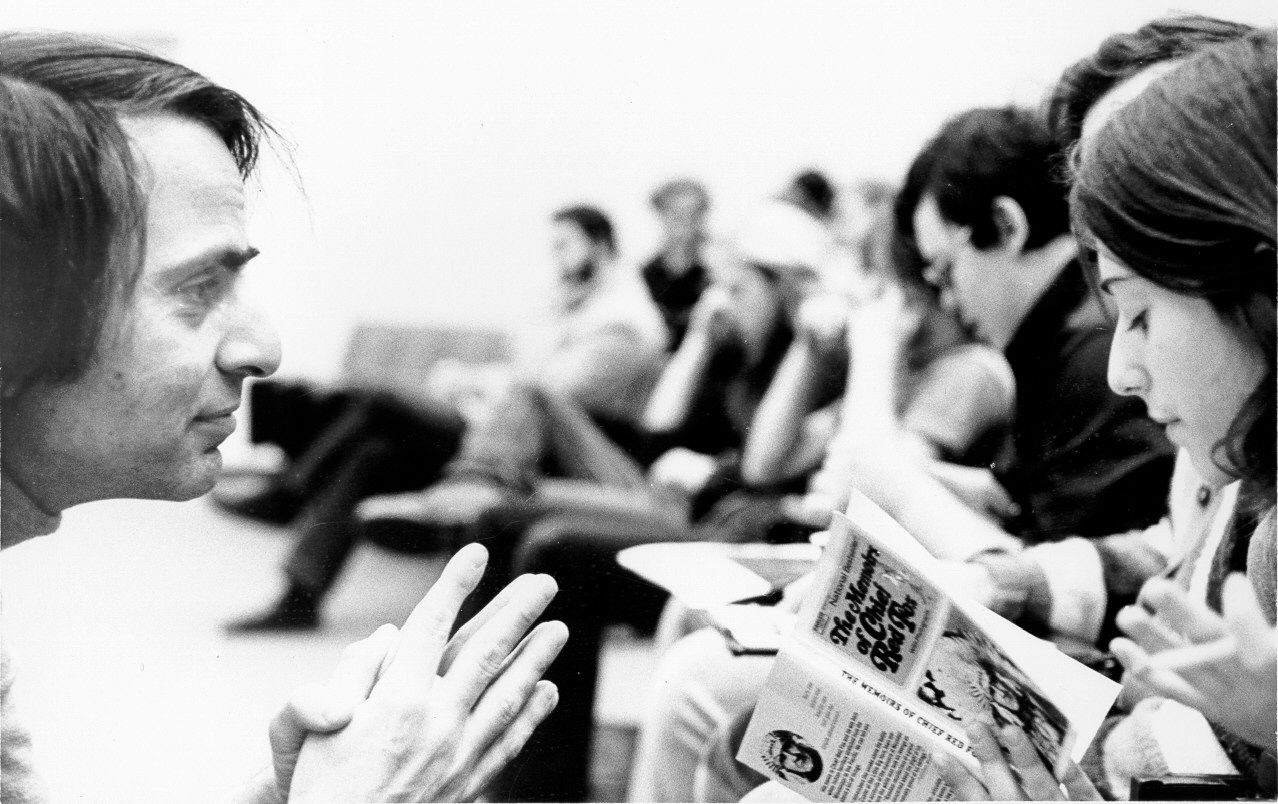
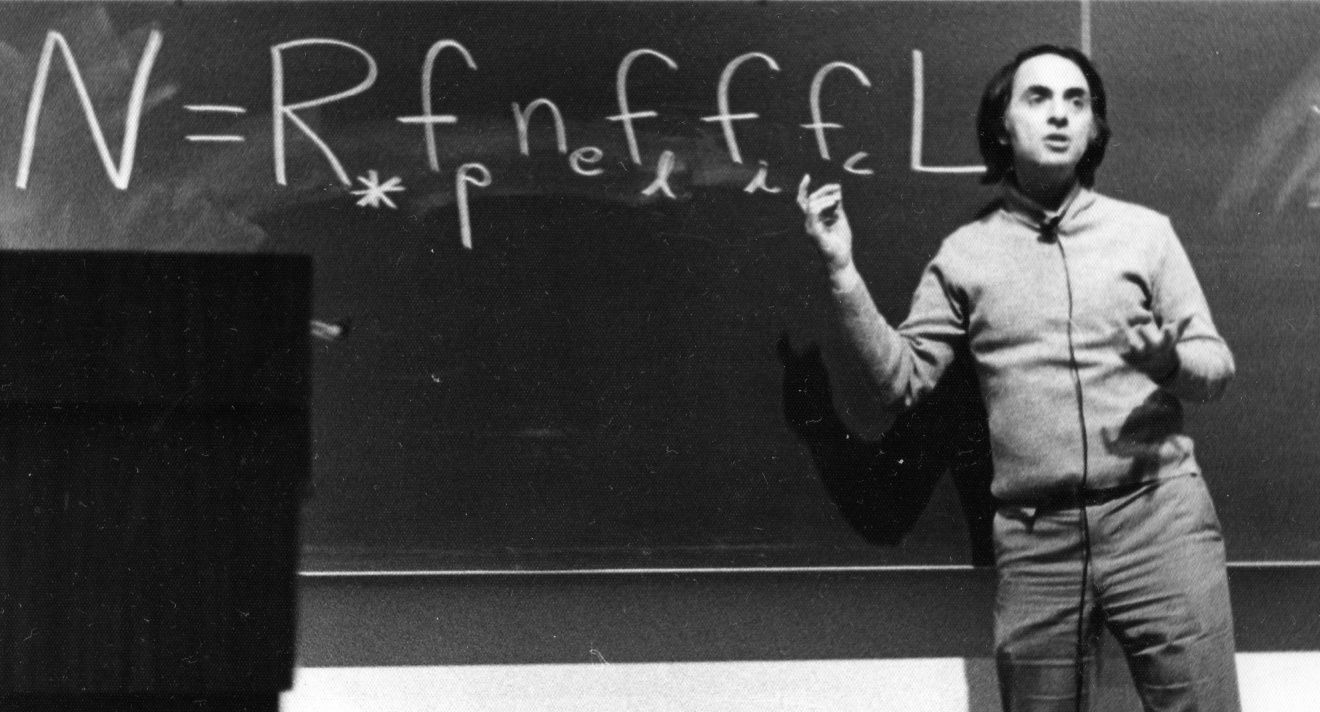
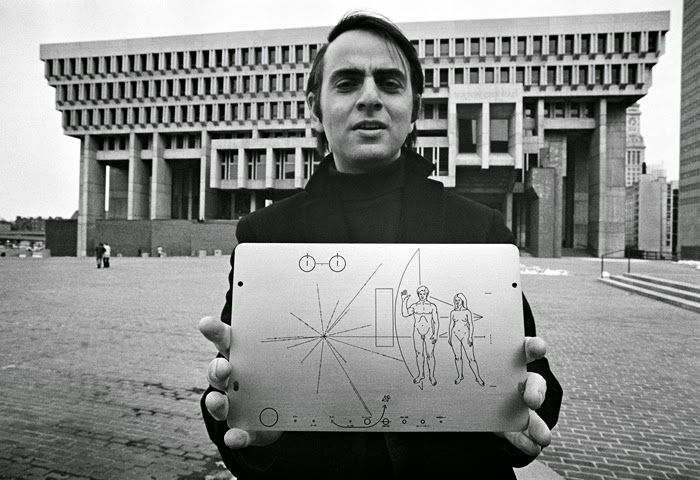
I am not an astronomer or astrophysicist. I have never worked for NASA or JPL. But, during my graduate year at Cornell University, I was short on cross-discipline credits, and so I signed up for Carl Sagan’s popular introductory course, Astronomy 101. I was also an amateur photographer, occasionally freelancing for local media—and so the photos shown here, are my own.
By the end of the 70’s, Sagan’s star was high and continuing to rise. He was a staple on the Tonight Show with Johnny Carson, producer and host of the PBS TV series, Cosmos, and he had just written Dragons of Eden, which won him a Pulitzer Prize. He also wrote Contact, which became a blockbuster movie, starring Jodie Foster.
Sagan died in 1996, after three bone marrow transplants to compensate for an inability to produce blood cells. Two years earlier, Sagan wrote a book and narrated a film based on a photo taken from space.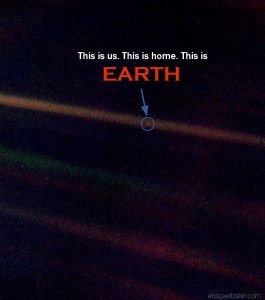
Pale Blue Dot is a photograph of Earth taken in February 1990, by Voyager 1 from a distance of 3.7 billion miles (40 times the distance between earth and the sun). At Sagan’s request (and with some risk to the ongoing scientific mission), the space probe was turned around to take this last photo of Earth. In the photo, Earth is less than a pixel in size. Just a tiny dot against the vastness of space, it appears to be suspended in bands of sunlight scattered by the camera lens.
Four years later, Sagan wrote a book and narrated the short film, Pale Blue Dot, based on the landmark 1990 photograph. He makes a compelling case for reconciliation between humans and a commitment to care for our shared environment. In just 3½ minutes, he unites humanity, appealing to everyone with a conscience. [Full text]
—Which brings us to a question: How are we doing? Are we getting along now? Are we treating the planet as a shared life-support system, rather than a dumping ground?
Sagan points out that hate and misunderstanding plays into so many human interactions. He points to a deteriorating environment and that that we cannot escape war and pollution by resettling to another place. Most importantly, he forces us to face the the fragility of our habitat and the need to protect it. He drives home this point by not just explaining it, but by framing it as an urgent choice between life and death.
It has been 22 years since Sagan wrote and produced Pale Blue Dot. What has changed? Change is all around us, and yet not much has changed. To sort it all out, let’s break it down into technology, our survivable timeline and sociology.
Technology & Cosmology
Survivable Timeline
We have an insatiable appetite for raw materials, open spaces, cars and luxury. Yet no one seems to be doing the math. As the vast populations of China and India finally come to the dinner table (2 billion humans), it is clear that they have the wealth to match our gluttony. From where will the land, water, and materials come? And what happens to the environment then? In Beijing, the sky is never blue. Every TV screen is covered in a thick film of dust. On many days, commuters wear filter masks. There is no grass in the parks and no birds in the sky. Something is very wrong. With apologies for a mixed metaphor, the canary is already dead while the jester continues to dance.
Sociology: Man’s Inhumanity to Man
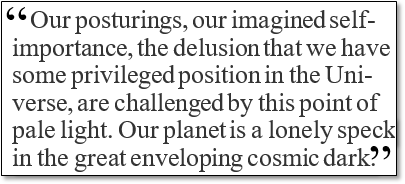
Is it time to revisit Pale Blue Dot? Is it still relevant? The urgency of teaching and heeding Carl Sagan’s words has never been more urgent than now.
Postscript:
Carl Sagan probably didn’t like me. When I was his student, I was a jerk.
Sagan was already a TV personality and author when I took Astronomy 101 in 1977. Occasionally, he discussed material from the pages of his just-released Dragons of Eden, or slipped a photo of himself with Johnny Carson into a slide presentation. He clearly was a star attraction during parent’s weekend before classes started.
Indeed, he often used the phrase “Billions and Billions” even before it led as his trademark. Although he seemed mildly mused that people noticed his annunciation and emphasis, he explained that he thought it was a less distracting alternate to the phrase “That’s billions with a ‘B’ ” when generating appreciation for the vast scope of creation.
At this time that Sagan was my professor, he appeared on the cover of Newsweek magazine. Like a lunkhead, I wrote to Newsweek, claiming that his adulation as a scientist was misplaced and that he was nothing more than an PR huckster for NASA and JPL in the vein of Isaac Asimov. I acknowledged his a gift for popularizing science, but argued that he didn’t have the brains to contribute in any tangible way.
I was wrong, of course. Even in the role of education champion, I failed to appreciate the very powerful and important role that he played in influencing an entire generation of scientists, including, Neil DeGrasse Tyson. Although Newsweek did not publish my letter to the editor, someone on staff sent it to Professor Sagan! When the teaching assistant, a close friend of Sagan, showed me my letter, I was mortified.
Incidentally, I always sat in the front row of the big Uris lecture hall. As a student photographer, I took many photos, which show up on various university web sites from time to time. In the top photo, Professor Sagan is crouching down and clasping hands as he addresses the student seated next to me.
Supermassive black holes are incredibly tiny. So small that we’ve never actually seen one.
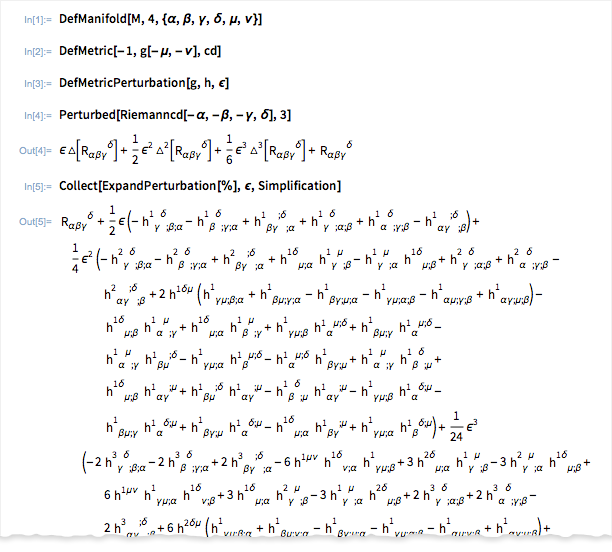
New equation proves no “Big Bang” theory and no beginning either as well as no singularity.
(Phys.org) —The universe may have existed forever, according to a new model that applies quantum correction terms to complement Einstein’s theory of general relativity. The model may also account for dark matter and dark energy, resolving multiple problems at once.
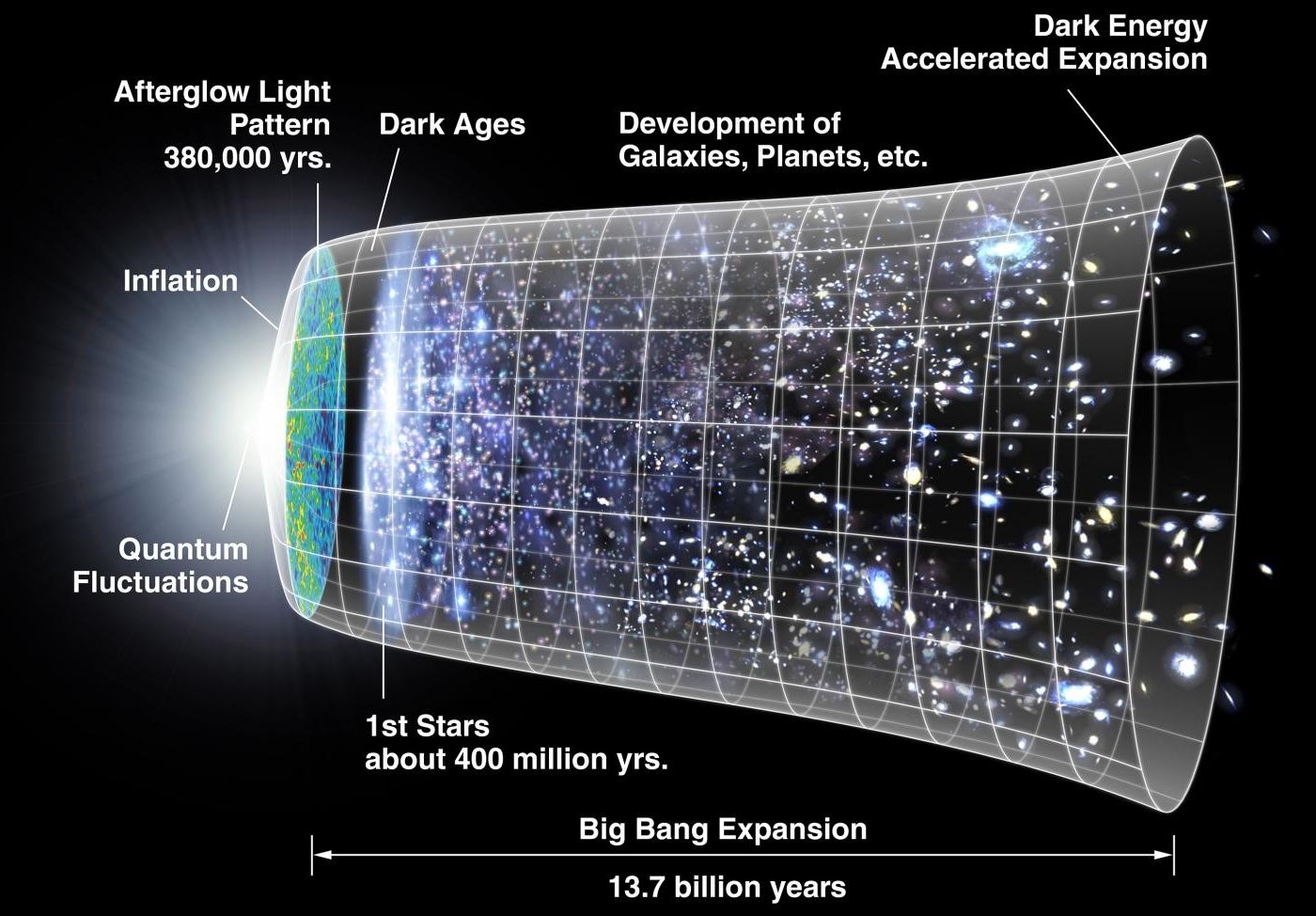
The widely accepted age of the universe, as estimated by general relativity, is 13.8 billion years. In the beginning, everything in existence is thought to have occupied a single infinitely dense point, or singularity. Only after this point began to expand in a “Big Bang” did the universe officially begin.
Although the Big Bang singularity arises directly and unavoidably from the mathematics of general relativity, some scientists see it as problematic because the math can explain only what happened immediately after—not at or before—the singularity.