Toggle light / dark theme

Nuclear Fantasies

Neutron stars cannot exist.

“The sky was clear—remarkably clear—and the twinkling of all the stars seemed to be but throbs of one body, timed by a common pulse.” —Thomas Hardy.

On June 13, 2012 NASA launched the Nuclear Spectroscopic Telescope Array (NuSTAR) on a mission to study X-rays in what are thought to be the remnants of supernova explosions, called pulsars. NuStar joins other X-ray space telescopes like Chandra and XMM-Newton, except that it is capable of focusing X-rays to a sharp point, enabling it to “see” energies up to 79,000 electron-volts. That capability makes it more than 100 times more powerful than the other observatories.

Coronal Holes, Cosmic Collision, Big Announcement | S0 News Nov.14.2019

Daily sun, earth and science news

Need to Catch Up?
CLIMATE FORCING: https://youtu.be/rEWoPzaDmOA
CLIMATE FORCING [Short]: https://youtu.be/tul07hx8V8w
PLASMA COSMOLOGY: https://youtu.be/E4pWZGBpWP0
PLASMA COSMOLOGY [Short]: https://youtu.be/G48V-Fmh4uc
COSMIC DISASTER: https://youtu.be/B_zfMyzXqfI

Lots more on our channel page, just click our name!

Our Websites:
https://www.Suspicious0bservers.org
https://www.SpaceWeatherNews.com
https://www.QuakeWatch.net
https://www.ObservatoryProject.com
https://www.MagneticReversal.org

Facebook: https://www.facebook.com/observatoryproject/
Alerts on Twitter: https://twitter.com/TheRealS0s
Instagram: https://www.instagram.com/mobileobservatoryproject

Wanted- Earthquake Forecasters: https://youtu.be/l1iGTd84oys

Double Down

Stars explode. But how?

A recent press release asks, “What happens when a star explodes?” The answer, not surprisingly, is, “…the same thing that happens when gas explodes here on Earth.”

The Electric Universe agrees with modern physics: a supernova is an exploding star. However, there is much more to the story that involves plasma. Electricity flowing through plasma creates regions of charge separation isolated by double layers. Could charge separation be the foundation for supernovae?

NASA Scientists Detect Huge Thermonuclear Blast Deep in Space

NASA recently detected a massive thermonuclear explosion coming from outer space.

The culprit seems to be a distant pulsar, the space agency reports, which is the stellar remains of a star that blew up in a supernova but was too small to form a black hole. NASA spotted the burst because it sent out an intense beam of x-rays that got picked up by the agency’s orbital observatory NICER.

All in all, it serves as a potent reminder: space is an extremely dangerous, extremely metal place.

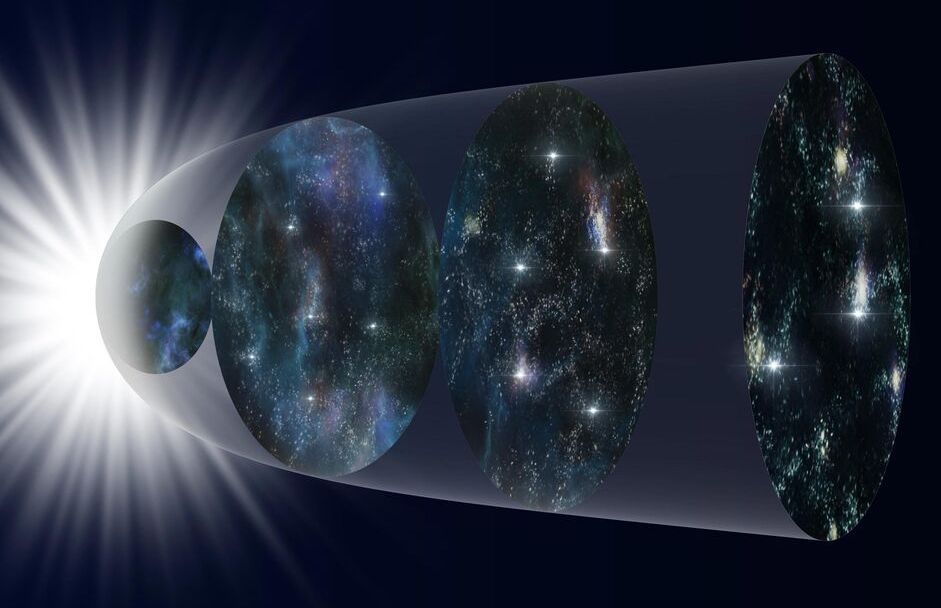
New Research Suggests the Universe May Be A Closed Sphere, Not Flat

Most people think of space as a flat sheet: You travel in one direction, and you end up far from your starting point. But a new paper suggests that the universe may in fact be spherical: If you travel far enough in the same direction, you’d end up back where you started.

Based on Einstein’s theory of relativity, space can bend into different shapes, so scientists assume the universe must be either open, flat, or closed. Flat is the easiest shape to understand: it is how we experience space in our everyday lives, as a plane in which a beam of light would extend off into infinity. An open universe would be saddle-shaped, with a beam of light bending across the curvature. And a closed universe would be a sphere, with a beam of light eventually looping back around it to meet its origin.

In order to tell which shape our universe is, scientists can look at a phenomenon called the cosmic microwave background (CMB). This is the electromagnetic radiation which remains from the Big Bang, also called “relic radiation.” It fills all of space and can be detected with a sufficiently powerful radio telescope.

Scientists further refine how quickly the universe is expanding

Wielding state-of-the-art technologies and techniques, a team of Clemson University astrophysicists has added a novel approach to quantifying one of the most fundamental laws of the universe.

In a paper published Friday, Nov. 8, in The Astrophysical Journal, Clemson scientists Marco Ajello, Abhishek Desai, Lea Marcotulli and Dieter Hartmann have collaborated with six other scientists around the world to devise a new measurement of the Hubble Constant, the unit of measure used to describe the rate of expansion of the .

“Cosmology is about understanding the evolution of our universe—how it evolved in the past, what it is doing now and what will happen in the future,” said Ajello, an associate professor in the College of Science’s department of physics and astronomy. “Our knowledge rests on a number of parameters—including the Hubble Constant—that we strive to measure as precisely as possible. In this paper, our team analyzed data obtained from both orbiting and ground-based telescopes to come up with one of the newest measurements yet of how quickly the universe is expanding.”

Holographic Duality Yields Breakthrough in Black Hole Physics

A group of Skoltech researchers led by Professor Anatoly Dymarsky studied the emergence of generalized thermal ensembles in quantum systems with additional symmetries. As a result, they found that black holes thermalize the same way ordinary matter does. The results of their study were published in Physical Review Letters.

The physics of black holes remains an elusive chapter of modern physics. It is the sharpest point of tension between quantum mechanics and the theory of general relativity. According to quantum mechanics, black holes should behave like other ordinary quantum systems. Yet, there are many ways in which this is problematic from the point of view of Einstein’s theory of general relativity. Therefore, the question of understanding black holes quantum mechanically remains a constant source of physical paradoxes. The careful resolution of such paradoxes should provide us a clue as to how quantum gravity works. That is why the physics of black holes is the subject of active research in theoretical physics.

One particularly important question is how black holes thermalize. A recent study undertaken by a group of Skoltech researchers found that in this regard black holes are not that different from ordinary matter. Namely, the emergence of equilibrium can be explained in terms of the same mechanism as in the conventional case. An analytical study of black holes became possible due to the rapidly developing theoretical tools of the so-called holographic duality. This duality maps certain types of conventional quantum systems to particular cases of quantum gravity systems. Although additional work is necessary to extend this similarity to thermalization dynamics, this work provides additional support for the paradigm that important aspects of black holes and quantum gravity, in general, can be explained in terms of the collective dynamics of conventional quantum many-body systems.

/* */