Toggle light / dark theme

New 3D wiring technique brings scalable quantum computers closer to reality

Great advancement around how to make QC available on small scale devices.


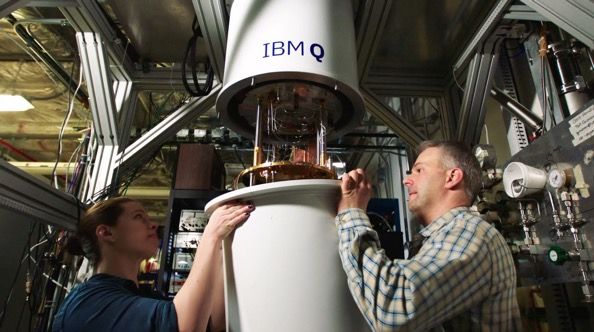
Researchers from the Institute for Quantum Computing (IQC) at the University of Waterloo led the development of a new extensible wiring technique capable of controlling superconducting quantum bits, representing a significant step towards to the realization of a scalable quantum computer.

“The quantum socket is a wiring method that uses three-dimensional wires based on spring-loaded pins to address individual qubits,” said Jeremy Béjanin, a PhD candidate with IQC and the Department of Physics and Astronomy at Waterloo. He and Thomas McConkey, PhD candidate from IQC and the Department of Electrical and Computer Engineering at Waterloo, are lead authors on the study that appears in the journal Physical Review Applied as an Editors’ Suggestion and is featured in Physics. “The technique connects classical electronics with quantum circuits, and is extendable far beyond current limits, from one to possibly a few thousand qubits.”

One promising implementation of a scalable quantum computing architecture uses a superconducting qubit, which is similar to the electronic circuits currently found in a classical computer, and is characterized by two states, 0 and 1. Quantum mechanics makes it possible to prepare the qubit in superposition states, meaning that the qubit can be in states 0 and 1 at the same time. To initialize the qubit in the 0 state, superconducting qubits are brought down to temperatures close to −273 degrees Celsius inside a cryostat, or dilution refrigerator.

How quantum effects could improve artificial intelligence

(Phys.org)—Over the past few decades, quantum effects have greatly improved many areas of information science, including computing, cryptography, and secure communication. More recently, research has suggested that quantum effects could offer similar advantages for the emerging field of quantum machine learning (a subfield of artificial intelligence), leading to more intelligent machines that learn quickly and efficiently by interacting with their environments.

In a new study published in Physical Review Letters, Vedran Dunjko and coauthors have added to this research, showing that quantum effects can likely offer significant benefits to .

“The progress in machine learning critically relies on processing power,” Dunjko, a physicist at the University of Innsbruck in Austria, told Phys.org. “Moreover, the type of underlying information processing that many aspects of machine learning rely upon is particularly amenable to quantum enhancements. As quantum technologies emerge, quantum machine learning will play an instrumental role in our society—including deepening our understanding of climate change, assisting in the development of new medicine and therapies, and also in settings relying on learning through interaction, which is vital in automated cars and smart factories.”

Cognitive Scale – Cognitive Computing in The Cloud

Everything is about cloud computing these days. In fact, there is such an emphasis on stuffing all your applications into the cloud that we’ve managed to create a situation where now we’re having performance issues. So then the tech world came up with another concept called fog computing which means we take everything out of the cloud and move it “to the edge”. It’s only a matter of time before we decide that edge computing isn’t centralized enough and then start moving everything back up to the cloud. All the while, highly paid data consultants are laughing all the way to the bank. The truth is though that cloud based solutions (also called software-as-a-service or SaaS) are here to stay. In many cases, the technology on offer is so complex and resource intensive that it only works with a centralized model. Quantum computing is a good example of this. So is IBM’s Watson cognitive computing solution. The company we’re going to talk about in this article, Cognitive Scale, is taking IBM Watson and making cognitive computing available to anyone via the cloud.

cognitive-scale-logo

Founded in 2013, Texas based startup Cognitive Scale took in $25 million in funding just last week from investors that included Intel, Microsoft, and IBM. Probably the most compelling thing about Cognitive Scale is the pedigree of their leadership. The Company Chairman, Manoj Saxena, was responsible for commercializing IBM’s Watson with a $1 billion investment from IBM. He ended up at IBM because a company he founded called Webify was acquired by IBM in 2006. In fact, he founded and sold two venture-backed software companies in just 5 years’ time. The founder and CTO of Cognitive Scale, Matt Sanchez, was the 3rd employee and Chief Architect of Webify and was responsible for founding the R&D arm of IBM Watson called IBM Watson Labs. See how this all fits together?

DeepMind’s new computer can learn from its own memory

DeepMind, an artificial intelligence firm that was acquired by Google in 2014 and is now under the Alphabet umbrella, has developed a computer than can refer to its own memory to learn facts and use that knowledge to answer questions.

That’s huge, because it means that future AI could respond to queries from humans without being taught every possible correct answer.

TNW Momentum is our New York technology event for anyone interested in helping their company grow.

Brain implant provides sense of touch with robotic hand – and that’s just the start

A dozen years ago, an auto accident left Nathan Copeland paralyzed, without any feeling in his fingers. Now that feeling is back, thanks to a robotic hand wired up to a brain implant.

“I can feel just about every finger – it’s a really weird sensation,” the 28-year-old Pennsylvanian told doctors a month after his surgery.

Today the brain-computer interface is taking a share of the spotlight at the White House Frontiers Conference in Pittsburgh, with President Barack Obama and other luminaries in attendance.

/* */