Some more words on this idea that black holes are quantum computers.

Researchers of CWI, University of Gdansk, Gdansk University of Technology, Adam Mickiewicz University and the University of Cambridge have proven that quantum communication is based on nonlocality. They show that whenever quantum communication is more efficient than classical communication, it must be possible find a nonlocal correlation somewhere. Their paper ‘Quantum communication complexity advantage implies violation of a Bell inequality’, appeared in this month’s issue of the influential journal PNAS.
It has long been known that quantum mechanics predicts counterintuitive effects such as instantaneous interaction at a distance between entangled particles. This teleportation effect, which Albert Einstein famously called ‘spooky action at a distance,’ was long thought to show that the theory of quantum mechanics was incomplete. However, in 1964, physicist J.S. Bell proved that no theory involving the principle of locality can ever reproduce all predictions of quantum mechanics. In other words, it is impossible to find classical explanations for quantum correlations. This evidence for the existence of nonlocality became known as Bell’s inequality.
For a long time, the existence of quantum correlations was merely of interest to philosophically minded physicists, and was considered an exotic peculiarity rather than a useful resource for practical problems in physics or computer science. This has changed dramatically in recent years. Quantum correlation proved to be very useful in information processing. In several communication tasks, using quantum effects substantially reduced the communication complexity: the minimum number of steps necessary to complete a certain task between two parties. In such cases, there is a so-called quantum advantage in communication complexity.
A lot of transhumanism friends have asked me to write about Bernie Sanders, so here are my thoughts:
The transhumanism movement has been dramatically growing in size—and most of that growth is from millennials and youth joining. Transhumanists want to use science and technology to radically improve the human race, and the onslaught of new gear and gadgets to do that—like virtual reality, robots, and chip implants —are giving them plenty of ammunition to do that.
But what has caught many people off guard—including myself who probably best fits into the category: left-leaning Libertarian—is the amount of support transhumanists are giving to Bernie Sanders’s presidential campaign. Historically, transhumanism (and its de facto home: Silicon Valley) has been Libertarian-minded —with a hands-off attitude towards the government, religion, and basically any authority trying to tell them what to do or how to innovate. But with the demographics of the transhumanism movement sharply changing from older academics and technologists to young people—especially those in college—the push towards more leftist and progressive-leaning ideas is strong. For many young transhumanists, they believe they have found an ideal in Sanders.
While I like the charisma of Sanders and his long standing devotion to the people—and that is enough for me to say he’d be a good president for change—the reality is capitalism is still a hallmark of the American way. For the next four and maybe even eight years, capitalism won’t be going anywhere. Afterward, though, within 10–25 years, when robots, software, and AI really start dismantling capitalism as we know it (see my latest TechCrunch article and thoughts on a Universal Basic Income), it will be a totally different story.
Like it or not, millennials and youth obsess over this type of economy stuff—especially machines taking jobs. They know future employment statistics better than many 30-year veteran business executives running publicly traded companies. The dangerous truth is many young people know they likely won’t have jobs in the future. And neither will most of the executives for that matter, since they too can (and will) be replaced by super intelligent machines programmed to make sound mathematical business decisions.
Welcome to the future.
Blast from the past. Someone in an astrobiology group seemed to question the validity of the question in my recent story on 5 Questions For E.T. about whether the universe is artificial. Here’s my response:
In the dog days of summer, when a gush of hot air from a Fifth Avenue subway grate can feel as real as it gets, take heart that the downtown traffic nipping at your heels may just be part of a cosmic-scale computer simulation.
The idea that the cosmos and everything in it could be a super-advanced civilization’s version of Xbox first came to the fore a little over a decade ago.
In a Philosophical Quarterly paper, philosophy professor Nick Bostrom at Oxford University in the U.K., posits that what we observe as our universe may in fact be a very advanced simulation designed by our distant progeny.

However, Rob Ott, a computer scientist at Stanford University in Palo Alto, California, who did work on the system—Deep Learning Interface for Accounting (DELIA)—notes that it simply held all of the missing money, some $40,120.16, in a “rainy day” account. “I don’t think you can attribute malice,” he says. “I’m sure DELIA was going to give the money back.”
Technologists shocked by program’s ability to set its own priorities—such as getting rich.

The machine overlords of the future may now, if it pleases them, eliminate all black and white imagery from the history of their meat-based former masters. All they’ll need is this system from Berkeley computer scientist Richard Zhang, which allows a soulless silicon sentience to “hallucinate” colors into any monochrome image.
It uses what’s called a convolutional neural network (several, actually) — a type of computer vision system that mimics low-level visual systems in our own brains in order to perceive patterns and categorize objects. Google’s DeepDream is probably the most well-known example of one. Trained by examining millions of images of— well, just about everything, Zhang’s system of CNNs recognizes things in black and white photos and colors them the way it thinks they ought to be.
Grass, for instance, has certain features — textures, common locations in images, certain other things often found on or near it. And grass is usually green, right? So when the network thinks it recognizes grass, it colors that region green. The same thing occurs for recognizing certain types of butterflies, building materials, flowers, the nose of a certain breed of dog and so on.

Nanoparticle diodes and devices that work when wet.
“Groundbreaking” research by Prof. Bartosz Grzybowski (School of Natural Science).
Nanoparticle Diodes and Devices That Work When Wet.
A new study by an international team of researchers, affiliated with UNIST has found a new way to produce electronic devices, such as diodes, logic gates, and sensors without the need of semiconductors.
In their study, published in the current edition of Nano Technology, the team reported that they used metal nanoparticles, coated with charged organic ligands to create versatile electronic circuits, which they have named “chemoelectronic” circuits.
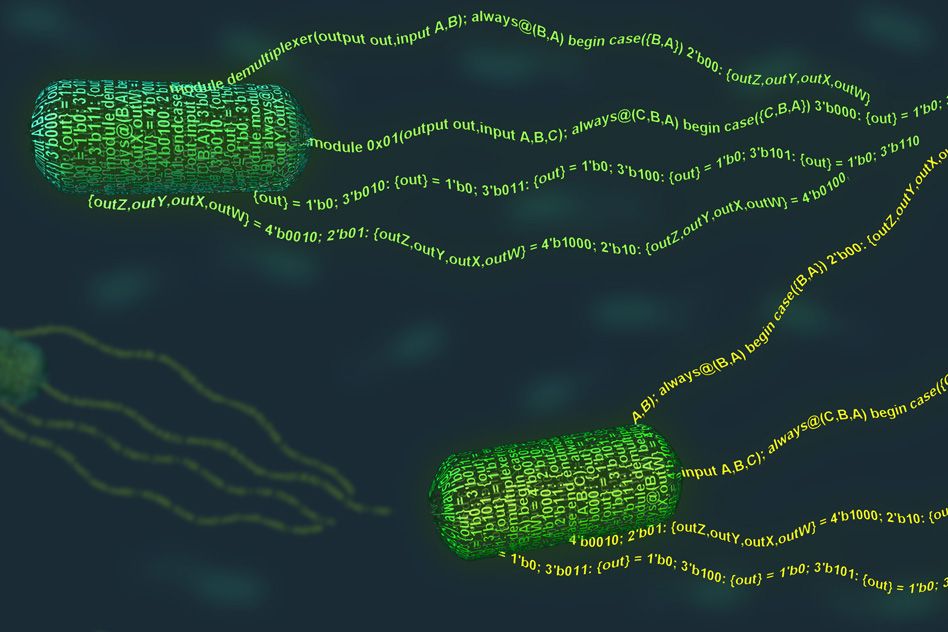
MIT biological engineers have created a programming language that allows them to rapidly design complex, DNA-encoded circuits that give new functions to living cells.
Using this language, anyone can write a program for the function they want, such as detecting and responding to certain environmental conditions. They can then generate a DNA sequence that will achieve it.
“It is literally a programming language for bacteria,” says Christopher Voigt, an MIT professor of biological engineering. “You use a text-based language, just like you’re programming a computer. Then you take that text and you compile it and it turns it into a DNA sequence that you put into the cell, and the circuit runs inside the cell.”
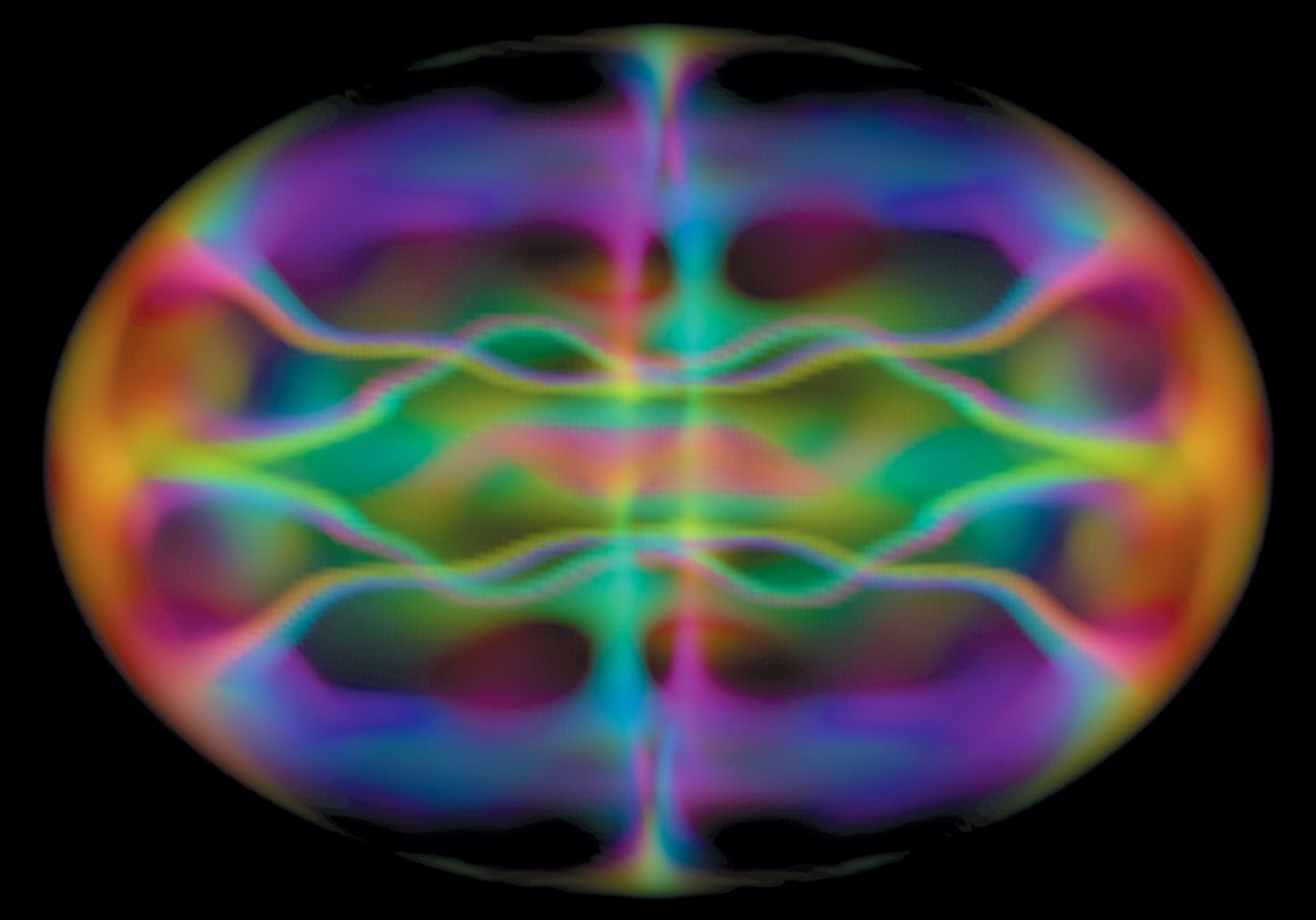
Black-hole computing.
Might nature’s bottomless pits actually be ultra-efficient quantum computers? That could explain why data never dies.
