Toggle light / dark theme

Intel and Toshiba Make 3D SSD With 10TB Capacity at Lower Prices

The BiCS uses 48-layer stacking process that improves reliability and speed. Toshiba was the company that invented flash memory and has the 15nm NAND cells which are the smallest in the world.

Right now company is gearing up for its mass production and giving out samples to the companies.

These new developments made by Micron and Intel, and Toshiba will take about one year to reach the market. These 3D SSDs will give a tough time to the existing players and will provide better speeds and more storage at cheaper rates to users.

Read more

Beautiful Engineering

1 Bit = Binary Digit.

8 Bits = 1 Byte.

1024 Bytes = 1 Kilobyte.

1024 Kilobytes = 1 Megabyte.

1024 Megabytes = 1 Gigabyte.

1024 Gigabytes = 1 Terabyte.

1024 Terabytes = 1 Petabyte.

1024 Petabytes = 1 Exabyte.

1024 Exabytes = 1 Zettabyte.

1024 Zettabytes = 1 Yottabyte.

1024 Yottabytes = 1 Brontobyte.

1024 Brontobytes = 1 Geopbyte.

1024 Geopbyte=1 Saganbyte.

1024 Saganbyte=1 Pijabyte.

Alphabyte = 1024 Pijabyte.

Kryatbyte = 1024 Alphabyte.

Amosbyte = 1024 Kryatbyte.

Pectrolbyte = 1024 Amosbyte.

Bolgerbyte = 1024 Pectrolbyte.

Sambobyte = 1024 Bolgerbyte.

Quesabyte = 1024 Sambobyte.

Kinsabyte = 1024 Quesabyte.

Rutherbyte = 1024 Kinsabyte.

Dubnibyte = 1024 Rutherbyte.

Seaborgbyte = 1024 Dubnibyte.

Bohrbyte = 1024 Seaborgbyte.

Hassiubyte = 1024 Bohrbyte.

Meitnerbyte = 1024 Hassiubyte.

Darmstadbyte = 1024 Meitnerbyte.

Roentbyte = 1024 Darmstadbyte.

Coperbyte = 1024 Roentbyte…!

More At:- Beautiful Engineering.

Read more

3D Microchip Allows Information to Travel in Three Dimensions

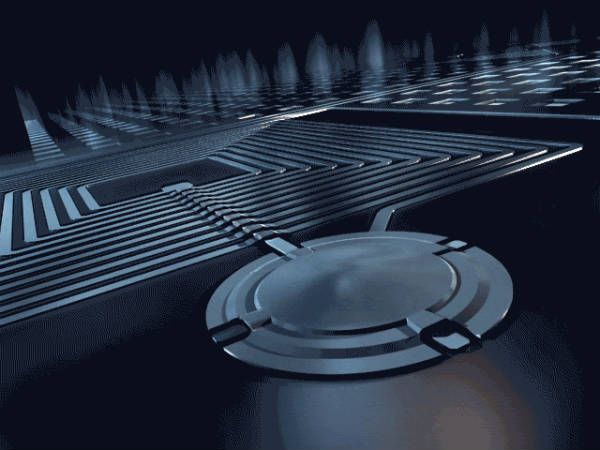
Researchers at the University of Cambridge have created a new type of microchip that allows information to move in three dimensions, left to right, back to front and up and down.

Scientists from the University of Cambridge have created, for the first time, a new type of microchip which allows information to travel in three dimensions. Currently, microchips can only pass digital information in a very limited way – from either left to right or front to back. The research was published today, 31 January, in Nature.

Dr Reinoud Lavrijsen, an author on the paper from the University of Cambridge, said: “Today’s chips are like bungalows – everything happens on the same floor. We’ve created the stairways allowing information to pass between floors.”

Read more

Microsoft demos English-to-Chinese universal translator that keeps your voice and accent Alternative World News Network At an event in China

Microsoft demos English-to-Chinese universal translator that keeps your voice and accent.

Alternative World News Network.

At an event in China, Microsoft Research chief Rick Rashid has demonstrated a real-time English-to-Mandarin speech-to-speech translation engine. Not only is the translation very accurate, but the software also preserves the user’s accent and intonation. We’re not just talking about a digitized, robotic translator here — this is firmly within the realms of Doctor Who or Star Trek universal translation.

The best way to appreciate this technology is to watch the video below. The first six minutes or so is Rick Rashid explaining the fundamental difficulty of computer translation, and then the last few minutes actually demonstrate the software’s English-to-Mandarin speech-to-speech translation engine. Sadly I don’t speak Chinese, so I can’t attest to the veracity of the translation, but the audience — some 2,000 Chinese students — seems rather impressed. A professional English/Chinese interpreter also remarked to me that the computer translation is surprisingly good; not quite up to the level of human translation, but it’s getting close.

Read more

Single photon decision-maker solves multi-armed bandit problem

https://en.wikipedia.org/wiki/Multi-armed_bandit

In probability theory, the multi-armed bandit problem (sometimes called the K- or N-armed bandit problem) is a problem in which a gambler at a row of slot machines (sometimes known as “one-armed bandits”) has to decide which machines to play, how many times to play each machine and in which order to play them. When played, each machine provides a random reward from a distribution specific to that machine. The objective of the gambler is to maximize the sum of rewards earned through a sequence of lever pulls.


(Phys.org)—A combined team of researchers from France and Japan has created a decision-making device that is based on basic properties of quantum mechanics. In their paper published in Scientific Reports (and uploaded to the arXiv preprint server), the team describes the idea behind their device and how it works.

There is a classic decision-making problem that is known as the exploration-exploitation dilemma—it is typically described by suggesting a scenario where a gambler faced with a floor full of must decide which offers the best payout on a regular basis. In real life, the solution involves feeding all of the machines coins until a discernible pattern emerges. Computer algorithms have been developed to run essentially the same process. Now, however, that approach appears to be ready for an update, as the researchers with this new effort have come up with a way to run the same sort of algorithm without using any kind of computer. Instead, they use a laser, a and feedback device. The idea is based on the fact that laws are probabilistic in nature.

The device is based on prior research that has shown that if photons are fired from a proton gun at a 45 degree angle, they will each have an equal chance of being vertically or horizontally polarized when they strike a detector—thus a stream will have equal numbers of both. But, if the filter on the gun is changed slightly, to say fire at 44 or 46 degree angles, that increase the odds of the associated polarization. The team used that fact by adding a feedback loop to the system—data sent back representing a “win” on a slot machine caused the filter to move in one direction, while a loss moved it in the other. Over time, the preponderance of wins (indicating a learning process) from one virtual machine would drive the device towards indicating it was the winning choice.

Read more

/* */