Toggle light / dark theme

UCLA chemists report new insights about properties of matter at the nanoscale

UCLA’s new method to smaller molecule machines.


UCLA nanoscience researchers have determined that a fluid that behaves similarly to water in our day-to-day lives becomes as heavy as honey when trapped in a nanocage of a porous solid, offering new insights into how matter behaves in the nanoscale world.

“We are learning more and more about the properties of matter at the nanoscale so that we can design machines with specific functions,” said senior author Miguel García-Garibay, dean of the UCLA Division of Physical Sciences and professor of chemistry and biochemistry.

The research is published in the journal ACS Central Science.

Study claims: Chinese Civilization Come From Ancient Egypt

On a cool Sunday evening in March, a geochemist named Sun Weidong gave a public lecture to an audience of laymen, students, and professors at the University of Science and Technology in Hefei, the capital city of the landlocked province of Anhui in eastern China. But the professor didn’t just talk about geochemistry. He also cited several ancient Chinese classics, at one point quoting historian Sima Qian’s description of the topography of the Xia empire — traditionally regarded as China’s founding dynasty, dating from 2070 to 1600 B.C. “Northwards the stream is divided and becomes the nine rivers,” wrote Sima Qian in his first century historiography, the Records of the Grand Historian. “Reunited, it forms the opposing river and flows into the sea.”

In other words, “the stream” in question wasn’t China’s famed Yellow River, which flows from west to east. “There is only one major river in the world which flows northwards. Which one is it?” the professor asked. “The Nile,” someone replied. Sun then showed a map of the famed Egyptian river and its delta — with nine of its distributaries flowing into the Mediterranean. This author, a researcher at the same institute, watched as audience members broke into smiles and murmurs, intrigued that these ancient Chinese texts seemed to better agree with the geography of Egypt than that of China.

In the past year, Sun, a highly decorated scientist, has ignited a passionate online debate with claims that the founders of Chinese civilization were not in any sense Chinese but actually migrants from Egypt. He conceived of this connection in the 1990s while performing radiometric dating of ancient Chinese bronzes; to his surprise, their chemical composition more closely resembled those of ancient Egyptian bronzes than native Chinese ores. Both Sun’s ideas and the controversy surrounding them flow out of a much older tradition of nationalist archaeology in China, which for more than a century has sought to answer a basic scientific question that has always been heavily politicized: Where do the Chinese people come from?

Quantum Computers Are Coming, and the World Might Not Be Ready

Computadores qu nticos estão chegando. O mundo pode não estar pronto.
A mec nica qu ntica, Carl Sagan observou certa vez, é tão estranho que o “senso comum é quase inútil em se aproximar dela.” Os cientistas ainda não entendem exatamente por que a matéria se comporta como faz no nível qu ntico. No entanto, eles estão ficando melhor a exploração dos seus din mica peculiar — de maneiras que podem em breve revolucionando o negócio tecnoloco.

Não é surpresa, então, o investimento no campo está crescendo. IBM, Microsoft e Google são todos construção de laboratórios de pesquisa qu ntica. Startups estão se preparando. Os bancos estão muito interessados na verdade. Governos ver aplicações para a exploração espacial, a investigação médica e de coleta de inteligência. Agência de Segurança Nacional dos Estados Unidos, na verdade, foi discretamente tentando construir um computador qu ntico, durante anos, na esperança de que ele iria fazer um código-breaker imparável.

Via Bloomberg.

Methuselah Foundation Fellowship Award Winner Tackles Research in Macular Degeneration

Our friends at the Methuselah Foundation are working on macular degeneration.


Typically, a fellowship and participation in a research study to cure a major disease would occur years after completing undergrad, possibly even after earning a PhD. But Jennifer DeRosa is not a typical student.

As early as high school, DeRosa was already in the lab, conducting research in plant biotechnology at the College of Environmental Science and Forestry (SUNY-ESF) before graduating valedictorian from Skaneateles High School. As a freshman student at Onondaga Community College, she continued to develop skills in molecular biology, analytical chemistry, and cell biology. She logged over 1,600 hours in academic and industry laboratories while maintaining a perfect 4.0 GPA, completing her associate’s degree in Math and Science in only one year.

Although she had planned to continue to a bachelor’s program, DeRosa elected to defer enrollment after being offered a Methuselah Foundation research fellowship. “The fellowship provides distinguished students a year-long stipend to work in any laboratory of their choosing that conducts work on age-associated diseases,” said Methuselah Foundation CEO David Gobel. “We are very pleased that she chose to complete her fellowship at Ichor Therapeutics, where she has been working as a paid intern. Methuselah Foundation has a high degree of confidence in the quality and scope of work being conducted there.”

Now we can watch DNA Repair itself!

Watching DNA self-repair itself.


After 2015’s Nobel Prize in chemistry was awarded for advancements in our understanding of DNA repair, a recent Nature report characterises the mechanism in molecular detail. The implications for cancer research are vast.

Researchers in Paris, France, and Bristol, England, have leveraged recent advances in microscopy and fluorescent imaging to characterise the entire process of DNA repair at the molecular level. They were able to observe RNA polymerase, which ‘reads’ DNA and initiates its replication, as it moved along the DNA strand.

When it encountered damage inflicted by UV radiation, the enzyme stalled, and a number of proteins descended on the site. The team followed them as they acted in an ordered step-wise fashion and elucidated the critical steps of the DNA repair process: first, a protein called Mfd coordinates to RNA polymerase, then it directs a sort of relay team of UvrA, UvrB and UvrC. This deeper understanding of the mechanism could bolster efforts towards treatments for a variety of conditions.

Moving metal promises dynamic circuits

Scientists have developed self-propelling liquid metals that could be used for future electronic circuits.

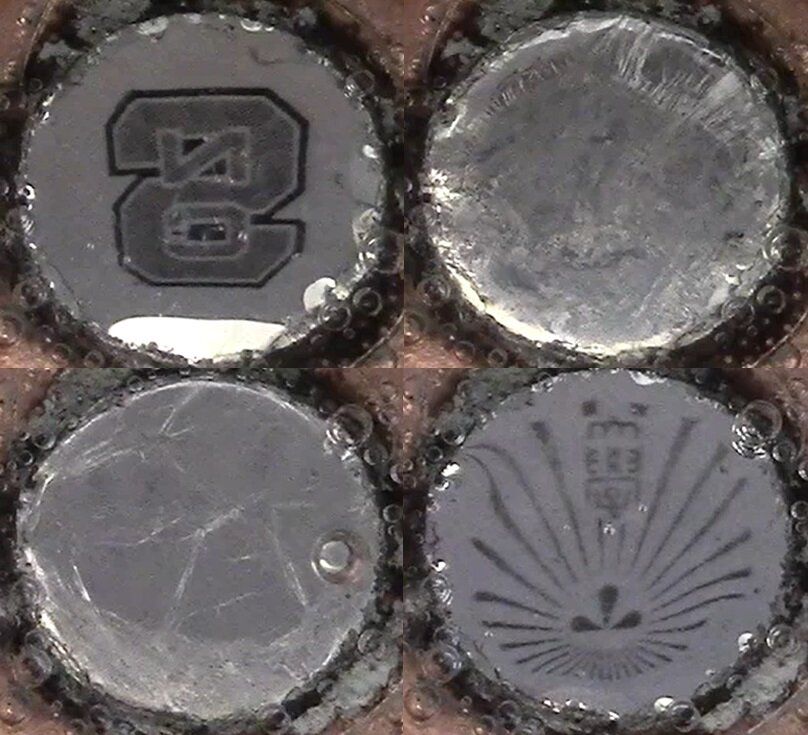
Current electronic technology is based on solid state components with fixed metallic tracks and semiconductors. Researchers are investigating soft circuit systems that act like live cells, communicating with each other to form new circuits when possible. In one study, Professor Kalantar-zadeh from RMIT University in Australia, along with his researchers immersed a number of different metallic elements, in the form of liquid droplets, in water.

Professor Kourosh Kalantar-zadeh said: “Putting droplets in another liquid with an ionic content can be used for breaking symmetry across them and allow them to move about freely in three dimensions. We adjusted the concentrations of acid, base and salt components in the water and investigated the effect. Simply tweaking the water’s chemistry made the liquid metal droplets move and change shape, without any need for external mechanical, electronic or optical stimulants.”

Quantum dots with impermeable shell used as a powerful tool for “nano-engineering”

I never get tired of talking about the many uses for Q-dot technology. One area that has me even more intrigued is how it is used in crystallized formations. I expect to see more and more experimenting on crystalized formations on many fronts including complex circuitry for performance and storage.

And, with synthetic technology today plus 3D printing along with Q-dots we could (as I have eluded to many times over several months) truly begin to see some amazing technology be developed on the wearable tech front.

Wearables could include synthetic circuitry stones in various accessories to not only store information, but also serve as another form of unique id because in synthetic stones we have been able (like in nature) create complex crystalized formations that are each unique/ 1 of a kind like a unique finger print, or iris of an eye. I expect to see some very interesting things coming in this space.


Unique optical features of quantum dots make them an attractive tool for many applications, from cutting-edge displays to medical imaging. Physical, chemical or biological properties of quantum dots must, however, be adapted to the desired needs.

Unfortunately, up to now quantum dots prepared by chemical methods could only be functionalized using copper-based click reactions with retention of their luminescence. This obstacle can be ascribed to the fact that copper ions destroy the ability of quantum dots to emit light. Scientists from the Institute of Physical Chemistry of the Polish Academy of Sciences (IPC PAS) in Warsaw and the Faculty of Chemistry of the Warsaw University of Technology (FC WUT) have shown, however, that zinc oxide (ZnO) quantum dots prepared by an original method developed by them, after modification by the click reaction with the participation of copper ions, fully retain their ability to emit light.

“Click reactions catalyzed by copper cations have long attracted the attention of chemists dealing with quantum dots. The experimental results, however, were disappointing: after modification, the luminescence was so poor that they were just not fit for use. We were the first to demonstrate that it is possible to produce quantum dots from organometallic precursors in a way they do not lose their valuable optical properties after being subjected to copper-catalysed click reactions,” says Prof. Janusz Lewinski (IPC PAS, FC WUT).

The laws of nature make life on other planets inevitable — according to this groundbreaking theory

According to theoretical physicist and super-genius Stephen Hawking, “The human race is just a chemical scum on a moderate-sized planet orbiting round a very average star in the outer suburb of one among a hundred billion galaxies.” Indeed, to most modern scientists we are nothing more than an entirely random ‘happy accident’ that likely would not occur if we were to rewind the tape of the universe and play it again. But what if that is completely wrong? What if life is not simply a statistical anomaly, but instead an inevitable consequence of the laws of physics and chemistry?

A new theory of the origin of life, based firmly on well-defined physics principles, provides hefty support for the notion that biological life is a “cosmic imperative”. In other words, organic life had to eventually emerge. If such a theory were true, it would mean that it is very likely that life is widespread throughout the universe.

Chemical Switch Engineered into a Light-Driven Proton Pump

Synthetic biology is an emerging and rapidly evolving engineering discipline. Within the NCCR Molecular Systems Engineering, Scientists from Bernese have developed a version of the light-driven proton pump proteorhodopsin, which is chemically switchable and it is also an essential tool to efficiently power synthetic cells and molecular factories.

Synthetic biology is a highly complex field with numerous knowledge branches that incorporate physics, biology, and chemistry into engineering. It aims to design synthetic cells and molecular factories with innovative functions or properties that can be applied in medical and biological research or healthcare, industry research.

These artificial systems are available in the nanometer scale and are developed by assembling and combining current, synthetic or engineered building blocks (e.g., proteins). Molecular systems are applicable for a wide range of applications, for instance these systems can be used for waste disposal, medical treatment or diagnosis, energy supply and chemical compound synthesis.

/* */