The security of applications is not just a technical issue but a cornerstone of business integrity and continuity.

🐤 Follow Me on Twitter https://twitter.com/TheAiGrid.
🌐 Checkout My website — https://theaigrid.com/
Links From Todays Video:
https://blog.samaltman.com/reflections.
00:00 — Why 2025 is crucial.
00:21 — AI Agents.
01:10 — Digital Employees.
02:20 — Klarna’s AI
03:39 — 11 Labs AI
05:00 — Workflow Agents.
06:08 — AI Deployment.
06:48 — Google’s 2026 Vision.
07:30 — Agent Reliability.
08:48 — Anthropic’s Agents.
09:44 — Current Benchmarks.
10:24 — GPT Improvements.
11:23 — Microsoft AI Teams.
12:01 — Sam Altman’s 2025 Vision.
12:31 — Superintelligence.
13:24 — OpenAI’s Tools.
14:00 — Upcoming AI Agent.
Welcome to my channel where i bring you the latest breakthroughs in AI. From deep learning to robotics, i cover it all. My videos offer valuable insights and perspectives that will expand your knowledge and understanding of this rapidly evolving field. Be sure to subscribe and stay updated on my latest videos.
Was there anything i missed?
(For Business Enquiries) [email protected].
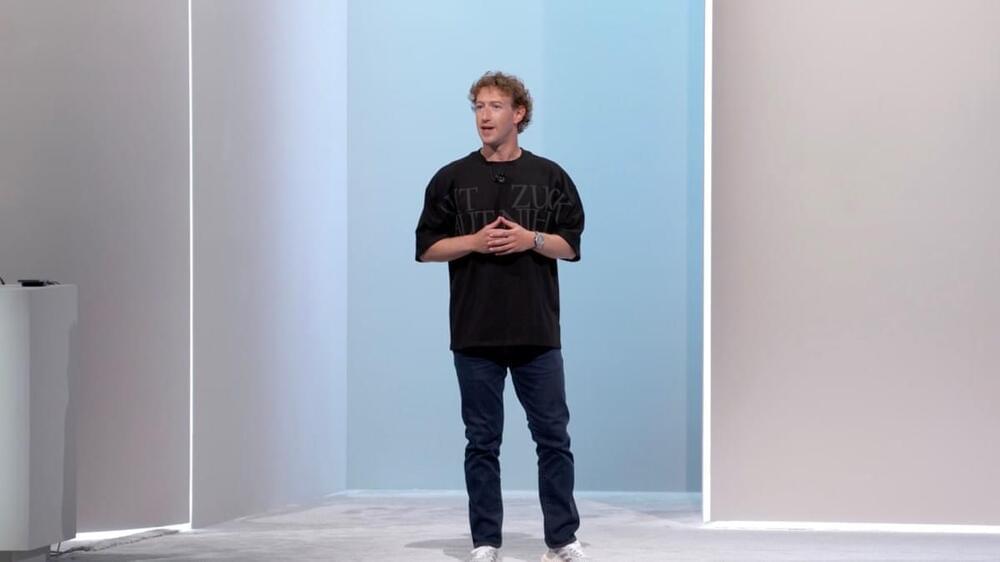
Meta has appointed three new members to its board of directors, the company announced Monday: UFC president and CEO Dana White, European investment company Exor CEO John Elkann, and tech investor and entrepreneur Charlie Songhurst.
In a press release, Meta CEO Mark Zuckerberg said that White, Elkann, and Songhurst “will add a depth of expertise and perspective” that’ll help Meta “tackle the massive opportunities ahead with AI, wearables, and the future of human connection.”
White was named CEO of UFC in 2023, after the organization merged with WWE to form a new public company, TKO Group Holdings. He’s responsible for the overall strategic direction of UFC’s global business, including its live events series.
Join my AI Academy — https://www.skool.com/postagiprepardness.
🐤 Follow Me on Twitter https://twitter.com/TheAiGrid.
🌐 Checkout My website — https://theaigrid.com/
00:00 — Intro: Sam Altman on AI
00:19 — ASI in Days.
00:43 — September Manifesto.
01:56 — Fast Science Progress.
03:30 — Sam’s ASI Path.
05:19 — 3,500 Days to ASI?
07:19 — Ilya on AI Reasoning.
10:25 — Future AI by 2027
12:10 — Gary Marcus’s View.
Links From Todays Video:
Ilya founded SSI with the plan to do a straight shot to Artificial Super Intelligence. No intermediate products, no intermediate model releases.
Many people (me included) saw this as unlikely to work since if you get the flywheel spinning on models / products, you can build a…
— Logan Kilpatrick (@OfficialLoganK) December 30, 2024
https://www.forbes.com/sites/johnwerner/2024/12/27/sam-altma…is-coming/
Welcome to my channel where i bring you the latest breakthroughs in AI. From deep learning to robotics, i cover it all. My videos offer valuable insights and perspectives that will expand your knowledge and understanding of this rapidly evolving field. Be sure to subscribe and stay updated on my latest videos.
Was there anything i missed?
(For Business Enquiries) [email protected].
How Elon Musk turned failure into $350 billion. Use code NEWSTHINK at http://nordpass.com/newsthink to get a FREE 3-month NordPass Business trial. No credit card required.
I highly recommend Walter Isaacson’s biography of Elon Musk: https://www.amazon.com/Elon-Musk-Walt?tag=lifeboatfound-20…
Chapters.
00:00 SpaceX: The Most Valuable Private Company.
0:35 Elon Musk’s Mars Obsession Begins.
3:25 Building SpaceX from the Ground Up.
4:34 Tragedy and Perseverance.
5:18 Building Rockets the SpaceX Way.
8:53 Falcon 1 Flight 1
10:35 Falcon 1 Flight 2
11:17 Falcon 1 Flight 3
13:04 Success at Lasts: Falcon 1 Flight 4
14:01 The Next Chapter.
15:33 Starship: The Ultimate Goal.
16:11 The Role of Starlink.
16:43 Today’s Sponsor: NordPass.
Follow Newsthink on X https://twitter.com/Newsthink.
Newsthink is produced and presented by Cindy Pom.
https://twitter.com/cindypom.
Grab your Newsthink merch here: https://newsthink.creator-spring.com.
Join my AI Academy — https://www.skool.com/postagiprepardness.
🐤 Follow Me on Twitter https://twitter.com/TheAiGrid.
🌐 Checkout My website — https://theaigrid.com/
00:01 New Chinese Humanoid Robot (LimX Dynamics)
01:47 Artificial Superintelligence (ASI) Discussion.
03:57 Sam Altman’s 2025 Predictions.
06:53 Geoffrey Hinton Supports Elon Musk’s Lawsuit Against OpenAI
09:11 O1 Model Surpasses Doctors in Diagnoses.
12:09 DeepSeek V3: A Cost-Effective Alternative to GPT-4
14:53 “Reproduce” Paper: Recreating OpenAI’s Reasoning.
15:41 Meta’s Large Concept Models (LCMs)
17:42 AGI Release Insights from OpenAI Employee.
19:45 Google CEO Gears Up for a Big 2025
23:28 Alibaba’s 70B Model.
24:30 OpenAI’s AGI Definition: $100 Billion in Profits.
25:24 Matrix One Humanoid Robot.
Links From Todays Video:
Chinese LimX humanoid robot CL2 reminds me of the new Atlas model
byu/torb insingularity
OpenAI’s Sébastien Bubeck says GPT-4 already outperformed human doctors at diagnosis, but there are cases in which o1 is nearly twice as accurate as humans pic.twitter.com/zhg0Xuop5t
— Tsarathustra (@tsarnick) December 27, 2024
https://gizmodo.com/godfather-of-ai-throws-support-behind-el…2000544349
https://www.cnbc.com/2024/12/27/google-ceo-pichai-tells-empl…-2025.html.
will AGI be announced publically?
OpenAI Ex-Researcher Daniel Kokotajlo predicts 3 important scenarios:
- before we see robots like plumbers, AGI research will already be automated for over a year
- superintelligent systems in data centers will surpass human abilities in every… pic.twitter.com/qbj77p0jYR
— Haider. (@slow_developer) December 31, 2024
Welcome to my channel where i bring you the latest breakthroughs in AI. From deep learning to robotics, i cover it all. My videos offer valuable insights and perspectives that will expand your knowledge and understanding of this rapidly evolving field. Be sure to subscribe and stay updated on my latest videos.
Was there anything i missed?
Mobile 5G station for future robot wars.
China has introduced the world’s first mobile 5G base station, designed for battlefield deployment after completing rigorous testing. Developed collaboratively by China Mobile Communications Group and the People’s Liberation Army (PLA), the station delivers high-speed, low-latency, and secure data exchange services. It can support up to 10,000 users within a 3-kilometer (1.8-mile) radius, representing a significant technological advancement in military communication.
#worldnews #china #wion.
About Channel:
WION The World is One News examines global issues with in-depth analysis. We provide much more than the news of the day. Our aim is to empower people to explore their world. With our Global headquarters in New Delhi, we bring you news on the hour, by the hour. We deliver information that is not biased. We are journalists who are neutral to the core and non-partisan when it comes to world politics. People are tired of biased reportage and we stand for a globalized united world. So for us, the World is truly One.
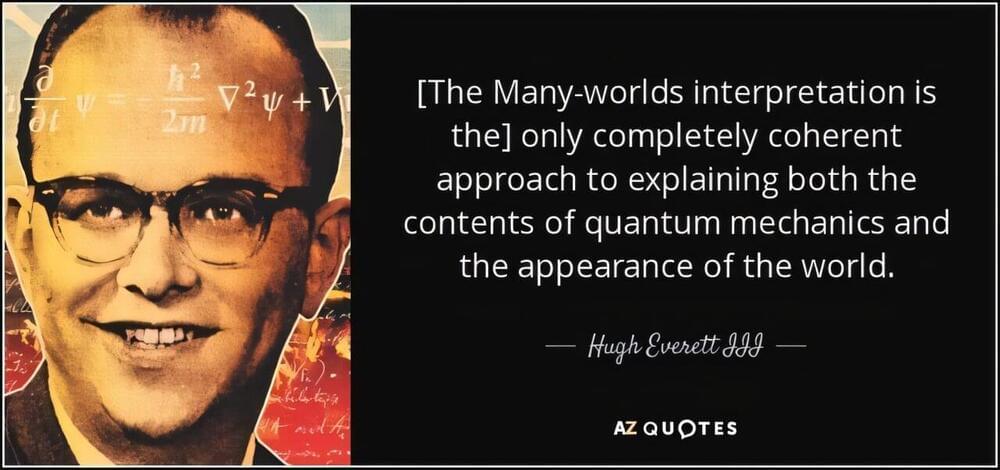
Students learning quantum mechanics are taught the Schrodinger equation and how to solve it to obtain a wave function. But a crucial step is skipped because it has puzzled scientists since the earliest days—how does the real, classical world emerge from, often, a large number of solutions for the wave functions?
Each of these wave functions has its individual shape and associated energy level, but how does the wave function “collapse” into what we see as the classical world—atoms, cats and the pool noodles floating in the tepid swimming pool of a seedy hotel in Las Vegas hosting a convention of hungover businessmen trying to sell the world a better mousetrap?
At a high level, this is handled by the “Born rule”—the postulate that the probability density for finding an object at a particular location is proportional to the square of the wave function at that position.

AI’s impact extends beyond operational efficiency; it is vital in boosting job satisfaction and retention among hourly workers. Inconsistent scheduling and poor communication have long been pain points for this group, especially as one in five Gen-Z workers juggles multiple jobs (poly-employment). AI will directly address the challenges associated with this shift through predictive scheduling and real-time updates, providing clear and reliable expectations. It’s truly a win-win: When employees are on time, customers receive the quality service they deserve.
The World Economic Forum predicts that 23% of global jobs will change in the next five years due to industry shifts, including AI. Through AI, employees can receive support with ongoing training and development tailored to their unique needs and career goals. By providing accessible, on-demand learning, it empowers workers to upskill and grow within their roles, fostering a sense of progress and fulfillment. These resources are essential for Gen-Z, who prioritize personal growth and are likelier to stay with employers who invest in their development.
As we look toward the future, it’s clear that AI is not just a tool for corporate jobs but also a powerful ally for the hourly workforce. By embracing AI, businesses can meet diverse employee needs, enhance productivity and create work environments that are technologically advanced and genuinely supportive. However, for AI to reach its potential in workplaces, industry-wide standards around data transparency and ethical practices are essential.