Toggle light / dark theme

Gene regulatory mutation linked to rare childhood cancer

Nice and interesting Gene Mutation Discovery.


A single defect in a gene that codes for a histone — a “spool” that wraps idle DNA — is linked to pediatric cancers in a study published in the journal Science.

“Unlike most cancers that require multiple hits, we found that this particular mutation can form a tumor all by itself,” says Peter W. Lewis, an assistant professor of biomolecular chemistry in the School of Medicine and Public Health at the University of Wisconsin-Madison.

Histones derive their pattern from the same genome that they help to pack up and organize. “A histone’s day job is compacting the genome,” says Lewis. “The histone takes six feet of DNA and packs it in something that is a few microns in diameter.”

Cancer cells escape when they block this gene

I remember years ago when researchers identified that families with high rates for severe allergies also had high rates of cancer. Today, we talk about cancer and immunology as an intertwined dependency. Just means we’re still understanding cancer, genetic mutations, and the trigger/s in causing cancer among families and individual.


Scientists say the NLCR5 gene allows cancer cells to escape the immune system. A test for the biomarker may predict how long a cancer patient can survive.

Scientists prove effectiveness of gene editing system in eliminating HIV from DNA of CD4+ T-cells

Hope for HIV patients.


In 2014, a team of researchers in the Lewis Katz School of Medicine at Temple University became the first to successfully eliminate the HIV-1 virus from cultured human cells. Fewer than two years later, the team has made further strides in its research by eliminating the virus from the genome of human T-cells using the specialized gene editing system they designed.

In a new study published in Scientific Reports, the researchers show that the method can both effectively and safely eliminate the virus from the DNA of human cells grown in culture.

How this research differs In previous work, the team—led by Kamel Khalili, professor and chair of the Department of Neuroscience at Temple—had demonstrated the ability of their technology to snip out HIV-1 DNA from normal human cells. The newest findings used that same technology to snip out the virus from latently and productively infected CD4+ T-cells, which host the virus in persons infected with HIV.

Is Zika How Humanity Ends?

It’s absolutely insane to go ahead with the summer Olympics in light of this horrid mess. It’s unlikely to end us. but it could hurt us all, badly. No disease of this kind could ask for a better opportunity to spread around the world than that which the Olympics are about to give it. It’s insane.


Probably not, but pathogens that damage brains may earn a special place in cosmic hell.

By Caleb A. Scharf on May 11, 2016.

NVIDIA Brings Virtual Reality to Materials

When I look at technology and other things; my brain just dissolves all boundaries/ scope of the technology was originally defined for. For me, this is and has always been in my own DNA since I was a toddler. When I first looked at VR/ AR, my future state vision just exploded immediately where and how this technology could be used, how it could transform industries and daily lives, and other future technologies. So, I am glad to see folks apply AR and VR in so many ways that will prove valuable to users, companies, and consumers.


NVIDIA is working with various companies in different sectors such as automotive, manufacturing, and medical to bring AR benefits in their business. It is working with Audi, General Motors (GM), and Ford (F) to create a VR application where the consumer can design a car by changing its wheels, paint, or seat leather. NVIDIA is also working with European (IEV) furniture manufacturer IKEA to build a virtual reality application that allows the user to design their own rooms and homes.

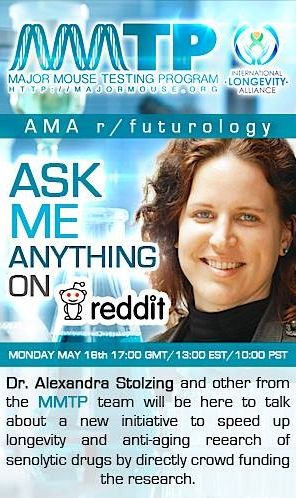
Help Crowdfund Senescent Cell Clearance as a Therapy for Aging at the Major Mouse Testing Program

The community has the power to direct science and we no longer have to accept the traditional path of state funded science. We have the power to choose the direction science takes!


The cadence of SENS rejuvenation research fundraising this year will be a little different from that of past years. There will be more groups involved and more smaller initiatives running through existing crowdfunding sites for a start. The first of these fundraisers for 2016 has launched at crowdfunding site Lifespan.io, and is definitely worthy of our support. The Major Mouse Testing Program is a new non-profit group of researchers and advocates, who have spent the last six months making connections and laying the groundwork to run more animal studies of SENS-relevant prototype therapies focused on health and life span. This is an important gap in the longevity science community as it exists today: consider the painfully slow progress in organizing animal studies in senescent cell clearance over the past five years, for example. Given more enthusiasm and more funding, that could have happened a lot faster. Consider also that the research mainstream — such as the NIA Interventions Testing Program — carries out very few rigorous health and life span studies of potential interventions for aging in mice, and of those almost none are relevant to the SENS approach of damage repair, the only plausible path to radical life extension within our lifetimes.

Animal studies are vital; not just one or two, here or there, but a systematic approach to generating rigorous supporting data, establishing dosage, and uncovering unexpected outcomes. The Major Mouse Testing Program can do a great deal to fill this gap for our community, and has the potential to be an important supporting organization for the SENS Research Foundation, for startups working on SENS technologies such as Oisin Biotechnologies, and for labs involved in SENS research. The more diversity the better. The only thing that the Major Mouse Testing Program lacks today is the initial funding and support that we can provide to give them a good start on their plans for the future. With clever organization, a non-profit organization allied with established labs can carry out solid animal studies at a cost low enough for people like you and I to fund the work via fundraisers, and that is exactly what we should do.

I have stepped up to donate to this first fundraiser for the Major Mouse Testing Program, and I hope that you will too. This is a useful, needed initiative, the people involved are solid members of the community, doing the right thing, and pulling together the right networks, and they deserve our support. This first crowdfunding initiative is focused on expanding animal studies of drug-based senescent cell clearance approaches, in collaboration with existing groups that are working in this field. Remember, however, that this isn’t just about setting up one set of experiments. This is the first step in building out an organization that can help greatly in the years to come, as the field of potential rejuvenation treatments expands, and the need grows for the non-profit groups in our community to specialize and diversify.

Russell Smith: What’s behind our sudden fascination with immortality?

A documentary film just had its premiere at the Hot Docs festival in Toronto. How To Build A Time Machine, the work of filmmaker Jay Cheel, is a strange and incoherent little document of two middle-aged men with loosely related obsessions: One of them wants to build a perfect recreation of a movie prop – the machine from the 1960 movie The Time Machine, based on the H.G. Wells novel – and the other is a theoretical physicist who thinks he may have effected a kind of time travel in a lab, on a microscopic scale, using lasers that push particles around. The weak connection between the two men is that they both regret a death in their past – a best friend, a father – and are preoccupied with what they might have done to prevent the death; they both wonder if time travel to the past might have been a remedy for death itself. (Compared to the protagonist of Zero K who seeks immortality as a way of avoiding the loss of a loved one.) The 80s synthpop song Forever Young by Alphaville booms symbolically at one point.

Why this sudden ascendancy of yearning for immortality now? Is it simply because immortality of a medical sort might be imminent, a result of technological advances, such as nanobots, that will fight disease in our bloodstream? Or is it because, as Ray Kurzweil implies, digital technology is now so advanced that we have already left our bodies behind? We already live outside them, and our digital selves will outlive them. (“I mean,” says Kurzweil, “this little Android phone I’m carrying on my belt is not yet inside my physical body, but that’s an arbitrary distinction.”)

The frequently quoted axiom of Arthur C. Clarke – “Any sufficiently advanced technology is indistinguishable from magic” – is pertinent to this current fascination with life without end. We are now perceiving technology as not just magic but as god-like, as life-giving, as representing an entirely new plane of being.

Frequency of extreme heat waves on the increase in Africa: Could occur annually

Not good; hope we can by 2045 have new methods to create weather/ drought resistant vegetation, and matured the improved options around converting sea water to fresh water so no one suffers from harsh weather including droughts.


Longer, hotter, more regular heat waves could have a damaging effect on life expectancy and crop production in Africa warn climate scientists in a study published in the journal Environmental Research Letters. Examining temperature data from 1979 to 2015, the researchers caution that heat waves classified as unusual today could become a normal occurrence within 20 years. This scenario could be triggered by an increase in average global temperature of 2 degrees.

Risk all year round

Located between the Tropic of Cancer and the Tropic of Capricorn, Africa experiences high levels of solar radiation all year round and heat waves can occur in any season, not just during summer months. Running climate models through to 2075, the scientists found that so-called unusual heat waves could occur as frequently as four times per year towards the end of the century. In other words, one dangerously hot spell for every season of the year.

/* */