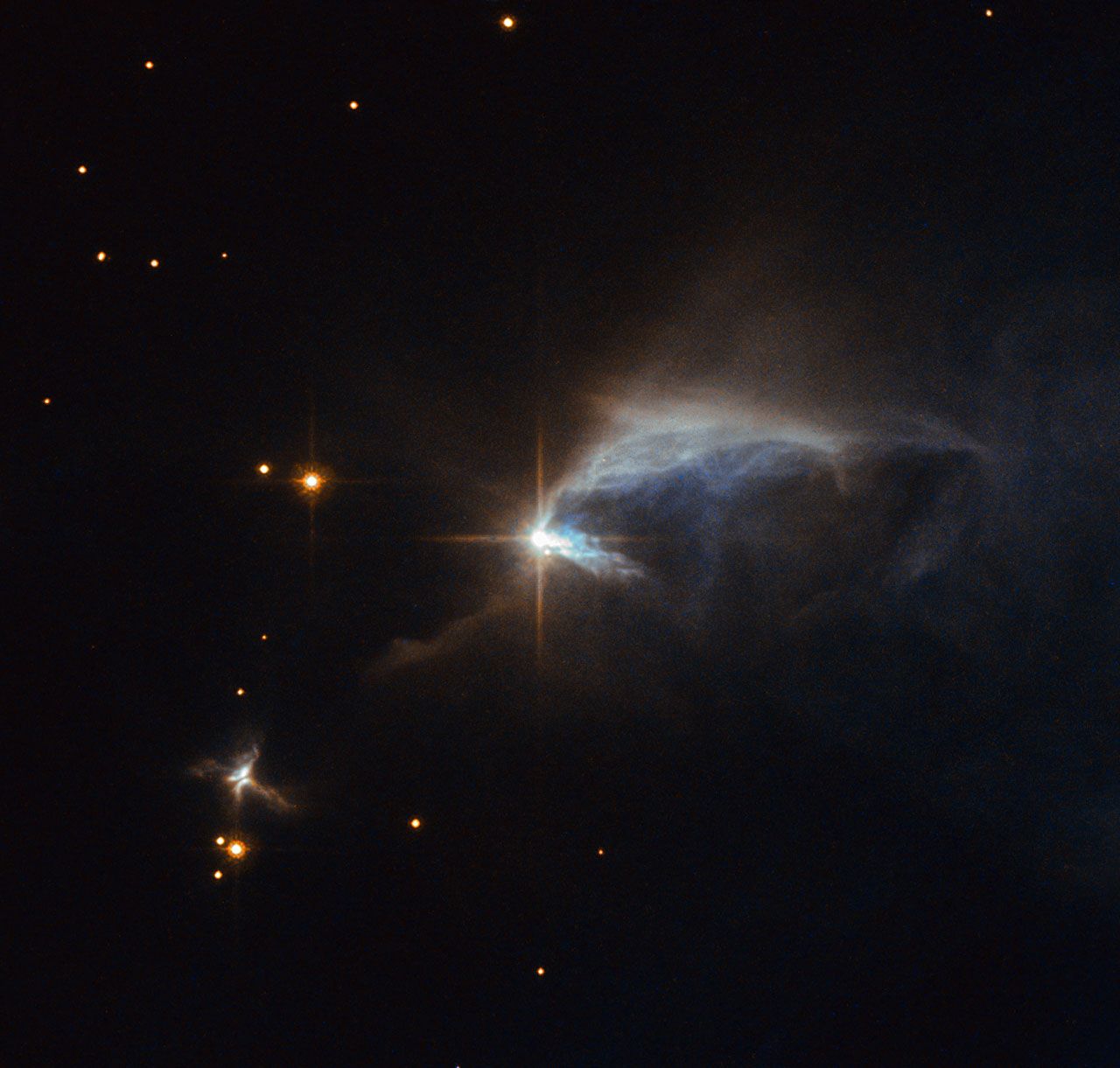
Ten of the alien worlds that represent our best hope for alien life beyond the solar system, according to the University of Puerto Rico at Arecibo.
Construction is well underway on what will become the world’s largest radio telescope. Once complete, the half-kilometer-wide dish will explore the origins of the Universe and scour the skies for signs of extraterrestrial intelligence.
Looking for aliens is really, really cool. But more cool would be finding them. And this obviously leads to the question, what if we catch E.T. watching “Guardians of the Galaxy” in a dark corner of our galaxy? What if we’re not alone? The philosophical consequences are worth intense contemplation.
Green Bank Telescope (credit: Geremia/Wikimedia Commons) Russian billionaire Yuri Milner, Stephen Hawking, Martin Rees, Frank Drake and others announced at The Royal Society today $100 million funding for Breakthrough Listen — the “most powerful, comprehensive, and intensive scientific search ever undertaken for signs of intelligent life beyond Earth.”
On Monday, famed physicist Stephen Hawking and Russian tycoon Yuri Milner held a news conference in London to announce their new project: injecting $100 million and a whole lot of brain power into the search for intelligent extraterrestrial life, an endeavor they’re calling Breakthrough Listen.
“We believe that life arose spontaneously on Earth,” Hawking said at Monday’s news conference, “So in an infinite universe, there must be other occurrences of life.” Read more
According to the reputable Australian astro-enthusiast journal, SkyNews, a leading biologist says that it is surprising we have not already discovered extra-terrestrials that look like us — given the growing number of Earth-like planets now discovered by astronomers.
Simon Conway Morris, an evolutionary biologist suggests that aliens resembling humans must have evolved on other planets. He bases the claim on evidence that different species will independently develop similar features which means that life similar to that on Earth would also develop on equivalent planets.
The theory, known as convergence, says evolution is a predictable process which follows a rigid set of rules. Read the full story at Skynews…
__________
Philip Raymond is Co-Chair of The Cryptocurrency Standards
Association [crypsa.org] and chief editor at AWildDuck.com
“The ethics of encountering non-sentient alien life in our solar systems boils down to a core dilemma, says Waller. ‘Is it about conservation and preservation? Or is it about our needs, wants, and desires?’ On Earth, natural-resource grabs have a history of bringing out the worst in us as a species…There’s plenty of reason to believe other planets will be chock-full of resources we’d like to exploit, even if the life forms are microbial – perhaps especially if they’re microbial.” Read more
By Jason Dorrier — Singularity Hub
When scientists looked at Mars through early telescopes, they saw a fuzzy, rust-colored globe scored by mysterious dark gashes some believed were alien canals. Later, armed with sharper images, we scoffed at such naiveté. Mars is obviously dry as a bone and uninhabited. Now, with a great deal more information from rovers and satellites, we believe Mars was once wet. As for life? The jury’s still out.
It shows how much we still have to learn (and are learning) about our solar system. Not too long ago, we only suspected one ocean of liquid water beyond Earth (on Europa). Now, thanks to robotic explorers, like NASA’s Dawn and Cassini missions, we’re finding evidence of oceans throughout the solar system. Read more
It’s not easy convincing the world you’ve found aliens. But that’s what one British professor says he’s done, over and over again. His latest proof, he tells me, is his strongest yet. Should we take him seriously?
In fall of 2013, Milton Wainwright, a researcher at the University of Sheffield in the United Kingdom, made international headlines when he claimed that microorganisms he found in the stratosphere were not of this world. The organisms are believed to come from a class of algae called diatoms, were collected roughly 16 miles above the Earth’s surface using a balloon, and, according to Wainwright, have been raining down on the Earth, carried by meteorites, for perhaps many millennia. Read More