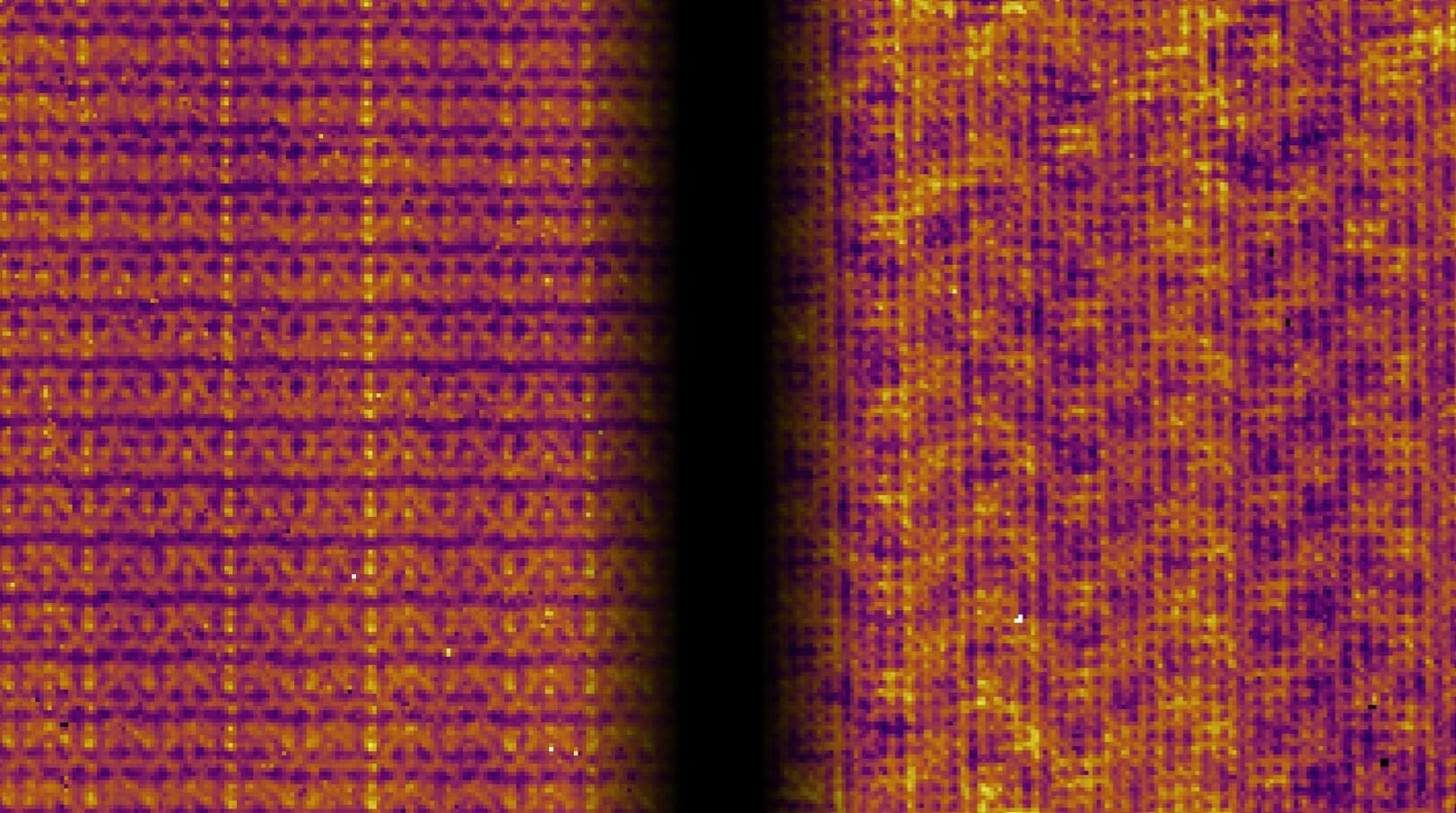
In most everyday materials, such as copper, silver and silicon, the behavior of electrons is relatively predictable. In quantum materials, however, electrons can interact in complex ways, giving rise to collective electronic states with remarkable properties. Understanding how these states emerge—and, ultimately, how to control them—is one of the central challenges in quantum materials research.
Now, researchers from the Okinawa Institute of Science and Technology (OIST) and Hiroshima University have discovered that a small magnetic field switches the layered quantum material CeTe₃ between competing electronic states that appear as striped or checkerboard patterns.
Published in Nature Communications, the work reveals how magnetism can reorganize a quantum material’s entire electronic state.