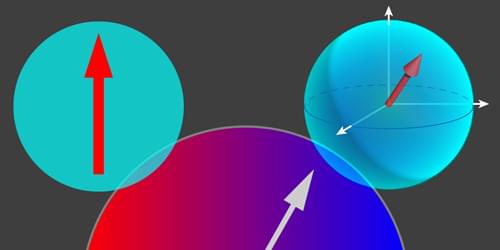
Artificial neural networks have become powerful tools for finding patterns in complex data, from classifying images to predicting protein structures and assisting mathematical discovery. Yet their success has so far relied almost entirely on classical hardware. Recent developments in quantum-computing technologies make it timely to ask whether trainable models can also make use of quantum effects such as superposition and the intrinsic uncertainty associated with quantum measurements. What’s more, running neural networks on real quantum processors could potentially turn these networks into probes, revealing how different hardware architectures shape networks’ behaviors.