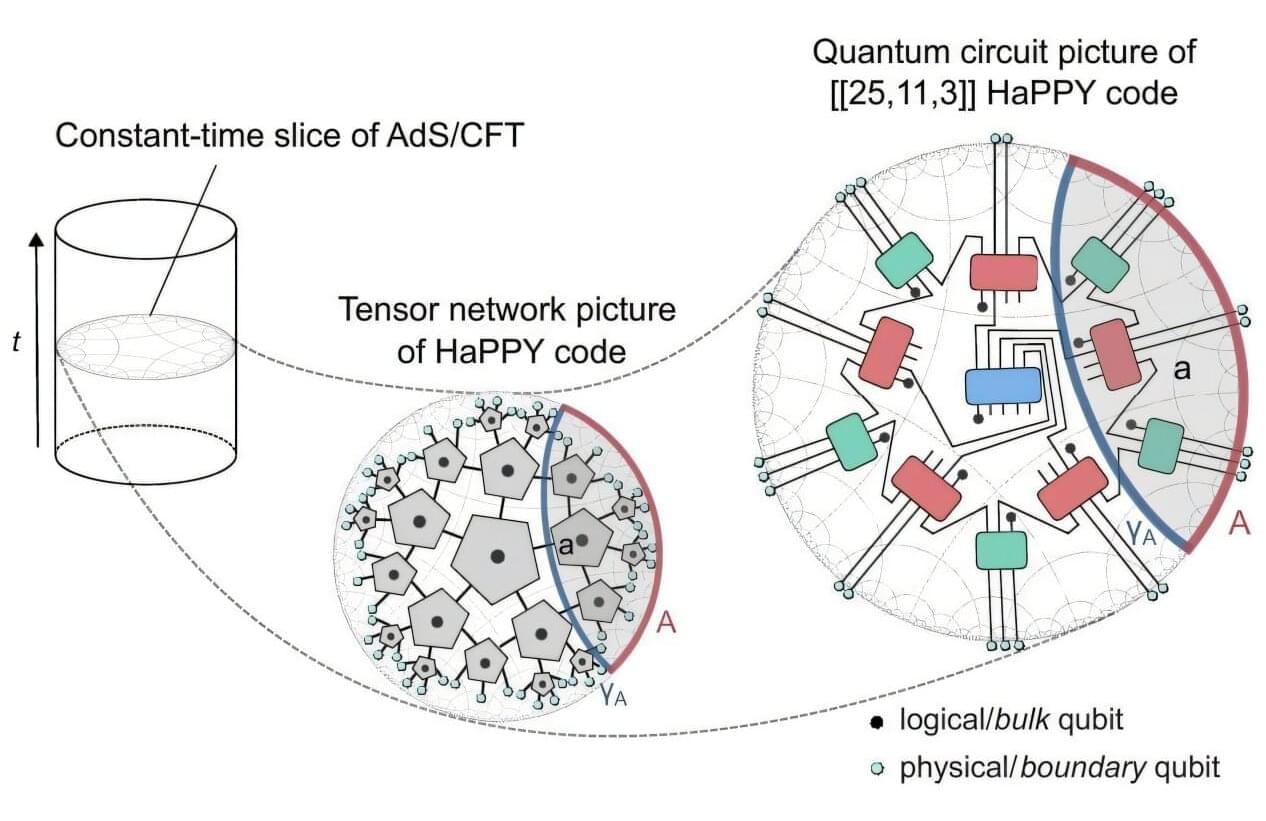
One of the deepest ambitions in modern physics is understanding how the fabric of space and time could emerge from fundamental quantum degrees of freedom to establish a quantum theory of gravity.
In the new paper, “Observation of gravity-like signatures in holographic codes on a quantum computer,” posted to the arXiv preprint server, researchers from the National Quantum Laboratory (QLab@UMD), the Duke Quantum Center, the Virginia Tech Center for Quantum Information Science and Engineering, Caltech’s Institute for Quantum Information and Matter, IonQ and BlueQubit have successfully simulated toy models of quantum gravity according to the AdS/CFT correspondence. The team, led by Crystal Noel and Charles Cao, includes quantum-computation pioneers John Preskill and Christopher Monroe.
Using the IonQ Forte ion-trap quantum computer, the study implements the intriguing HaPPY quantum error-correction code, which forms a bridge between quantum computing and quantum gravity. This code simulates a highly simplified model of a universe with a negative cosmological constant that features a so-called bulk-boundary correspondence, in which the properties of a higher-dimensional gravitational universe (bulk) are completely determined by a lower-dimensional quantum system without gravity living on the boundary. The team successfully demonstrated fundamental entanglement properties of these systems.