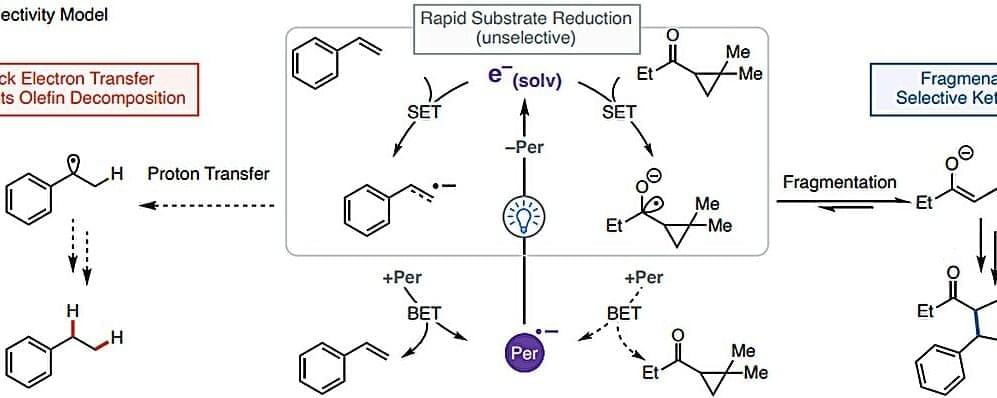
Chemists use single-electron transfers to synthesize complex, ring-shaped molecular structures found in many drug candidates and advanced materials, but current techniques still have limitations. A new study, accepted for publication in Nature, describes a technique that could steer these chemical reactions in ways that were previously limited by the redox potentials of the involved molecules.
Normally, in single-electron transfer (SET) reduction, the molecule that is easiest to reduce—according to its redox potential—grabs available electrons first. This ultimately blocks many useful reactions involving common but hard-to-reduce molecules, including many simple ketones. These ketones are useful in a wide range of applications, from making pharmaceuticals and agrochemicals to creating plastics and industrial solvents. Overcoming the limitations of competition for electrons based on redox potentials has been a goal for researchers looking for ways to streamline the synthesis of these useful chemicals.
Previous approaches to improve selectivity often relied on carefully matching reactants’ reduction potentials. Other methods used close catalyst-substrate interactions to alter selectivity, but these strategies were not broadly compatible with all reactants.