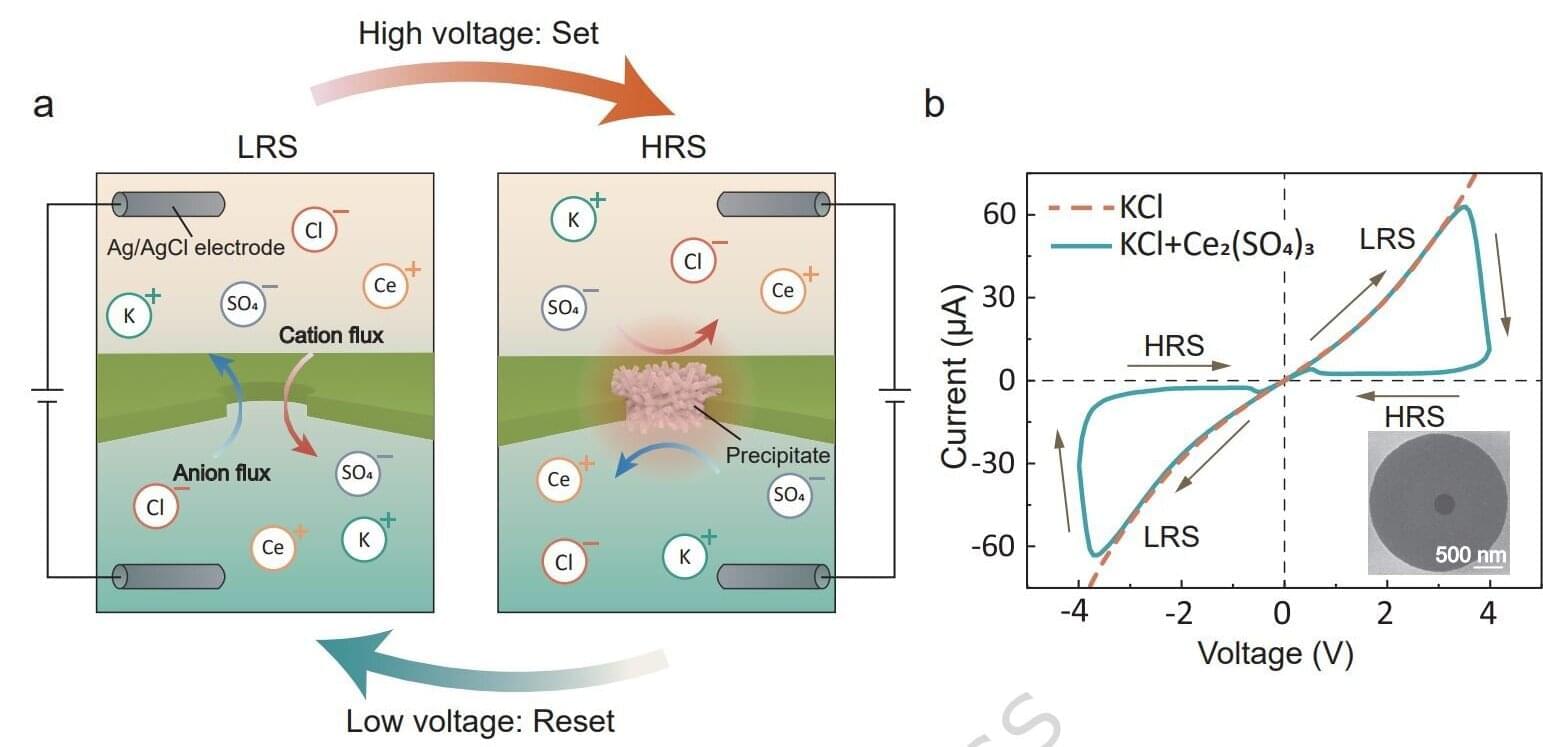
Some researchers are leaning into biology for inspiration in computing. In particular, neuromorphic computing offers a brain-inspired approach to hardware that replaces traditional binary processing with systems that function more like neurons and synapses. Now, a new study, published in Nature Communications, describes an innovative design for a fluidic memristor that uses its own self-heating mechanism to induce a history-dependent memory effect.
So far, most memristor (memory resistor) devices have used solid materials with electrons or holes functioning as charge carriers. But fluidic memristors instead take advantage of the movement of ions in liquids, which more closely mimics biological signaling, like that which occurs in the brain. However, existing fluidic memristors can be difficult to fabricate and offer a limited range of memory behaviors. The authors of the new study came up with a way to overcome some of these limitations by using temperature fluctuations while also making the device more “brain-like.”
They write, The exploration of additional memristive mechanisms may be beneficial. In conventional integrated circuits, localized heating is generally regarded as an unnecessary and even harmful side effect. However, in biological neural systems, thermal signals are closely linked to essential life processes. They significantly affect neuronal functions, including ion channel activation, action potential conduction speed, and firing patterns.