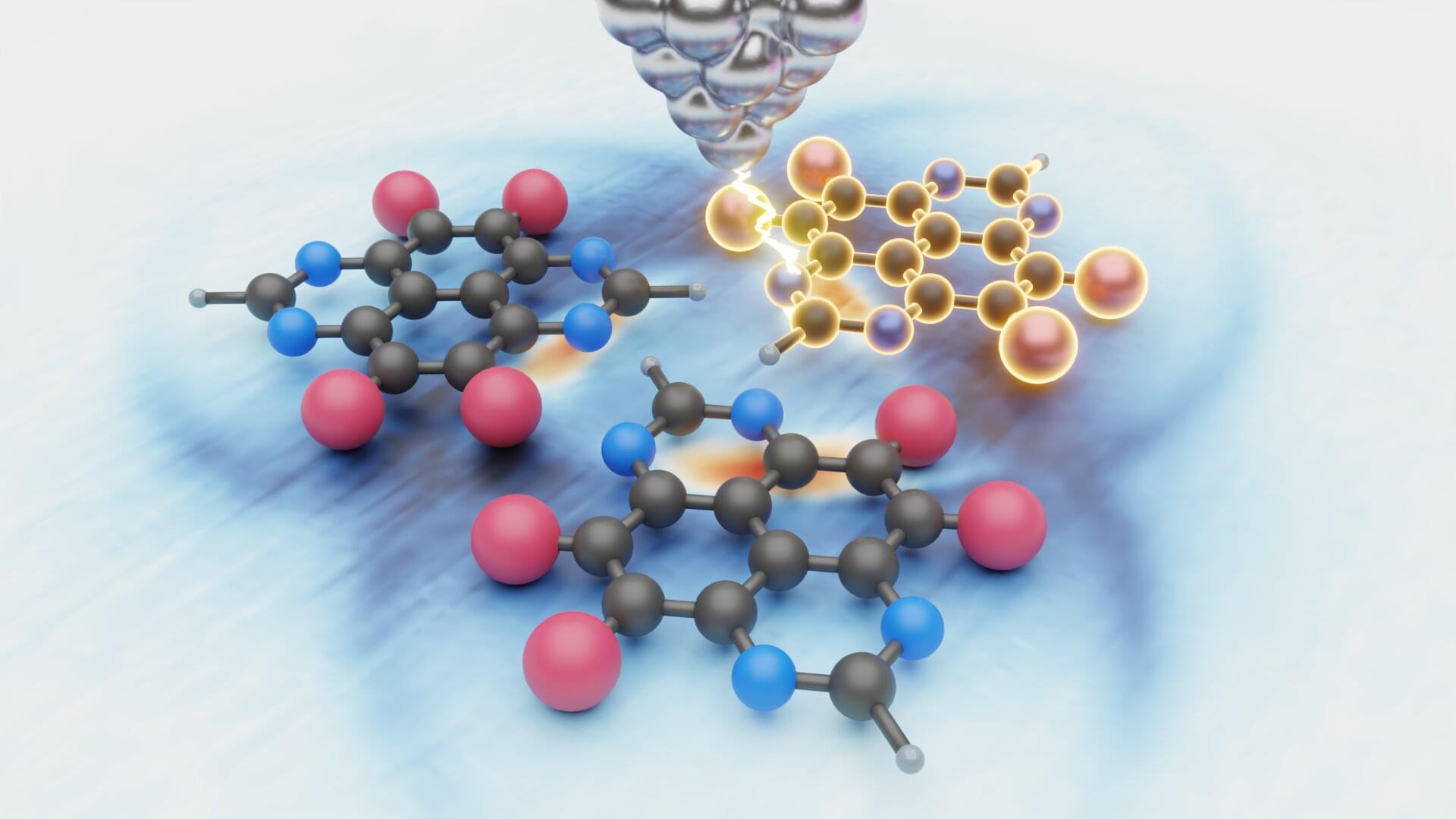
Researchers from the University of Basel have published details of how electrons within a cluster of molecules interact with one another and can be controlled. Their findings pave the way for new approaches to developing quantum components and electronic circuits on the nanometer scale.
Electronic components are becoming increasingly small—so small, in fact, that quantum phenomena such as the superposition of states play a key role. Understanding this phenomenon is vital for the further development of molecular components and tiny circuits on the nanometer scale.
The behavior of paired electrons within molecules is already well understood. However, for radicals—molecules with an unpaired electron in their outer shell—there were no theoretical models describing interactions between molecules and the associated charge redistribution in small molecule clusters.