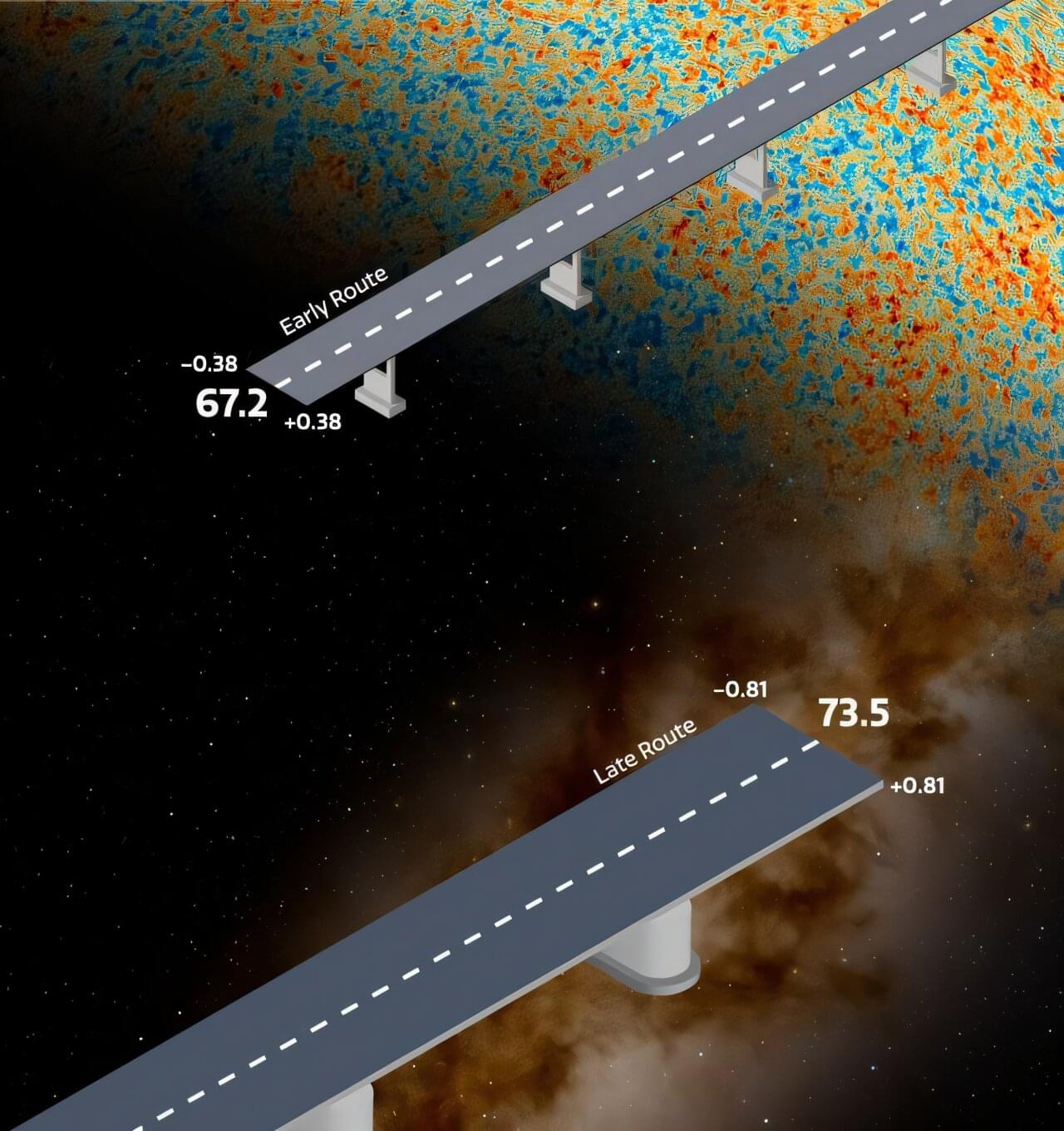
Astronomers have used the ages of more than 155,000 stars in the Milky Way to independently estimate the age of the universe, and their findings may be good news for the standard cosmological model. The new research was reported in a paper submitted to the arXiv preprint server on July 1.
The age of the universe is tied to a discrepancy known as the Hubble tension. There are two main ways to measure how fast the universe is expanding, known as the Hubble constant. The first uses the cosmic microwave background (CMB), the “afterglow” of the Big Bang, and gives a certain value. The other uses local measurements in our cosmic neighborhood, including Cepheid stars and supernovae, and gives a noticeably higher value.
The two figures disagree by about 9%—a mismatch known as the Hubble tension.