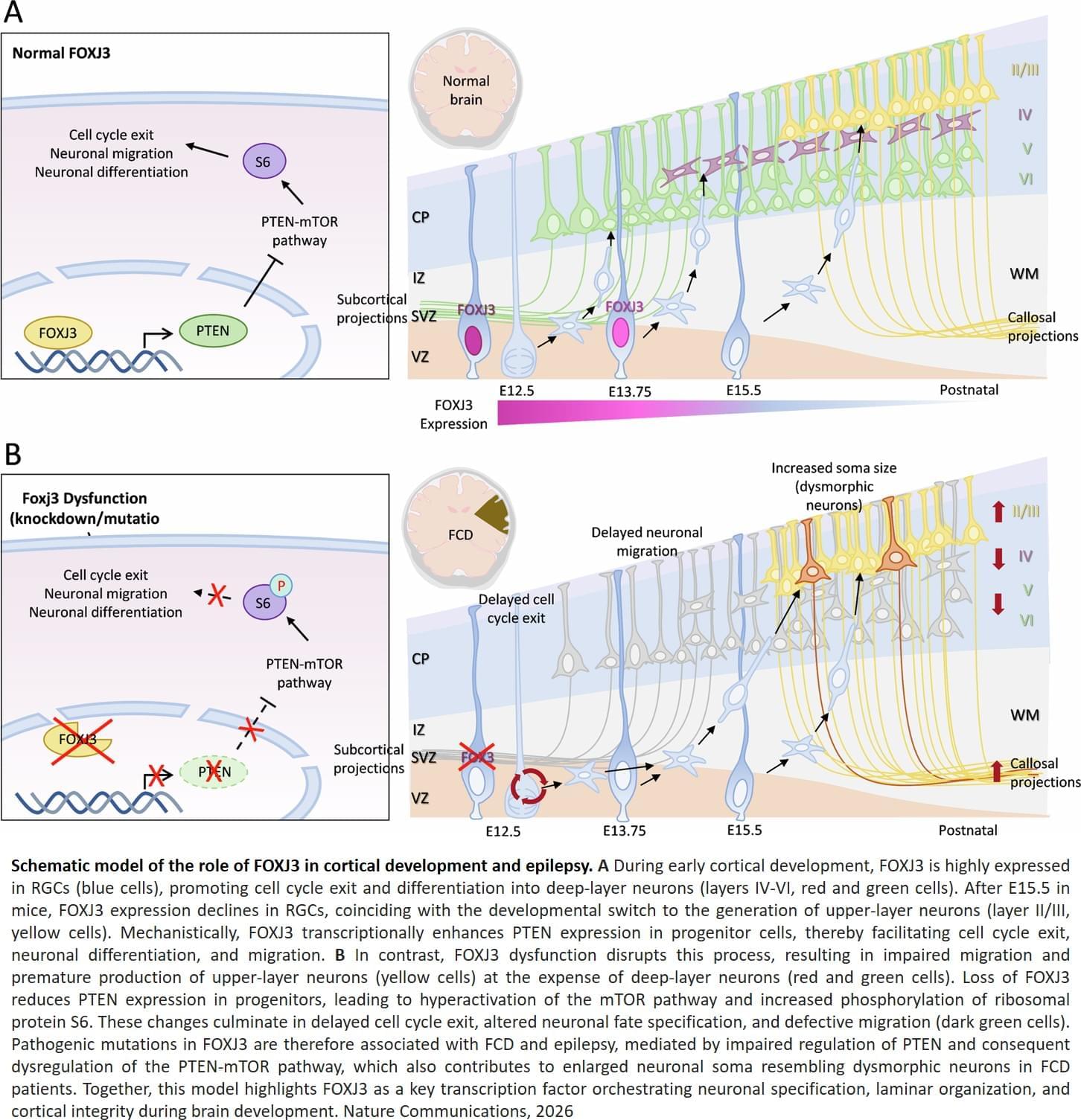
Researchers have discovered that mutations in the FOXJ3 gene act as a “master switch” failure, disrupting how the brain builds its layers and leading to FCD, a primary cause of drug-resistant epilepsy. The study reveals how FOXJ3 controls the formation of brain cortical layers during brain development by regulating the PTEN–mTOR signaling pathway.
The PTEN-mTOR signaling pathway acts as a critical control system for cell growth, proliferation, metabolism, and survival. When this system malfunctions, it causes many neurological disorders including FCD, tuberous sclerosis complex and neurofibromatosis. The discovery of FOXJ3, a transcription factor (a protein that regulates gene activity), as a new cause of these “mTOR pathway diseases” (mTORpathies) provides new insight into the biological origins of epilepsy and cortical malformations, as well as potential new treatments.
The research team by studying families with inherited focal epilepsy alongside mouse and single-cell analysis, uncovered how FOXJ3 mutations disrupt how brain cells move to their correct locations and take on their proper roles during early brain development.
“Focal cortical dysplasia is one of the most common causes of epilepsy that does not respond to medication, yet in many patients the underlying cause remains unknown,” said the corresponding author. “Our findings identify FOXJ3 as the critical genetic and molecular link between abnormal brain development and epilepsy.” ScienceMission sciencenewshighlights.