Dr. Ryan Cloutier: “We’ve seen this pattern: rocky inside, gaseous outside, across hundreds of planetary systems. But now, the discovery of a rocky planet in the outer part of a system forces us to rethink the timing and conditions under which rocky planets can form.”
What can rocky planets orbiting in the outer parts of a solar system teach scientists about planetary formation and evolution? This is what a recent study published in Science hopes to address as a team of scientists have discovered a rocky planet orbiting in the outer reaches of an exoplanetary system. This study has the potential to challenge longstanding hypotheses regarding the solar system architecture, specifically regarding rocky planets orbiting closer to their star and larger gas giants orbiting farther away.
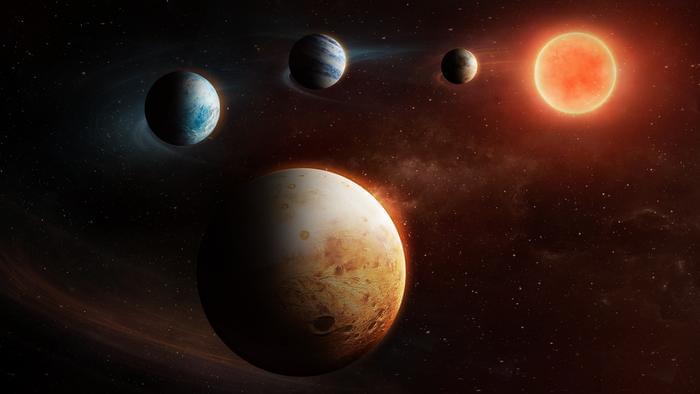
For the study, the researchers analyzed four exoplanets in the LHS 1903 system orbiting a red dwarf star, the latter of which is smaller and cooler than our Sun. Due to the planets orbiting closer to their star than our planets orbiting our Sun, the researchers estimated the orbital periods for the four exoplanets were between 2.2 and 29.3 days. However, the researchers were surprised to discover that while the innermost planet was rocky and the second the third planets were gaseous, the outermost planet was also rocky. As a result, this finding contradicts longstanding notions about solar system architecture, specifically regarding our own solar system that rocky planets orbit closer to the star while outer planets are gaseous.