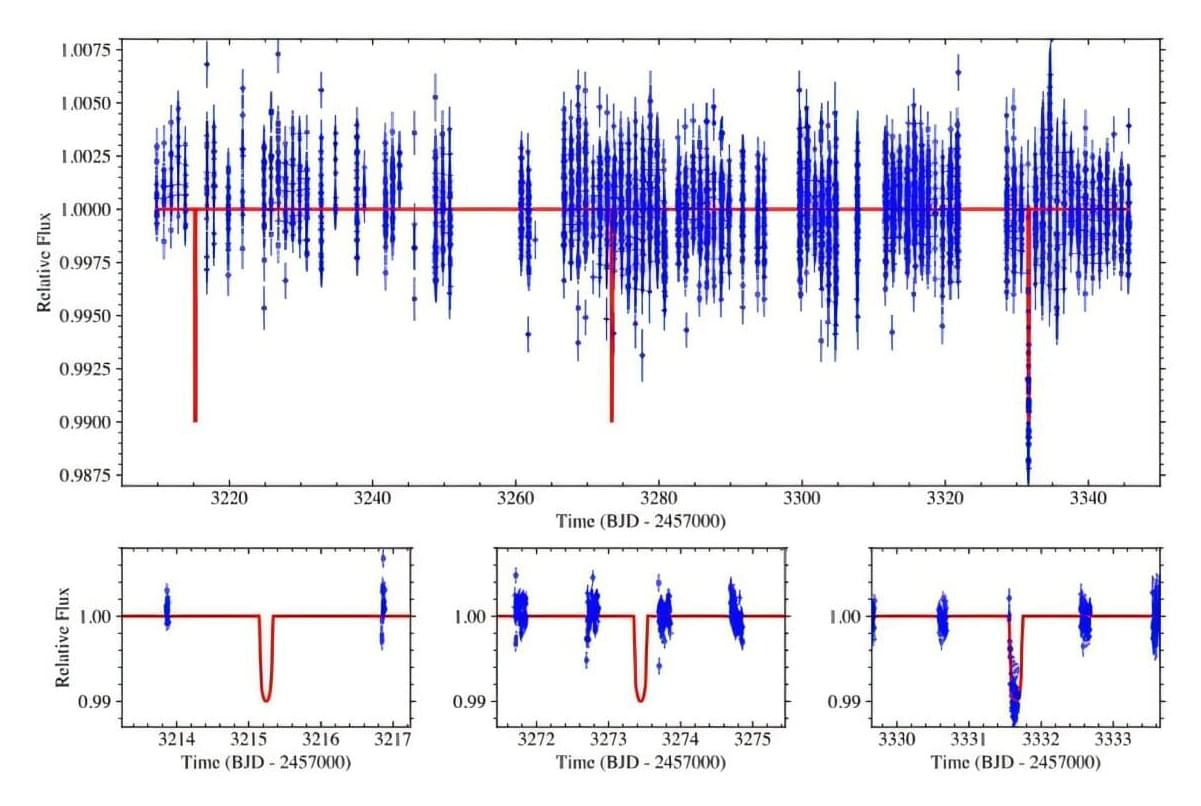
An international team of astronomers reports the discovery of a new exoplanet orbiting a sunlike star as part of the Next Generation Transit Survey (NGTS). The newfound alien world, designated NGTS-39 b, is a Jupiter-sized planet with an equilibrium temperature of about 519 K. The discovery was detailed in a paper published July 2 on the preprint server arXiv.
NGTS-39 (also known as TIC-453147896) is a relatively bright star of spectral type F9 located some 910 light-years from Earth. The star was observed multiple times between 2019 and 2024 with NASA’s Transiting Exoplanet Survey Satellite (TESS), which detected a transit signal in its light curve.
Now, a group of astronomers led by Ioannis Apergis of the University of Warwick, UK, have used NGTS’ 12 robotic Newtonian telescopes to perform follow-up photometric observations of NGTS-39. This, together with radial velocity measurements from CORALIE and HARPS spectrographs, allowed the team to confirm the planetary nature of the TESS-detected signal.