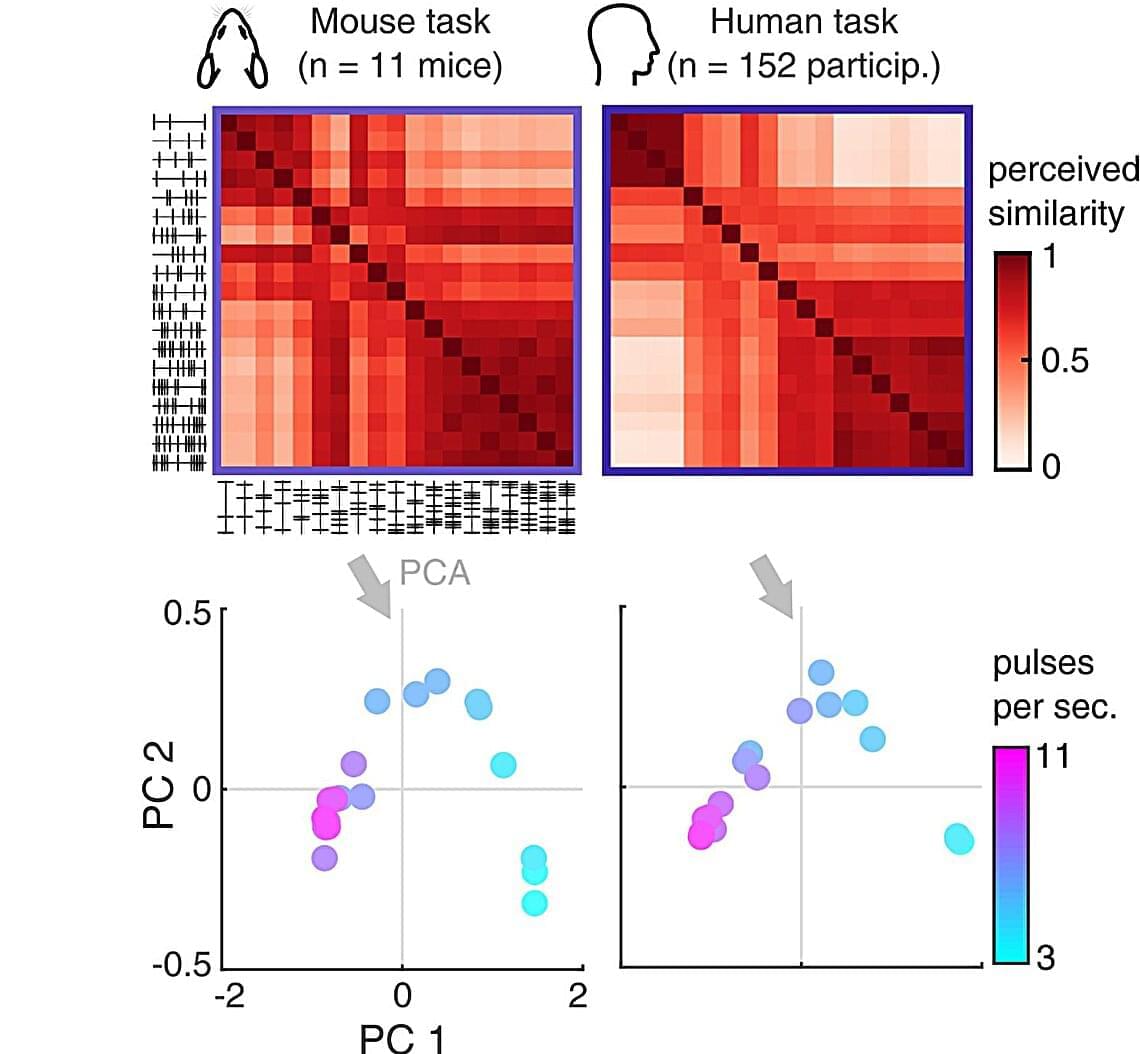
While exploring the world around them, both humans and other animals continuously interpret information they pick up with their sight, hearing, touch and other senses. Neuroscience research suggests that the brain does not individually process every single sensory experience, but rather organizes information into mental models known as internal representations.
Internal representations can help recognize familiar patterns or relationships between different stimuli and experiences. While many past studies have explored the role of these perceptual “maps,” fewer have looked at how stimuli are represented in the brains of different species and how they influence learning and decision-making.
Researchers at Johannes Gutenberg University Mainz recently carried out experiments aimed at better understanding how humans and mice perceive, mentally represent and distinguish the same sounds. Their paper, published in Communications Psychology, suggests that sounds are organized similarly in the human and mouse brain, but also that auditory maps tend to remain surprisingly stable during learning and decision-making.