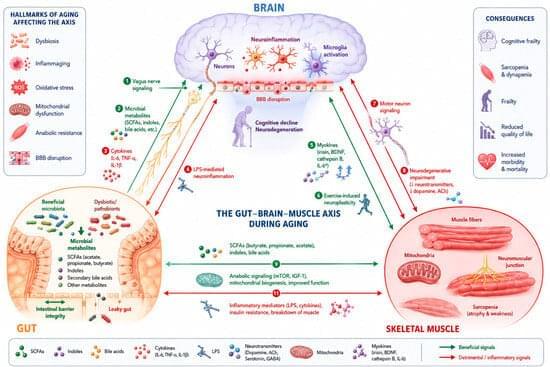
Cognitive frailty, characterized by the coexistence of physical frailty and cognitive impairment, has emerged as a major challenge in aging populations and is closely linked to sarcopenia, neurodegeneration, and chronic inflammation. Increasing evidence suggests that the gut microbiota acts as a central regulator of neuromuscular and neurocognitive aging through the integrated gut–brain–muscle axis. This review highlights how microbial dysbiosis, reduced short-chain fatty acid (SCFA) production, systemic endotoxemia, and altered microbial metabolites contribute to mitochondrial dysfunction, neuroinflammation, anabolic resistance, and impaired neuroplasticity.