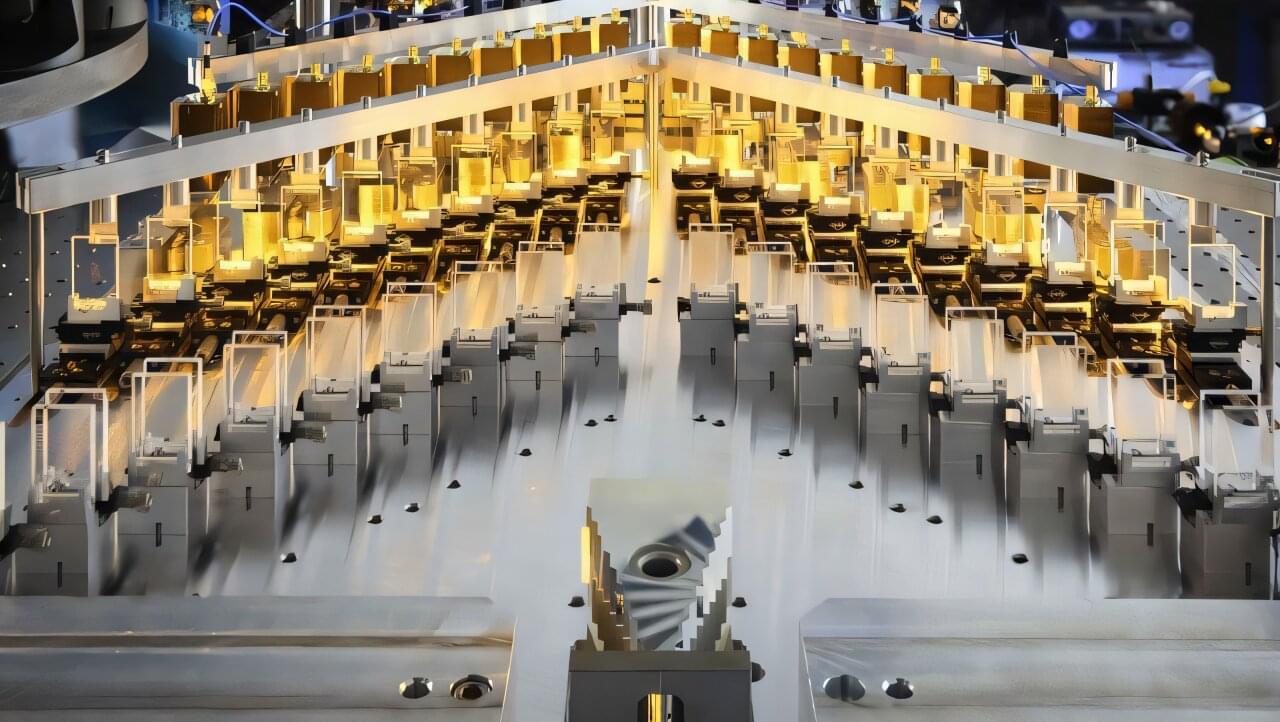
Fraunhofer ILT in Aachen has developed a highly complex laser-optical system for a quantum computer currently under construction at the 5th Institute of Physics at the University of Stuttgart. This system enables 2,000 Rydberg atoms to be positioned with submicrometer precision in the computer’s highly compact vacuum chamber. To do this, the system projects an array of 2,000 individually controllable laser beams into the chamber. These beams act as optical tweezers and hold the trapped Rydberg atoms precisely at the distance required for them to interact with each other. The computer’s quantum logic processes are based on these interactions.
The task was formidable: to develop a system capable of controlling 2,000 trapped strontium atoms using optical tweezers and positioning them with an accuracy of less than 100 nanometers (nm) within the vacuum chamber of a Rydberg quantum computer. The vacuum chamber is the computer’s processing unit, where two adjacent atoms are brought into a state through laser excitation in which they interact with one another. These interactions can be controlled and measured. Scientists refer to them as two-qubit logic gates; they are the building blocks of quantum logic in a Rydberg quantum computer.
Rydberg atoms are particularly well suited for quantum computing. In their laser-excited state, they are more than one micrometer (µm) in size because, as a result of the excitation, their outermost electron briefly moves to an orbital far from the atomic nucleus, where it nevertheless remains bound. However, due to the weak binding of the outer electron, the atoms are highly sensitive to electric fields, which can also originate from neighboring atoms. Scientists are leveraging this property for the highly precise electromagnetic control of quantum operations.