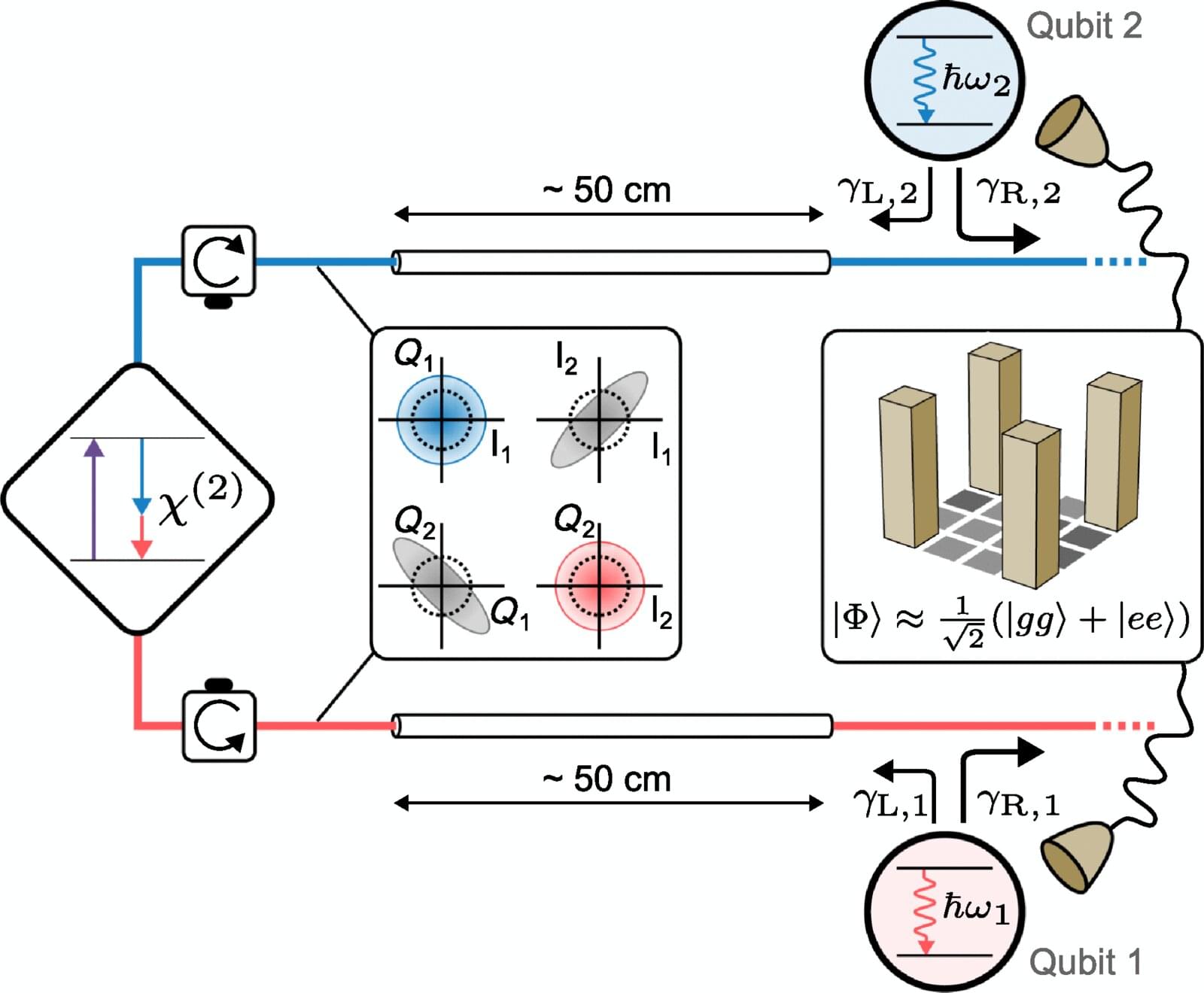
Future quantum computing will require correlations between distant modules—a feature known as distributed entanglement. Traditionally, such entanglement has relied on active control and repeated measurements. Now, physicists at the Institute of Science and Technology Austria (ISTA) have realized a fully autonomous method for distributed entanglement using a “quantum bath” of correlated light particles. Published in Physical Review X, their work experimentally confirms a 20-year-old prediction and could provide a new platform for applied quantum technologies.
Entanglement is a central feature of quantum physics in which shared correlations exceed what classical theories can explain. Achieving distributed entanglement between physically separated qubits (quantum bits) could enable future advances, such as scalable quantum computers and quantum networks.
To entangle distant qubits, earlier attempts have relied on two protocols. In one approach, a single, actively controlled photon is sent from one qubit to the other. In the second approach, each qubit emits a photon that must be matched to produce entanglement. While the second method earned the 2022 Nobel Prize in Physics, it requires many repeated measurements and post-selection and still does not always yield entanglement.