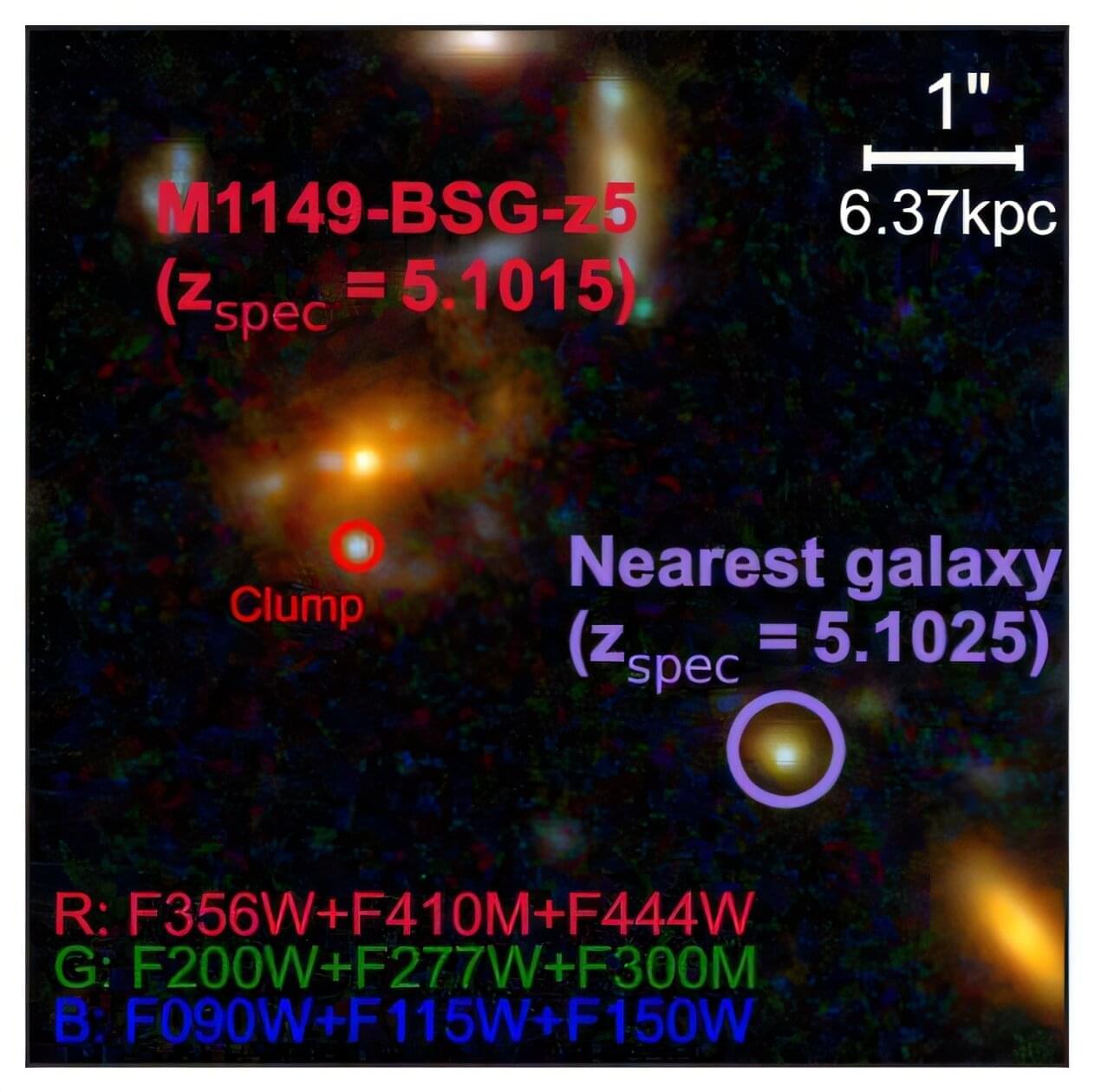
Astronomers using the James Webb Space Telescope have identified what may be the most distant barred spiral galaxy ever discovered, dating to a time less than 1.2 billion years after the Big Bang. The paper outlining its properties was posted to the arXiv preprint server on June 23.
Stellar bars are elongated formations of stars that stretch across a galaxy’s central region, spinning together as a single, unified structure. Through this rotation, they function much like a funnel, channeling gas toward the galactic center. This can ignite bursts of star formation, supply material to the central black hole and contribute to the buildup of a compact core. Such structures are common among galaxies in the local universe, and our own Milky Way is one example of a barred galaxy.
But bars don’t just form anywhere. They take shape in galaxies where stars move in smooth and orderly fashion, with something called a dynamically “cold” disk. Early-universe galaxies were the opposite: turbulent and gas-rich, constantly disrupted by mergers and bursts of star formation, conditions that should keep disks “hot” and unsettled for billions of years.