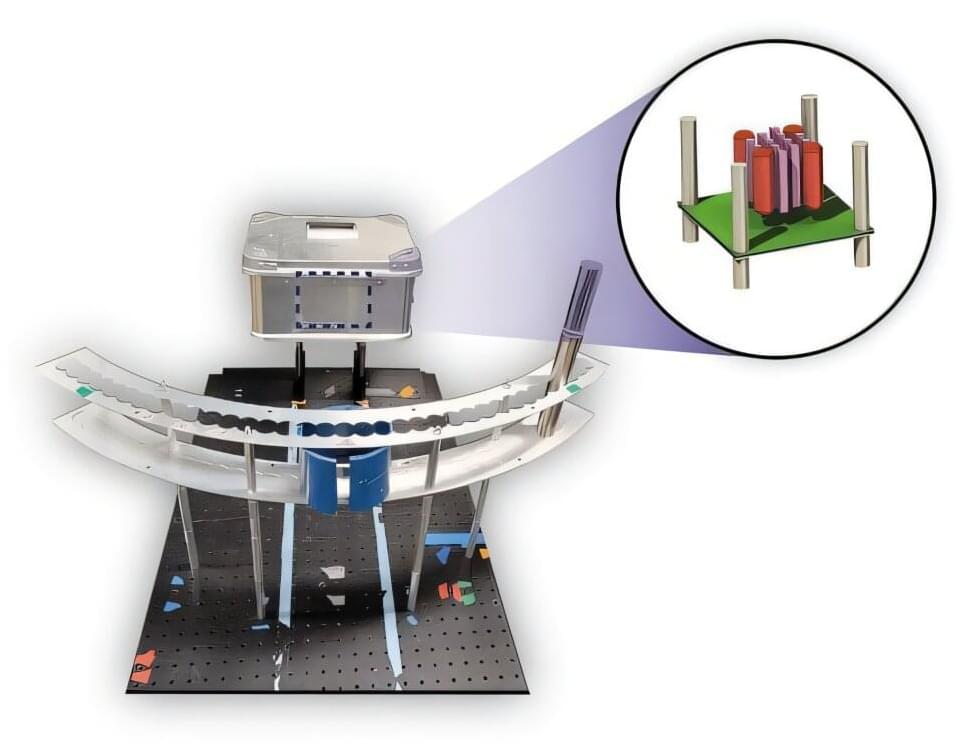
Neutron sources can be directly identified from measured spectra rather than proxies using inference tools adapted from cosmology, according to a University of Michigan Engineering study published in Physical Review Applied. The method can improve nuclear security by helping intercept materials at ports or borders or guide first responders during emergency response.
Directly detecting and characterizing a neutron source remains a challenge because most nuclear materials emit neutrons with energy patterns, called neutron spectra, that look similar to one another—whether from a benign industrial isotope or fissile material.
“This problem sits at the intersection of fundamental physics, statistics and real-world nuclear security. There is a very practical need to identify unknown neutron-emitting materials, but there is also a deep scientific challenge: How do you extract reliable information from signals that are weak, noisy and highly similar?” said David Breitenmoser, a postdoctoral research fellow of nuclear engineering and radiological sciences at U-M and lead author of the study.