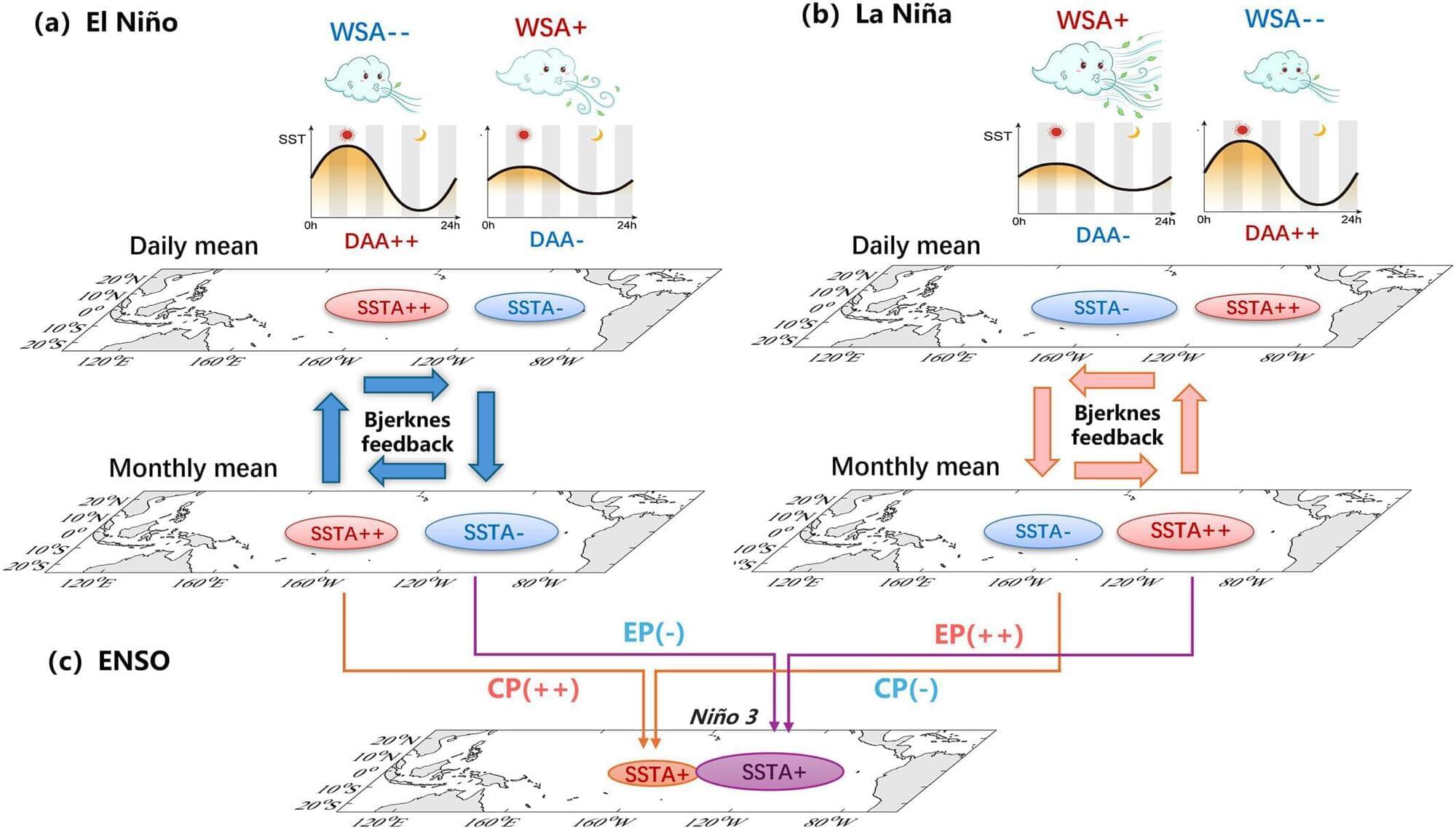
Researchers have long known that there is an asymmetry in the El Niño-Southern Oscillation (ENSO), the confluence of wind and water currents that creates warm El Niño events and cooler La Niña events. Large-scale climate models tend to underrepresent this asymmetry for reasons that are still not fully understood. Better modeling of the mechanisms that make El Niño events warmer could both provide insight into Earth’s climate system and improve future ENSO predictions.
Previous studies of the asymmetry have looked at large-scale processes such as wind stress responses and thermal advection but haven’t fully answered the question. In a new approach, Yang and team examined how variations in sea surface temperature from day to night affect ENSO asymmetry, approaching the problem at a much smaller scale. The findings are published in the journal Geophysical Research Letters.
Comparing 35 Coupled Model Intercomparison Project Phase 6 (CMIP6) models, the researchers found that models with larger diurnal amplitudes (DA) for temperature better captured the ENSO asymmetry. Looking deeper with targeted model experiments, they found that a major driver of this mechanism is opposing daily mean sea surface temperature anomaly responses in the central and eastern Pacific. This east–west temperature difference causes the ocean to warm unevenly over months or longer. As a result, El Niño warms the ocean more than La Niña cools it.