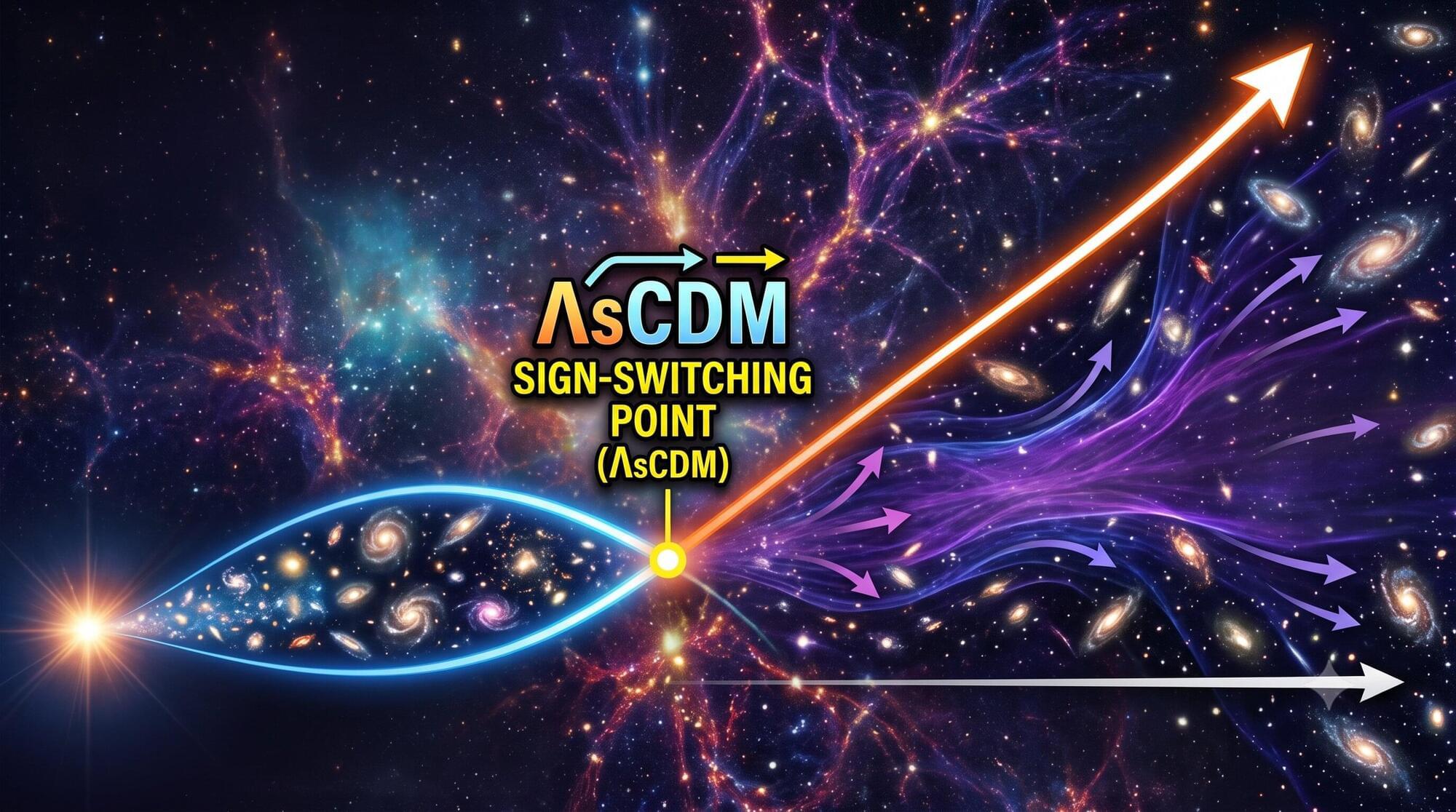
For nearly a century, astronomers have known that the universe is expanding. In the late 1990s, two independent teams, the Supernova Cosmology Project, led by Saul Perlmutter, and the High-Z Supernova Search Team, led by Brian Schmidt and Adam Riess, discovered something strange: The expansion is speeding up. The finding earned them the 2011 Nobel Prize in Physics. The leading explanation for this acceleration is “dark energy,” a mysterious force usually modeled as a constant called Lambda, pushing space apart. Combined with cold dark matter, this gives us the LCDM model, the standard picture of the cosmos for the past 25 years.
LCDM is remarkably successful. It fits observations of the cosmic microwave background (CMB), i.e., the leftover glow from the Big Bang, as well as maps of galaxy clustering and the brightness of exploding stars called Type Ia supernovae. But it has one nagging problem: the Hubble tension.
Cosmologists have proposed dark energy that switches sign over cosmic history. A rigorous new analysis published in Physical Review D checks whether it actually closes the gap.