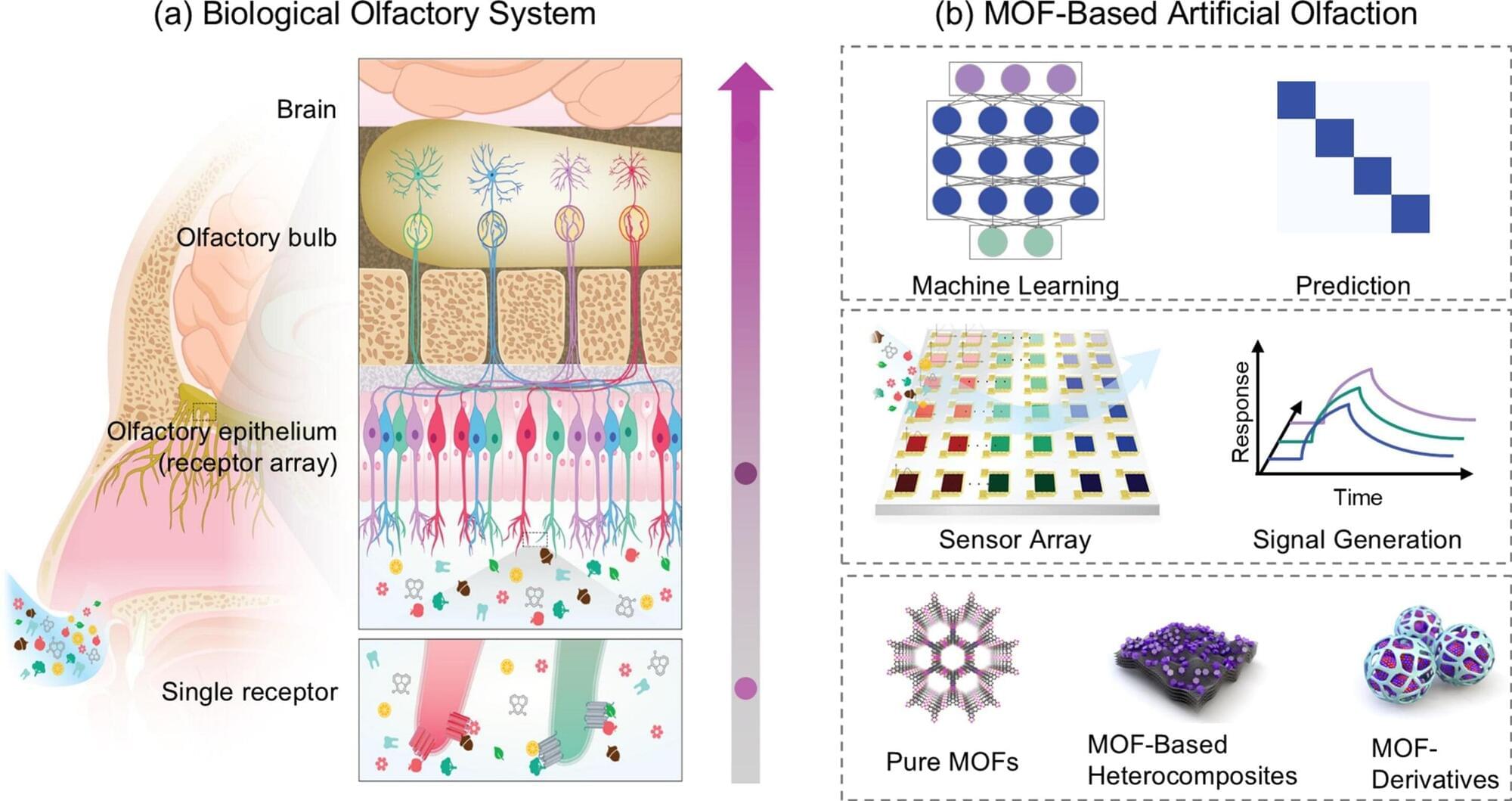
A research team has presented a roadmap for developing an “artificial olfactory system” that detects odors like the human nose and analyzes them using artificial intelligence (AI) by leveraging metal-organic frameworks (MOFs). The team systematically organized and reviewed key research trends in electronic nose technology, from MOF material design to sensor implementation and AI-based odor pattern recognition. The research was led by Hyuk-Jun Kwon’s in the Department of Electrical Engineering & Computer Science of Daegu Gyeongbuk Institute of Science and Technology. The work is published in the journal Progress in Materials Science.
An artificial olfactory system, or “electronic nose (e-nose),” is a technology in which AI learns and analyzes signal patterns generated when multiple sensors respond to odor molecules. Although it has broad potential applications in areas such as food safety, environmental pollution monitoring, hazardous gas detection and disease diagnosis, conventional sensor materials have faced limitations in selectivity, response speed and operating conditions.
The research team focused on MOFs as a key material for overcoming these limitations. MOFs are porous materials formed by combining metal ions and organic compounds, and they can effectively adsorb odor molecules through their microscopic pores. Moreover, because their structures and chemical properties can be tailored for specific purposes, they are regarded as next-generation sensor materials capable of sensitively detecting various odors even under room-temperature, low-power operating conditions.