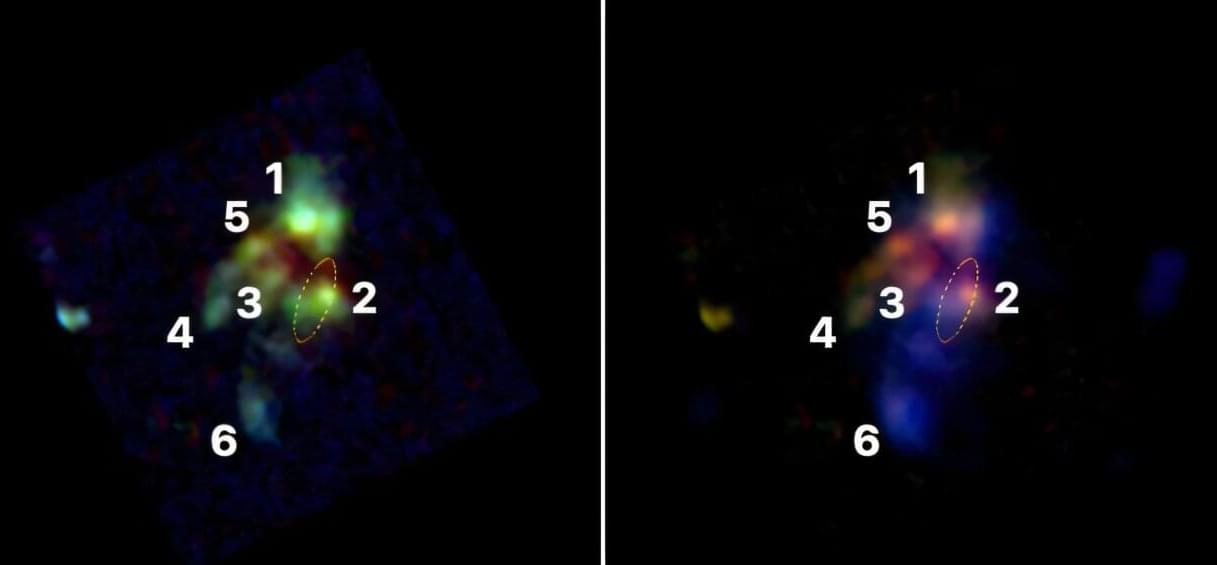
Astronomers have used the James Webb Space Telescope to catch an extraordinary glimpse of a massive galaxy taking shape in the early universe. They identified a compact group of at least six galaxies that are likely to merge into a single enormous system. At the heart of this cosmic construction site lies a growing supermassive black hole.
The international study was led by astronomers at Leiden University and the University of Oxford. The findings have been published in The Open Journal of Astrophysics and Astronomy & Astrophysics.
The system observed, TGSSJ1530+1049, lies more than 12 billion light-years away. We are seeing it as it was when the universe was only about 1.5 billion years old. Researchers pointed the James Webb Space Telescope at this location because earlier radio observations had hinted at an active supermassive black hole. The new data revealed that the surrounding region is far more complex than expected. “We didn’t find a single galaxy, but an entire complex of at least six galaxies,” says Aayush Saxena of the University of Oxford.