Black holes, regions in space where gravity is so strong that nothing can escape, have been widely studied over the past decades, due to their unique and intriguing properties. Einstein’s theory of general relativity predicts that black holes obey a set of rules, known as the laws of black hole mechanics. These rules somewhat resemble the laws of thermodynamics, which delineate how energy, heat, and entropy behave in our universe.
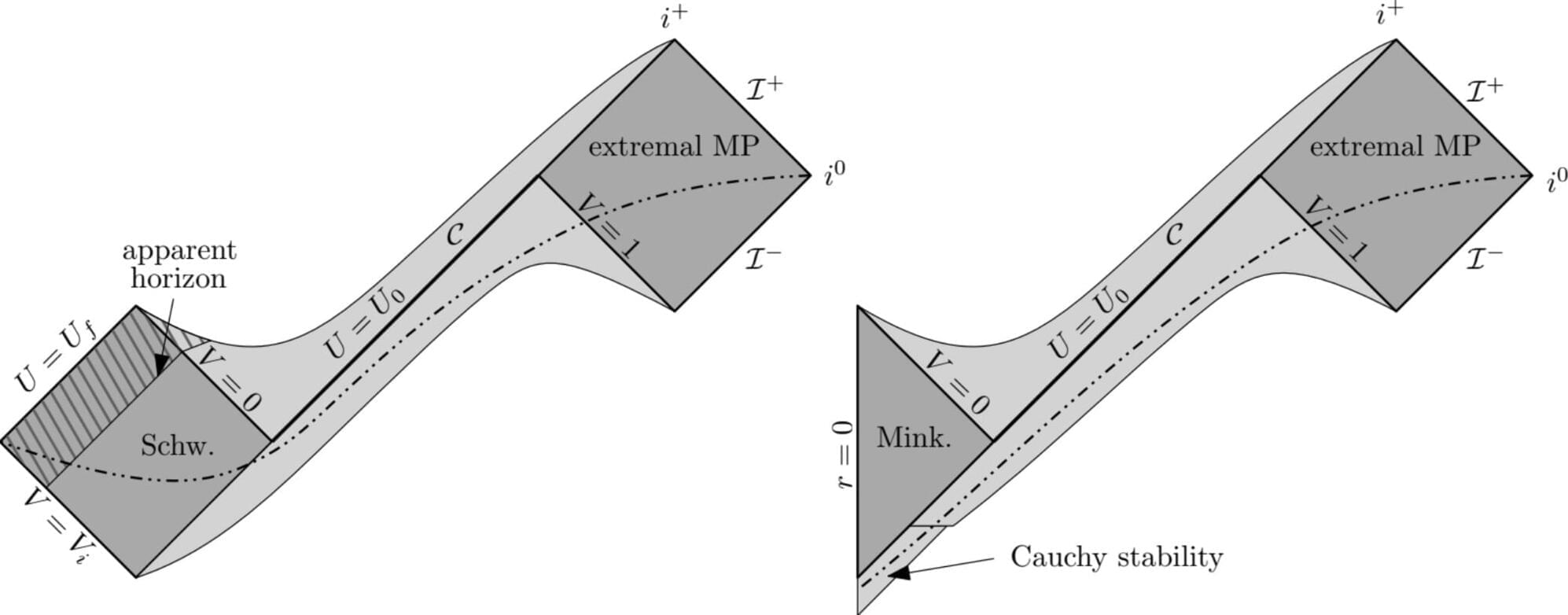
The 3rd law of black hole mechanics states that an extremal black hole, or in other words, a black hole that is spinning or charged to its absolute theoretical limit, cannot realistically form in a finite amount of time.
Extremal black holes are predicted to have a surface gravity of zero, thus they do not emit standard Hawking radiation and would not evaporate in a vacuum. This specific characteristic of extremal black holes is known as “zero temperature.”