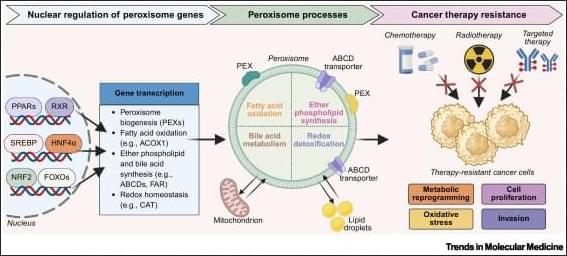
Therapy resistance is a major obstacle to durable clinical responses. While genetic alterations and signalling rewiring are primary drivers of resistance, metabolic adaptation, which is closely intertwined with these processes, enables tumour persistence under therapeutic pressure and directly contributes to resistance. Peroxisomes are metabolic organelles with a role in controlling lipid metabolism, together with redox signalling and homeostasis—processes that intersect with pathways governing cancer behaviour and therapy response. Indeed, peroxisomal functions are remodelled to support metabolic plasticity and redox buffering under therapeutic stress.