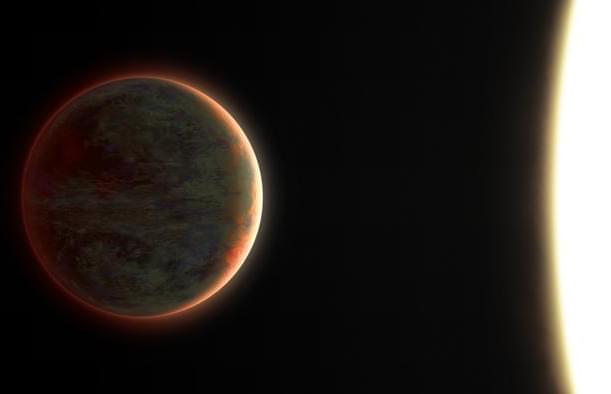
“WASP-121b is particularly extreme, with average temperatures on the dayside hemisphere being around 2,770 Kelvin, while those on the nightside are closer to about 1,000 Kelvin,” said Dr. Tom Evans-Soma. [ https://www.labroots.com/trending/space/30649/ultra-hot-jupi…-secrets-2](https://www.labroots.com/trending/space/30649/ultra-hot-jupi…-secrets-2)
What can an exoplanet’s temperature differences teach astronomers about exoplanet atmospheres? This is what a recent study published in Nature Astronomy hopes to address as a team of scientists investigated the extreme temperature difference between the dayside and nightside of an exoplanet. This study has the potential to help scientists better understand the atmospheric composition and evolution of exoplanets, which could narrow the criteria for searching for life beyond Earth.
For the study, the researchers used NASA’s James Webb Space Telescope (JWST) to observe WASP-121 b, which is a well-known ultra-hot Jupiter located approximately 880 light-years from Earth. The primary motivation behind the study was to fill existing knowledge gaps regarding the atmospheric effects of these extreme temperatures. When an exoplanet passes in front of its star, light passes through the atmosphere, enabling astronomers to study this light and learn about the atmosphere.
Until JWST, astronomers lacked the technology to observe exoplanet atmospheres in extreme detail. In the end, the researchers found that WASP-121 b’s atmosphere exhibits massive temperature differences between the dayside and night side, coinciding with changes in carbon monoxide and water vapor. These temperatures vary from approximately 4,525 degrees Fahrenheit on the dayside and 1,340 degrees Fahrenheit on the night side.